This is the sun's time to shine: Sunday is the longest day of the year in the Northern Hemisphere.
Sunday is the solstice, marking the start of astronomical summer north of the equator. It’s the opposite in the Southern Hemisphere, where it is the shortest day of the year and winter will start.
The word “solstice” comes from the Latin words “sol,” for sun, and “stitium,” which can mean “pause” or “stop.” The summer solstice is the end of the sun’s annual march higher in the sky, when it makes its longest, highest arc. The bad news for sun lovers: It then starts retreating and days will get a little shorter every day until late December.
People have marked solstices for eons with festivals and monuments, including Sweden's midsummer eve celebrations and Stonehenge, which was designed to align with the sun’s paths at the solstices.
Here’s what to know about the Earth’s orbit.
As the Earth travels around the sun, it does so at an angle, making the sun’s warmth and light fall unequally on the northern and southern halves of the planet for most of the year.
The solstices mark the times when the Earth is tipped most extremely either toward or away from the sun. This means the hemispheres are getting very different amounts of sunlight, and days and nights are at their most unequal.
At the Northern Hemisphere’s summer solstice, the Earth’s upper half is leaning toward the sun, creating the longest day and shortest night of the year. The summer solstice falls between June 20 and 22. This year it’s June 21.
The opposite happens at the Northern Hemisphere winter solstice: the Earth’s upper half leans the furthest away from the sun, leading to the shortest day and longest night of the year. The winter solstice falls between Dec. 20 and 23.
During the equinox, the Earth’s tilt is neither toward the sun nor away from the sun, so both the northern and southern hemispheres get an equal amount of sunlight. The sun rises almost exactly due east and it sets almost exactly due west.
The word equinox comes from two Latin words meaning equal and night. That’s because on the equinox, day and night last almost the same amount of time — though one may get a few extra minutes, depending on where you are on the planet.
The Northern Hemisphere’s fall — or autumnal — equinox can land between Sept. 21 and 24, depending on the year. Its spring — or vernal — equinox can land between March 19 and 21. The exact time of the equinox is the moment the sun is directly overhead at the equator.
These are just two different ways to carve up the year.
While astronomical seasons depend on how the Earth moves around the sun, meteorological seasons are defined by the weather. Meteorologists break down the year into three-month seasons based on annual temperature cycles. By that calendar, spring starts on March 1, summer on June 1, fall on Sept. 1 and winter on Dec. 1.
The Associated Press Health and Science Department receives support from the Howard Hughes Medical Institute’s Department of Science Education and the Robert Wood Johnson Foundation. The AP is solely responsible for all content.

FILE - Kansas City Royals second baseman Michael Massey (19) and shortstop Bobby Witt Jr., right, return to the dugout during the fourth inning of a baseball game against the Houston Astros, Friday, June 12, 2026, in Kansas City, Mo. (AP Photo/Charlie Riedel, File)

FILE - Soccer fans sit on a bench overlooking Lumen Field stadium at sunset during the 2026 World Cup in Seattle, Saturday, June 13, 2026. (AP Photo/Manu Fernandez, File)

FILE - Revelers gather at the ancient stone circle Stonehenge to celebrate the Summer Solstice, the longest day of the year, near Salisbury, England, Wednesday, June 21, 2023. (AP Photo/Kin Cheung, File)
CHICAGO--(BUSINESS WIRE)--Jun 19, 2026--
NEURA Robotics ("NEURA"), the pioneer in cognitive robotics and creator of the Neuraverse, will exhibit at Automate 2026, North America's largest automation and robotics trade show, taking place June 22-25 at McCormick Place in Chicago. NEURA will occupy a twin island booth featuring live demos across its full industrial robot portfolio, from collaborative robots (cobots) and mobile autonomous transports to humanoids, all connected through the Neuraverse platform.
This press release features multimedia. View the full release here: https://www.businesswire.com/news/home/20260619441783/en/
Physical AI Built for Industry, Today and Tomorrow
NEURA arrives at Automate with a clear thesis: Physical AI must be trained, validated and continuously improved upon in the real world, not just in simulation. The company offers one of the broadest portfolios of cognitive and industrial robots available from a single platform, designed to support industrial customers across their full automation journey, while providing system integrators, developers and OEMs with an open ecosystem for innovation and deployment.
At the heart of NEURA's ecosystem is the Neuraverse, an open, cloud-based platform connecting robots, developers, and industry partners worldwide. Every deployment contributes to a continuously growing pool of physical intelligence, enabling the entire ecosystem to become smarter with every robot, at every site. Alongside, NEURA Gyms form a global network of real-world training facilities where partners train and validate robots across all cognitive robot form factors for their specific use cases, before committing to full industrial deployment. Each Gym combines physical robot training with high-fidelity simulation, with the resulting data feeding directly into the Neuraverse. Together, they enable faster deployment, lower adoption risk and a scalable path toward Physical AI at industrial scale.
Full Product Range on Display
Visitors to NEURA's booth at Automate will see this platform in action across live demonstrations featuring the company's full portfolio: the 4NE1 flagship humanoid, the compact 4NE1 Mini, the MAIRA cognitive robot across industrial applications including bin picking and precision tasks, the LARA arm in palletizing and PCB handling, the MAV+ mobile autonomous transport robot and NEURA's quadruped robot. Applications developed collaboratively with select industrial partners will also be on display, alongside interactive exhibits of the NEURA Gym training environment and the Neuraverse digital twin and marketplace.
"As we expand into the U.S., we are proud to bring one of the broadest cognitive robotics portfolios in the industry to Automate, from collaborative robots to humanoids, all connected through the Neuraverse platform," said David Reger, Founder and CEO of NEURA Robotics. "American manufacturers are ready for automation that actually moves the needle, and NEURA is here to deliver it. Already trusted and proven in real-world industrial environments, our full-stack robotics are closing operational gaps and advancing the buildout of scalable automation solutions at the forefront of innovation.”
CEO David Reger to Take the Stage
David Reger will appear at two sessions on Tuesday, June 23 at the Humanoid Robot Forum
Record Funding, Real Commercial Traction
NEURA's participation at Automate comes shortly after the company announced a landmark Series C financing of up to $1.4 billion, which is the largest ever raised by a full-stack robotics company. The financing brought together global leaders across AI, robotics, compute, manufacturing and industrial infrastructure, including Tether, Qualcomm Technologies, Inc., Amazon, NVIDIA, imec.xpand, Bosch, Schaeffler, European Investment Bank, Lingotto Horizon, InterAlpen Partners and others.
The round will fund NEURA's global expansion, including a determined push into the U.S. market, anchored by a formal strategic collaboration with AWS and a co-development partnership with Qualcomm. The funding will also support the worldwide rollout of NEURA Gyms, with U.S. locations planned. The company's existing order book and strategic deployment pipeline already exceed $1 billion.
About NEURA Robotics
NEURA was founded on the belief that the next major technology revolution will not happen on screens, but in the physical world. As aging populations, labor shortages and growing demand for skilled work reshape economies worldwide, Physical AI will become essential to sustaining productivity, prosperity and quality of life.
Founded in 2019 and headquartered in Metzingen, Germany, NEURA Robotics is a global Physical AI company building the technologies that enable intelligent machines to learn, adapt and work alongside humans in the real world. The company develops cognitive robots that can see, hear, feel and learn, as well as the software, AI and data infrastructure required to deploy them at scale.
Today, a large share of global GDP is generated through physical work. NEURA’s mission is to make physical skills scalable by dramatically reducing the time required to teach machines new capabilities and deploy them globally. Through its cognitive robots, NEURA Gyms and the Neuraverse, an open ecosystem where robots continuously learn and share skills, the company is building the foundation for a future in which intelligent machines help solve some of humanity’s biggest challenges. NEURA Robotics is building Physical AI from Europe, together for the world.
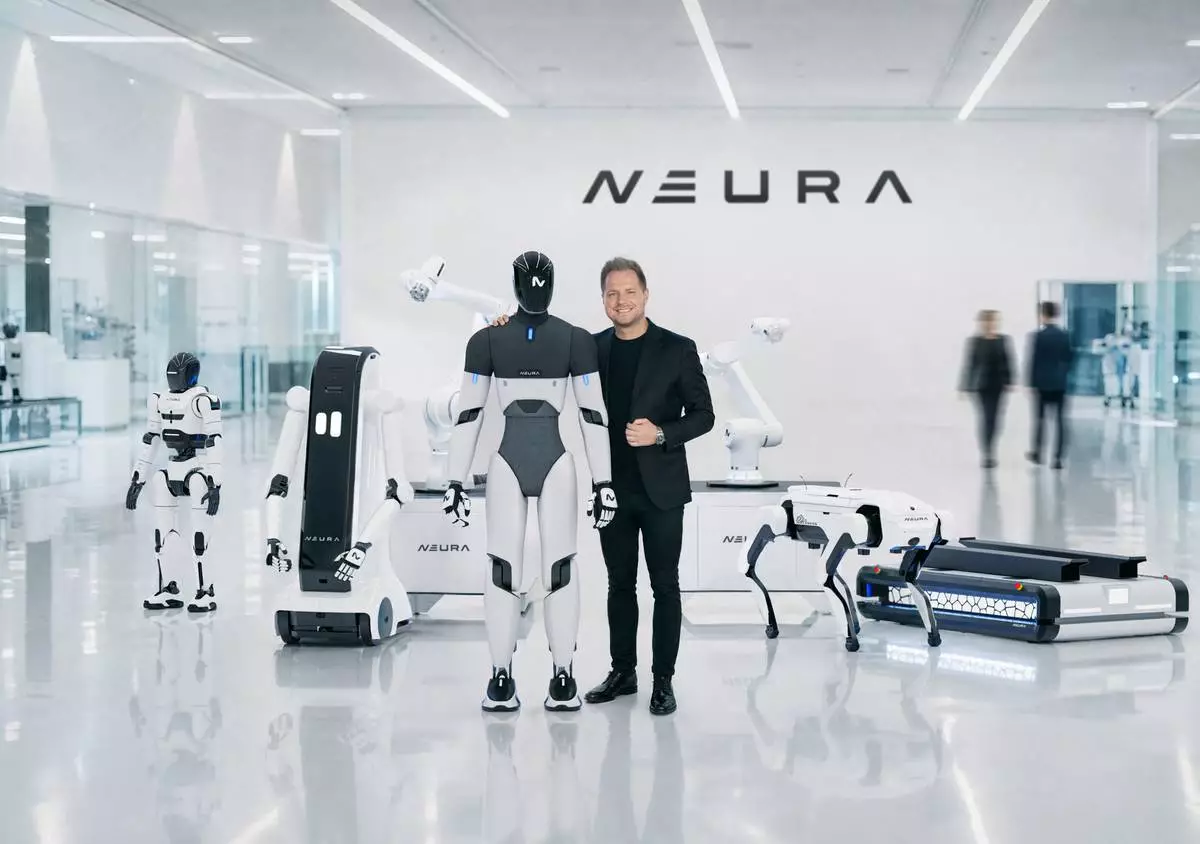
David Reger and NEURA product family