UNESCO officials on Wednesday praised China's efforts to promote information accessibility and support people with disabilities during a panel discussion held at UNESCO headquarters in Paris.
The Panel on Information and Communication Accessibility and Cultural Rights Protection was jointly organized by UNESCO's Information for All Programme (IFAP), the China Foundation for Human Rights Development, and the Communication University of China.
Speaking at the event, Guilherme Canela, director of UNESCO's Division for Digital Inclusion, Policies and Digital Transformation and secretary of IFAP, noted that the discussion took place at a significant moment, as the world will mark the 20th anniversary of the Convention on the Rights of Persons with Disabilities in December, alongside the 25th anniversary of IFAP.
"We believe that our collaboration will advance our shared work in promoting the full engagement of persons with disabilities," Canela said. He added that such cooperation would also support the implementation of the United Nations 2030 Agenda for Sustainable Development and the Global Digital Compact.
Mariya Gabriel, UNESCO assistant director-general for communication and information, commended the Communication University of China's Guangming Cinema initiative, which provides accessible films for people with visual impairments.
She said the project has helped more than 8 million visually impaired people access audiovisual content and has established partnerships with major streaming platforms.
Zheng Peng, a senior administrator at the Communication University of China, said China's outline for the 15th Five-Year Plan highlights the development of assistive technologies and the improvement of accessibility in public facilities, information services and social services.
According to Zheng, the university launched the Guangming Cinema project to produce 104 accessible films annually and has delivered them to 2,244 special education schools across China. In 2020, it also established the Research Institute on Information and Communication Accessibility and has since expanded cooperation with UNESCO in this field.
Qin Liang, deputy secretary-general of the China Foundation for Human Rights Development, said China has continued to improve equal access to public cultural services, promote digital reading programs for people with visual impairments, and upgrade the accessibility of digital platforms.
He noted that China released the National Human Rights Action Plan of China (2026-2030) recently. The plan calls for expanding cultural services and products for persons with disabilities, increasing the supply of accessible radio, television and audiovisual programs, and strengthening information accessibility.
Following the panel, the UNESCO headquarters hosted a screening ceremony for an accessible film.
Yang Xinyu, China's ambassador and permanent delegate to UNESCO, said China has continued to promote disability inclusion by improving access to education, employment, public services and cultural life. Accessibility is not simply about providing support, but about creating opportunities -- opportunities to participate, to express oneself and to share in the richness of cultural life, she added.
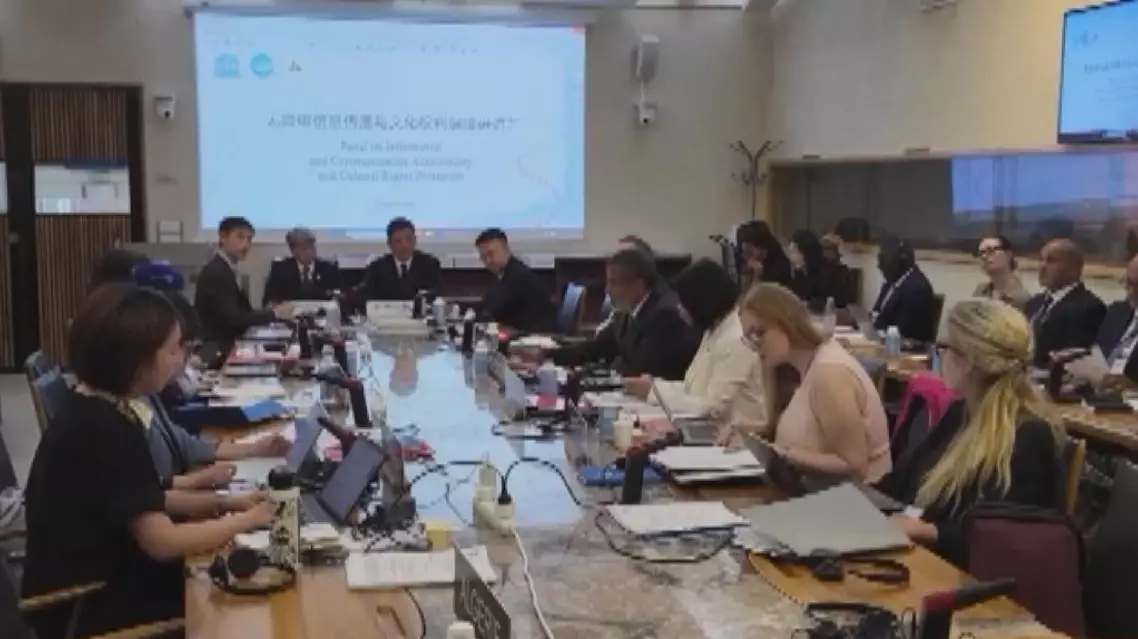
UNESCO Officials highlight cooperation with China on accessibility