Multiple areas in southwest China's Guizhou Province and south China's Guangxi Zhuang Autonomous Region on Saturday experienced intense downpours, with residents trapped and transportation networks disrupted.
In Mawei Town, Dushan County, Qiannan Buyi and Miao Autonomous Prefecture, Guizhou Province, sudden heavy rainfall struck on Saturday.
Monitoring data showed that from 06:00 to 22:00, cumulative rainfall at five meteorological stations in Mawei Town exceeded 200 millimeters. The torrential rain caused river water levels to surge rapidly, resulting in widespread road flooding and numerous fallen trees blocking passages.
In response to the flooding, local authorities immediately mobilized personnel to clear fallen trees, mud, and debris, quickly reopening blocked rural roads. Meanwhile, rescue teams used inflatable boats to conduct door-to-door hazard inspections and safely evacuating 600 residents in an orderly manner.
Heavy rainfall has persisted for several days across northern Guangxi, forcing numerous ferries to suspend operations.
As of 21:00 on Sunday, 120 river crossings and 192 ferry boats across Guangxi's inland waterways had been shut down. Water buses and nighttime cruise routes in Guangxi's Liuzhou City have been halted, and all tourist raft services on the Li River in Guilin City have been completely suspended.
On Saturday evening, a farmers' market in Jinchengjiang District of Guangxi's Hechi City was severely flooded due to river water backflow. Merchants had received advance warnings and had already urgently relocated their goods to safe areas. Hechi City issued a yellow flood warning on the day, with some rivers exceeding alert water levels.
The Guangxi Maritime Safety Administration upgraded its inland river flood emergency response to Level III at 20:30 on Saturday.
China has a four-tier emergency response system, with Level I being the most severe response.

Rescue operations underway in flood-hit regions in China's Guizhou, Guangxi
An age-old feather duster craft in north China's Hebei Province has found new life online, as livestreaming turns a village tradition into a source of income for elderly residents. In Luan'nan County, Tangshan City, Liu Wenhao, Party secretary of Zhangmawan Village, is promoting the village's handmade feather dusters alongside fellow villagers in livestreams. Since 2024, he has led villagers in bringing the traditional craft online, quickly turning it into an internet sensation.
Elderly villagers now craft dusters while also serving as online hosts, participating in livestreams and welcoming tourists. Liu Huiying is one of them.
"This is no small income. I earn about 20,000 yuan (about 2,981 U.S. dollars) a year, which is more than enough. They call me an internet celebrity. I'm happy," she said.
The feather duster craft has a long history in Zhangmawan. Once a sideline for villagers during the agricultural off-season, craftsmen worked from dawn to dusk only to sell a single duster for 0.3 to 0.5 yuan. Sales were slightly better at rural fairs, but earnings were barely enough to make a living. As modern cleaning products diversified, traditional feather dusters gradually faded from daily life.
In recent years, with the rise of short-video platforms, several young people in the village began experimenting with short videos. Their first video showing the making of a feather duster garnered more than 600,000 views.
"Our village's traditional craft was well-known throughout the region. So we thought, with so many people here skilled at making feather dusters, why not sell them online and help boost their incomes?" said Liu.
Zhangmawan has more than 200 residents over the age of 60. To boost their incomes and pass on the craft, product transformation was key. Young villagers pooled their ideas and decided to enter the cultural and creative market.
While veteran artisans persisted in handmade production, younger people focused on innovative designs, launching new items such as car hangings, bag charms, desktop ornaments and cat teasers, tailored to modern aesthetics and lifestyles.
Online popularity has also boosted offline tourism. The village has leveraged its advantages to offer craft workshops, rural sightseeing, farm meals and educational study tours, attracting a large number of visitors and children.
"You can hang it on a schoolbag or car keys -- it can go in many places. And if something gets dirty, you can use it to sweep," said Meng Shixuan, a young visitor.
"We want to keep updating our cultural and creative feather duster products, and through short videos and livestreaming, develop the village's study tour and sightseeing businesses to provide more jobs and income opportunities," Liu said.
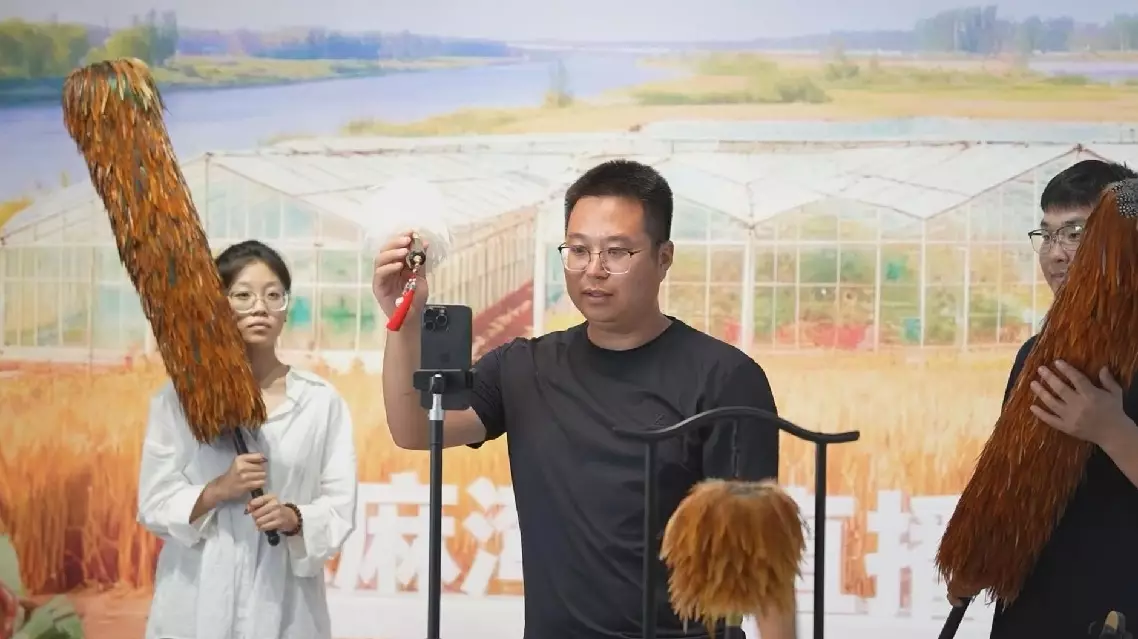
Chinese village turns traditional feather duster craft into online hit