In the first five months of this year, China's courier companies actively expanded new services and tailored their operations to local conditions, helping to unleash strong momentum in promoting smooth urban-rural economic circulation.
Rural express services in central and western China are expanding rapidly, with a growing volume of agricultural products including fruits being shipped nationwide through express delivery networks.
In Qinzhou District of Tianshui City, northwest China's Gansu Province, big cherries have entered its peak harvesting season.
The postal service has set up livestreaming studios right inside the orchards, where hosts showcase fresh cherries while explaining the packaging process and delivery timelines on the spot. The live broadcast offers viewers a clear view of the entire process from sorting and packing to shipping, with orders reaching 27 provinces and 186 prefecture-level cities.
"Nearly all the cherries have been sold, yielding an income approximately 20 percent higher than in previous years," said Yang Ruifeng, a local farmer.
As cherries are thin-skinned, tender, juicy, and highly perishable, the postal service has rolled out dedicated cold-chain trunk lines and offered growers a 20 percent shipping discount.
"Since May 18, daily shipments have ranged from 800 to 1,000 boxes. We currently offer next-day delivery to 156 cities," said Luo Erwei, a postal official from Qinzhou Branch, China Post Group Co., Ltd.
Data from the State Post Bureau showed that in the first five months of this year, the share of express delivery volume in the western region rose by 1.5 percentage points.
Similarly, steel spade shipments in Tangshan City's Luannan County of north China's Hebei Province have surged since March.
With the tools being irregularly shaped and hard to package, local postal authorities and couriers have customized shipping solutions using bubble wrap and rigid boxes, cutting the damage rate from 5 percent to under 0.3 percent. The service has helped manufacturers expand both domestic and international sales.
"With logistics so well developed, you just make a phone call and they come to your door to pick up the package. It's so convenient now. Ultimately, e-commerce relies on a logistics system to support it," said Han Shanshan, deputy general manager of Tangshan Renhe Hardware Co., Ltd.
At present, local steel spades and hardware products are exported to more than 140 countries and regions worldwide. In the first five months of this year, the cumulative output value has reached 2.2 billion yuan (about 320 million U.S. dollars), a year-on-year increase of 10 percent, with exports accounting for about 60 percent of the total.
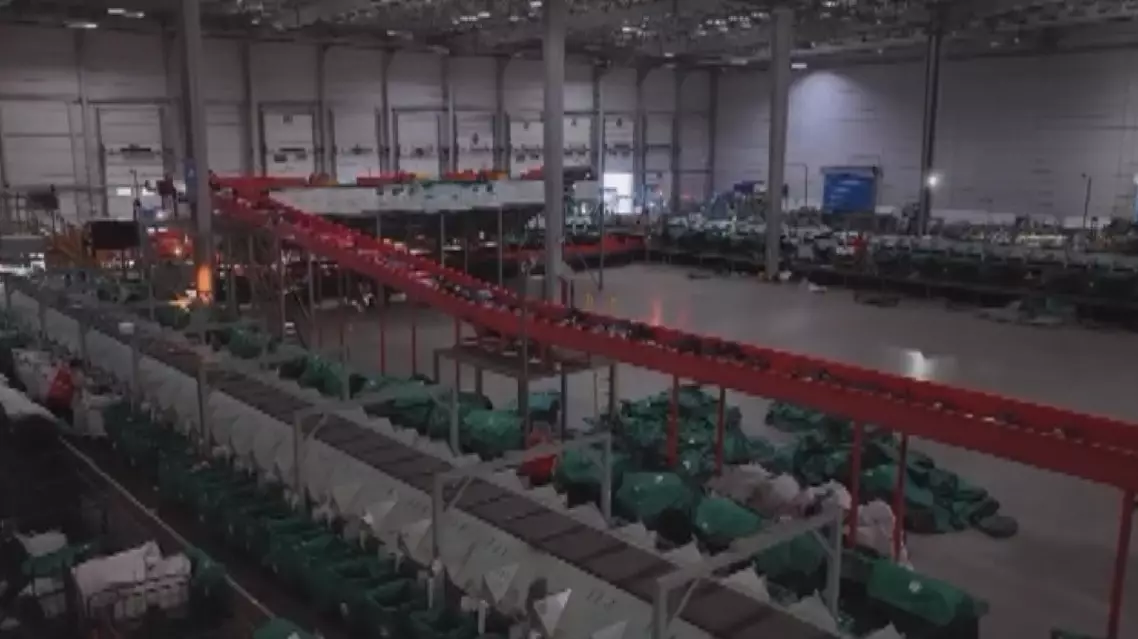
China's courier companies expand new service scenarios to meet rising market demands
The recently signed memorandum of understanding (MoU) between the United States and Iran has sparked major concern among Israeli officials, who fear that Israel's interests are being abandoned by its most crucial ally, according to analysts.
The development comes as Israel braces for a pivotal election later this year, with Prime Minister Benjamin Netanyahu potentially facing severe political fallout from the agreement.
"Israel views the MoU signed with Iran as a complete capitulation where the Americans were desperate to reach a deal because they clearly failed abysmally to plan for the blocking of the Strait of Hormuz. So they feel that all of Israel's interests have been abandoned," said Dan Perry, an American world affairs and political analyst.
Following the signing of the MoU, Iran and the United States held the first round of high-stakes indirect talks, mediated by Pakistan and Qatar, at the Swiss mountain resort of Buergenstock on Sunday.
On Monday, mediators announced encouraging outcomes from the talks, including a 60-day roadmap toward a final deal, and mechanisms to ensure the security of commercial shipping through the Strait of Hormuz and to end the fighting between Israel and Hezbollah, a close ally of Iran in Lebanon.
However, there have been concerns that Israel may jeopardize the negotiations.
"No doubt that the Americans, some of the Americans, definitely some of the Americans that are negotiating, like the Vice President JD Vance, think that Israel can put some obstacles and jeopardize the negotiations," said Yaki Dayan, former Israeli consul in Los Angeles.
With Israeli elections looming later this year, Netanyahu's core strategy to get re-elected was to portray the very good relations he holds with U.S. President Donald Trump. However, the MoU and the ensuing negotiations between the U.S. and Iran may dramatically affect the election results.
"Unless something dramatically changes, this is devastating for Netanyahu, not only because he pursued a strategy that has failed - the Iranian regime still stands, the nuclear program still exists, Hamas and Hezbollah are still fighting against Israel, but also because he was long perceived as Mr. America, with his incredible eloquence in American English. He could run circles around any American president to get America to do Israel's bidding," said Perry.
Perry added that instead of maintaining that influence, Netanyahu has brought Israel to an unbelievably low point in its relationship with the United States.
Although Netanyahu did practically everything to persuade the U.S. to withdraw from the previous Iran nuclear deal signed more than a decade ago under President Barack Obama, analysts doubt that he can repeat it again this time because Israel and its prime minister rely entirely on just one side of the American political spectrum.
"When you look at alternatives now, you don't have because Israel has lost the Democratic side as well. So you don't have an alternative in the American politics," said Dayan.

Israel feels its interests "abandoned" in US-Iran deal: analysts