Technology companies are spending big to incorporate artificial intelligence into their businesses and to build huge data centers. Investors who had jumped on the bandwagon appear to be having second thoughts.
Proponents of artificial intelligence see it as the next great revolution for the global economy. The revolution won't come cheap. Just four companies — Alphabet, Amazon, Meta Platforms and Microsoft — plan to spend up to $720 billion this year, primarily on AI data centers.
This week, investors are looking at the huge sums being spent and questioning whether AI can produce the profits and productivity necessary to make all the investment worth it. Critics have been talking about the possibility of a bubble in AI investment. On Monday, Amazon and Alphabet fell about 5%.
On Tuesday, several companies that make the chips needed for the data center buildup — Nvidia, Micron Technology, Broadcom and Lam Research — led the market lower.
At first, Microsoft, Alphabet and other so-called hyperscalers turned to cash on hand to fund the AI expansion. But they're increasingly relying on the markets to raise cash.
Alphabet, the parent company of Google, said earlier this month that it’s raising $80 billion in cash to help pay for its investments by selling shares of its stock. Overall, Alphabet is planning to spend as much as $190 billion this year — more than all the stock of The Walt Disney Co. is worth, and Alphabet is forecasting its spending on investments next year will “significantly increase.”
In March, Amazon sold $54 billion of bonds in the U.S. and Europe as it plans to spend around $200 billion this year on AI investments.
Elon Musk's rocket maker SpaceX was on a three-day skid heading into Tuesday. It regained some lost ground, but ended trading slightly below the closing price on its first day of trading on June 12. Musk acknowledges that SpaceX will have to spend heavily to fulfill its plans of sending AI data centers into space, and the company has announced that part of an upcoming bond offering will fund its AI buildout.
Chip companies have benefitted as the demand for memory chips and processing power for AI data centers and other projects has led to a supply shortage and a surge in prices. Investors have bid up the share prices of these companies now in anticipation of big profits down the road. By one measure, which compares a company's stock price to its earnings per share, these companies might look expensive.
Marvell Technologies lost money for five straight years before turning a profit of $2.7 billion in the fiscal year ended in January, thanks to gains in its data center business. The stock has more than tripled so far this year and its price-to-earnings ratio has gone from about 30 at the start of 2026 to near 100.
Some data storage companies have seen even more eye-popping gains. Sandisk shares have soared more than 700% year to date and its P/E ratio stands at 68. Whether Sandisk shares are overvalued will depend on whether it meets Wall Street’s lofty expectations for the next 12 months -- earnings per share of $188.05 per share compared with $29.16 per share for the 12 months ended March 31. When the current stock price is compared to the forecast, the price-to-earnings ratio falls to around 11.
The current price-to-earnings ratio for the S&P 500 is around 25.
On Tuesday, investors unloaded at least some of their holdings in these stocks. Sandisk sank 13.6%, while Marvell lost 9.4%.
The sell-off also took a bite out of exchange-traded funds, or ETFs, that invest heavily in tech stocks. The Invesco QQQ Trust Series ETF was down 3.3%, while iShares Semiconductor ETF slumped 7.9%.
While some investors may have doubts that companies going full throttle on AI infrastructure spending will ultimately be able to generate profits to justify their investment, it's likely some of the selling this week may be investors pausing to pocket some of their gains after the stock market’s recent string of all-time highs.
“With no clear catalyst driving the move lower, we believe today’s pullback likely reflects profit-taking following a strong rally from the March lows,” said Brock Weimer, an investments strategy analyst at Edward Jones.
Big Tech gains have powered major stock indexes on record-setting runs this year. Within the S&P 500, the tech sector alone is up nearly 27% just over the last three months and roughly 17% for the year. In Asia, South Korea’s Kospi has nearly doubled so far in 2026.
Heavy selling on Tuesday triggered a halt in trading in the Kospi, which set the stage for the wave of tech stock selling when trading opened in U.S. markets, Wedbush analyst Dan Ives wrote in a research note Tuesday.
Overall AI enterprise demand in Asia is “showing no cracks in the armor, which continue to make us very bullish on owning the tech AI winners over the coming year,” he added.
Still, tech companies’ race to invest in the expansion of AI infrastructure could ultimately be sowing the seeds of future oversupply, according to Philip Straehl, chief investment officer at Morningstar Wealth.
“Periods of elevated capital investment have historically not translated into strong outcomes for investors, leaving us cautious on the outlook,” Straehl wrote in a report last week.
He expects that the rapid expansion of AI computing power will weigh on pricing, hurting companies’ returns and eventually result in a pullback in investing. Semiconductor companies are “particularly exposed to this dynamic,” Straehl wrote.
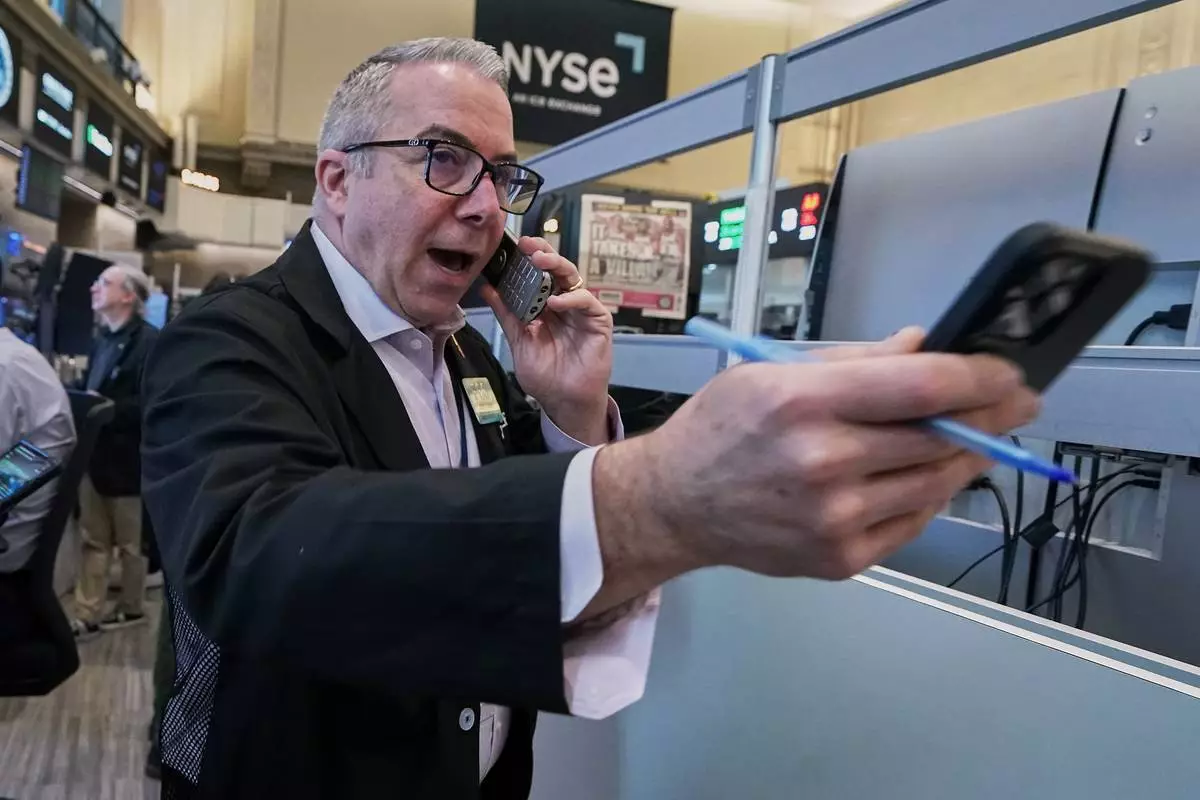
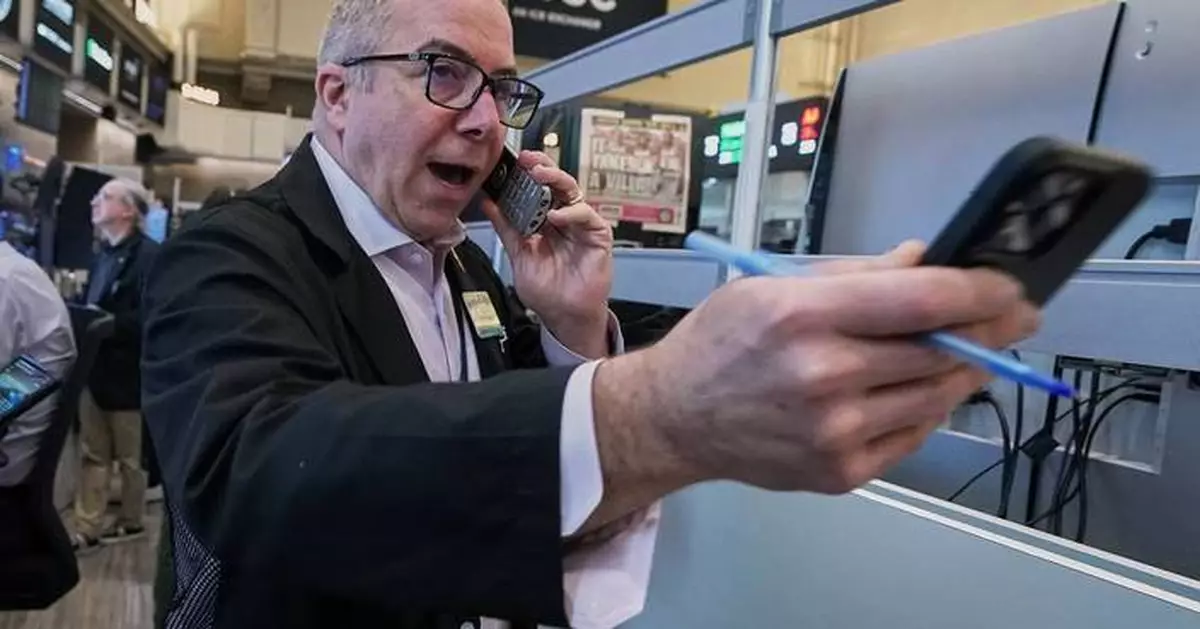
Options trader Joseph D'Arrigo works on the floor of the New York Stock Exchange, Tuesday, June 16, 2026. (AP Photo/Richard Drew)
WASHINGTON (AP) — The saga over the Lincoln Memorial Reflecting Pool took a turn as President Donald Trump said Tuesday that six people have been arrested over recent damage. The president’s troubled $14-million-plus rehabilitation project has become a visceral flashpoint over law enforcement, aesthetics and environmental concerns ahead of the country's 250th anniversary celebrations.
In a social media post, Trump claimed without supporting evidence that there had been a “350-foot gash” in the paint as the administration faces a self-imposed deadline to fix the botched renovation before the nation's 250th anniversary celebration next week. He has also said, including again on Tuesday, that the federal government would release images to substantiate his claim.
Trump pledged to beautify the century-old Reflecting Pool ahead of the anniversary celebrations, draining its water and having the bottom painted a color he dubbed “American flag blue.” But since the site was restored, its water has been plagued with algae bloom and pieces of the new coating appeared to be peeling off the bottom.
Trump, without evidence, has repeatedly blamed the peeling paint on vandalism.
“It was purposefully and criminally done, and somebody had to work very hard, probably in the dark of night, to create such a condition,” Trump wrote Tuesday, adding that another seven people were cited for allegedly damaging the pool.
The U.S. Park Police and the Interior Department did not immediately respond to requests for comment on the arrests or Trump's claim of vandalism.
The Associated Press verified that one man was arrested after touching the already-peeling paint. He said he wanted to examine the new coating, touching a still-attached chunk briefly then letting go shortly after a park worker told him to.
National Guard members and Park Police have been patrolling the deck around the pool after Trump insisted over the weekend that vandals were responsible for damage to the liner, without providing evidence.
Trump said Tuesday that the Interior Department will release images of alleged vandalism at the pool. Pressed by reporters after Air Force One landed in Pennsylvania for a visit to a trucking company, Trump said Interior is “going to share” photos and videos of the alleged vandalism, which remains unverified.
The president had said on Monday that the images existed and the federal government would provide them. No photos were made public as of Tuesday afternoon.
The arrests highlighted what’s expected to be tightened security in the capital ahead of and during the 250th anniversary celebrations, which are set to draw large crowds to the National Mall and other tourist sites.
Trump also said Tuesday that “some of the water” will be drained from the pool “either immediately before or after the Fourth of July, to do the permanent repair.”
It was unclear from his post what the scale, scope or cost of the permanent repair would be.
Atlantic Industrial Coatings, a contractor on the pool project, said it has identified some areas in the Reflecting Pool that require repairs. “These areas are a very small part of the massive 7-acre project, and do not indicate a failure of the liner,” the company said in a statement. The company said it expected to make the repairs to the pool once it is drained, as part of the warranty.
Adding to the controversy swirling around the pool, an environmental group called on the U.S. Fish and Wildlife Service to investigate after a Mallard duckling carcass was photographed floating in the algae-filled pool, and two other ducks were found dead nearby. The Center for Biological Diversity said Tuesday that the Wildlife Service must enforce the Migratory Bird Treaty Act, which protects migratory birds.
“Wasting taxpayer money turning the reflecting pool into a giant duck death trap just in time for America’s 250th birthday party is as Trump as it gets. Cruel, stupid and selfish,” said Tara Zuardo, a senior campaigner at the Arizona-based group.
City Wildlife, a Washington-based rescue and rehabilitation non-profit that also conducts necropsies on birds found in the city, said they could not comment on the cause of the death of the duckling because its carcass “wasn't recovered for examination.”
Trump pitched the original improvements as intended to clean, beautify and reinforce an iconic site that he said had become dilapidated and dirty because of previous presidents’ neglect. Algae has plagued the pool for a century, and Trump insisted that the newly installed “American flag blue” coating, which he selected himself, would turn the pool into a gleaming expanse along the National Mall.
Yet within weeks of Trump declaring the rehabilitation completed in time for Independence Day, the water was plagued by a vivid green algae bloom that clouded the pool’s coating. A piece of liner, about 4 square feet, was observed on Friday, partially floating in the pool. The Associated Press saw additional pieces in the water on Monday.
Workers were seen in recent days pouring hydrogen peroxide into the pool in an attempt to kill the algae. Hydrogen peroxide can act as a paint remover.
Experts say the dark lining can add to algae growth by absorbing more sunlight than lighter surfaces. That raises the surrounding water temperature, allowing algae to thrive.
Associated Press writer Josh Boak contributed to this story.
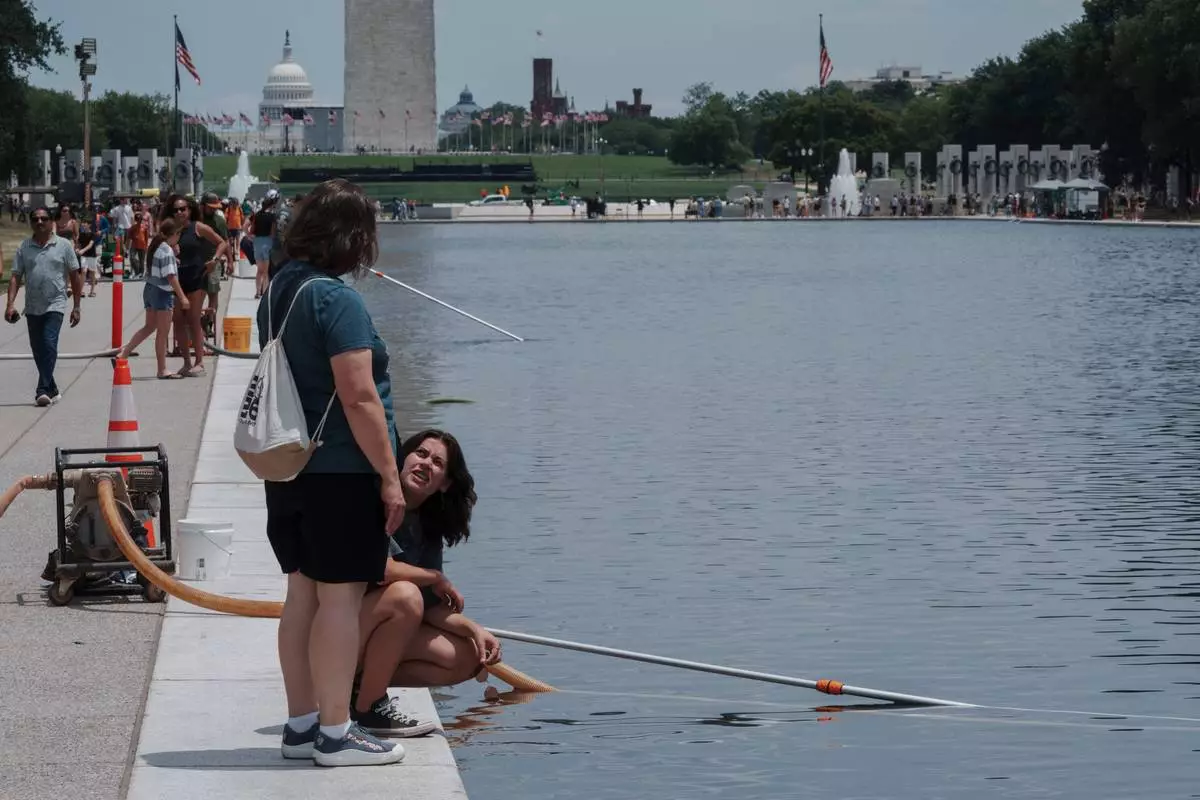
Visitors look at the Lincoln Memorial Reflecting Pool Sunday, June 21, 2026, on the National Mall in Washington. (AP Photo/Jon Elswick
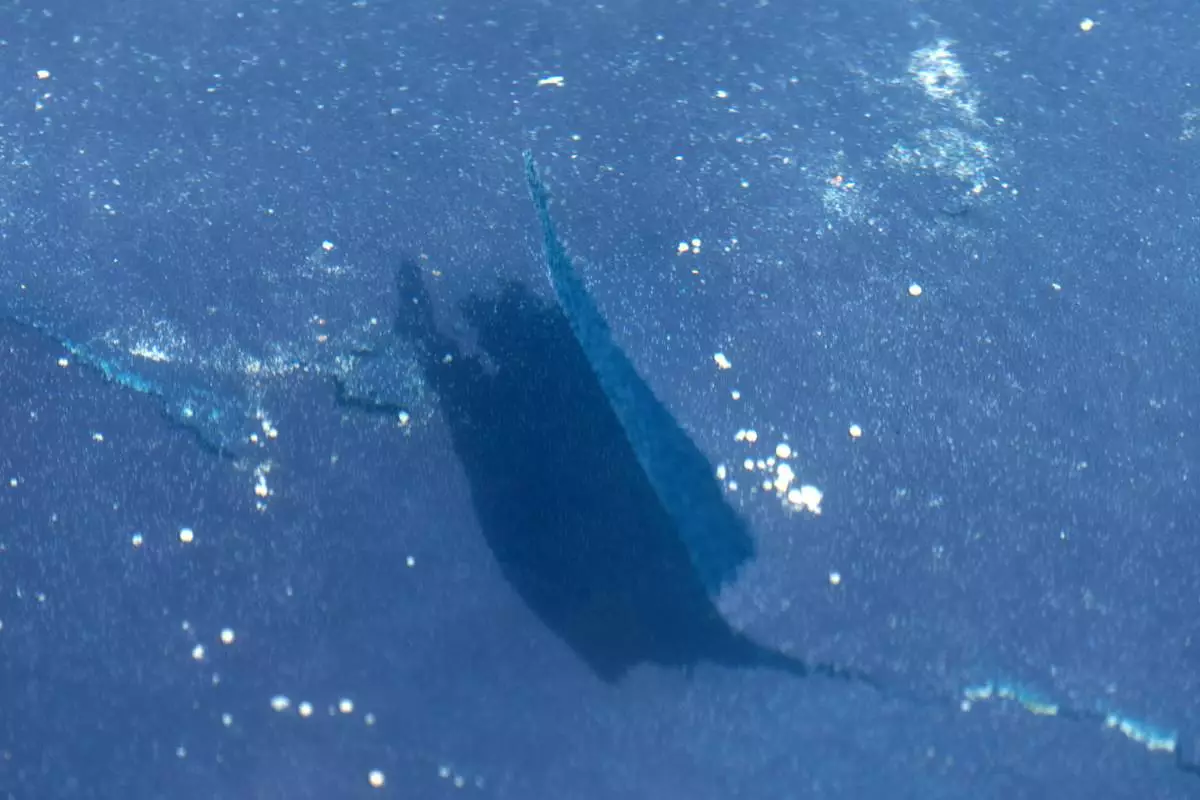
Separation is seen in the blue coating on the bottom of the Lincoln Memorial Reflecting Pool, Monday, June 22, 2026, in Washington. (AP Photo/Mark Schiefelbein)
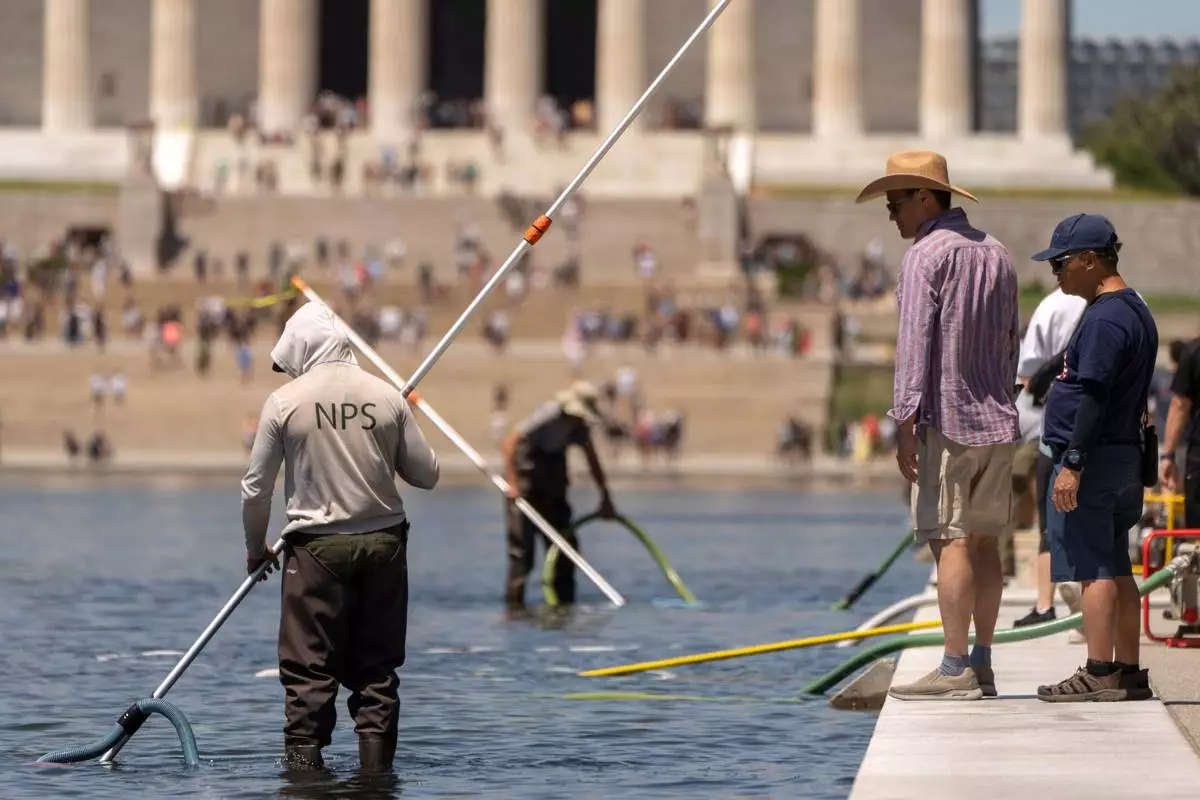
Visitors watch as National Park Service employees use vacuums to clean the Lincoln Memorial Reflecting Pool, Saturday, June 20, 2026, in Washington. (AP Photo/Mark Schiefelbein)
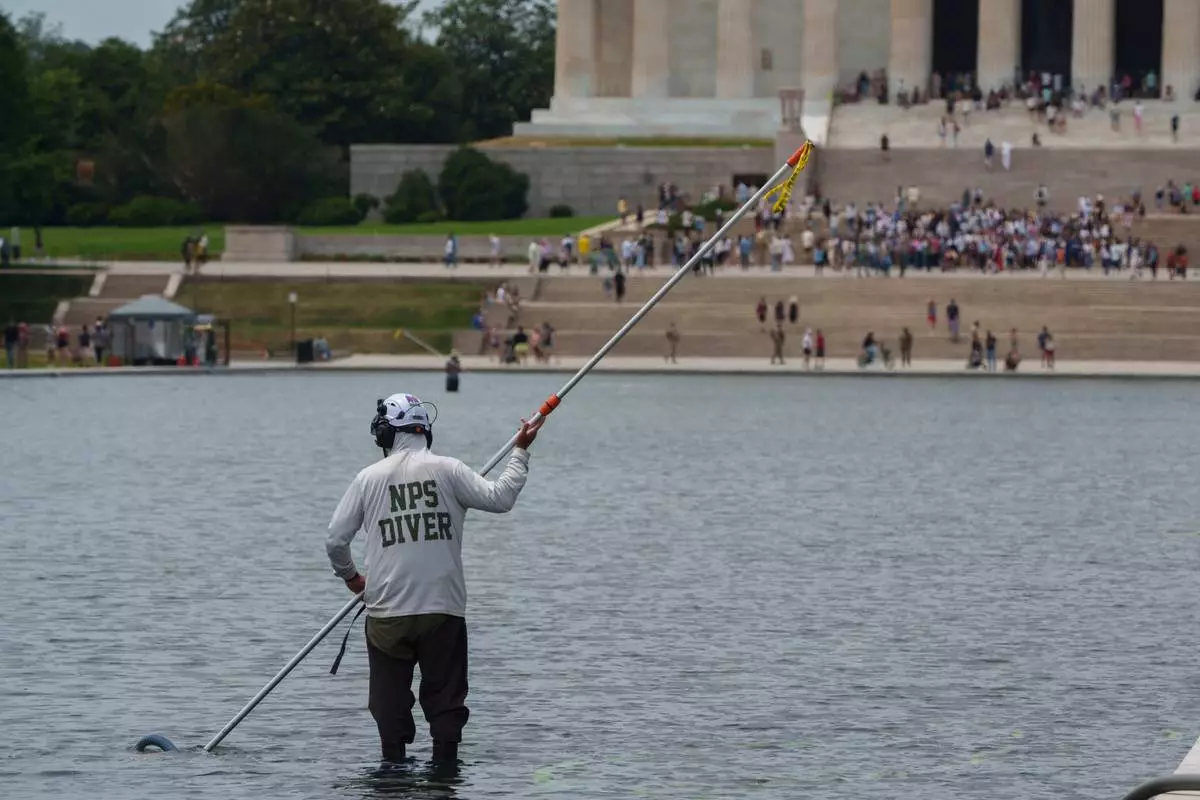
A National Park Service employee works to clean the Lincoln Memorial Reflecting Pool Sunday, June 21, 2026, on the National Mall in Washington. (AP Photo/Jon Elswick
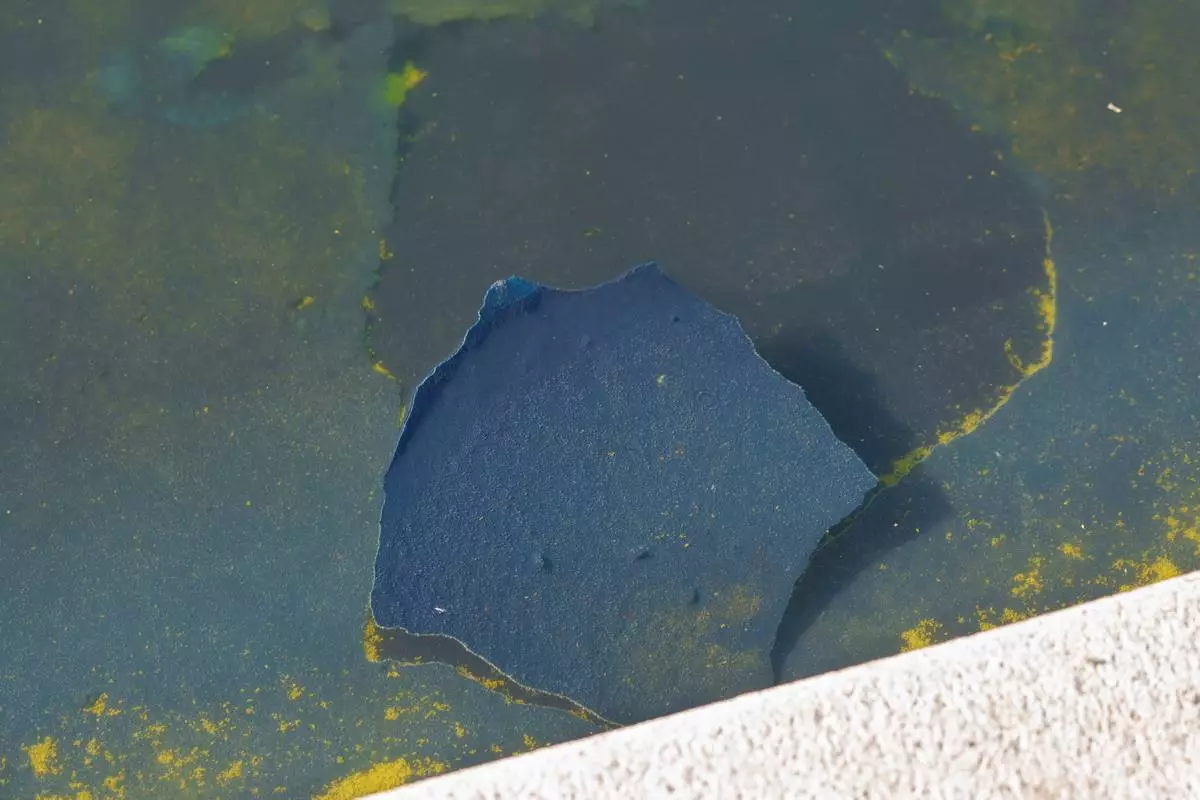
A piece of the blue coating floats among algae at the Lincoln Memorial Reflecting Pool Sunday, June 21, 2026, on the National Mall in Washington. (AP Photo/Jon Elswick

National Guard members look at the Lincoln Memorial Reflecting Pool, Monday, June 22, 2026, in Washington. (AP Photo/Mark Schiefelbein)