SAN RAMON, Calif.--(BUSINESS WIRE)--Jun 23, 2026--
Grid Dynamics Holdings, Inc. (Nasdaq: GDYN) (“Grid Dynamics”), a premier AI transformation partner for the Fortune 1000, hosted XT26. The invite-only conference convened over 250 senior technology leaders from banking, hedge funds, and capital markets at Tower Hill, London. Now in its 10th year, the XT conference series has grown into one of financial services engineering's most respected peer forums in London, built on a single premise: pure thought leadership grounded in real-world experience, with no sales pitches, and no vendor presentations. Just practitioners who are actually doing the work.
This press release features multimedia. View the full release here: https://www.businesswire.com/news/home/20260623112231/en/
The event included speakers and delegates from organizations including Bank of America, Citi, HSBC, UBS, RBC, Barclays, JP Morgan, Morgan Stanley, NatWest, Meta, FINOS, and Griffin Bank, among others.
With a focus on the volatility of AI in financial services, the event agenda addressed questions capital markets technology leaders are navigating in practice: where AI delivers genuine ROI, how to build software systems that hold up under regulatory scrutiny, and how to manage the complexity that comes with accelerating delivery at scale. Sessions spanned AI adoption strategy, low-latency development, platform engineering in large financial institutions, and the limits of agentic software development, all delivered by senior practitioners building and operating systems at scale in financial services. The expert panel closing the main program put the day's central question directly to the room: "How Far Can We Accelerate with AI?"
"XT26 brought together the engineering leaders who are closest to these problems, the people building and maintaining software systems under real regulatory pressure," said Jon Pither, CEO at JUXT, a Grid Dynamics company. “That is the conversation financial services needs to be having right now, and it is exactly what this event delivered.”
"I truly enjoyed XT26 and learned a lot from every speaker. The corporate world doesn't always make space for rigorous engineering, which is exactly why a forum built around financial sector practitioners feels so necessary," said Simone Steel, CIO Data & AI at Deutsche Bank.
Grid Dynamics continues to expand its financial services capabilities, working with capital markets clients to build software systems that create measurable business value.
About Grid Dynamics
Grid Dynamics (Nasdaq: GDYN) is a premier AI transformation partner for the Fortune 1000. We combine deep AI expertise with proven enterprise-scale delivery to help clients identify where to invest in AI, build systems that work at scale, and capture real business value from AI deployments. A key differentiator for Grid Dynamics is our nearly two decades of technology leadership and pioneering enterprise AI expertise. Founded in 2006, Grid Dynamics is headquartered in Silicon Valley with offices across the Americas, Europe, and India.
To learn more about Grid Dynamics, please visit https://www.griddynamics.com. Follow us on LinkedIn.
Forward-Looking Statements
This communication contains “forward-looking statements” within the meaning of Section 27A of the Securities Act of 1933 and Section 21E of the Securities Exchange Act of 1934 that are not historical facts, and involve risks and uncertainties that could cause actual results of Grid Dynamics to differ materially from those expected and projected. These forward-looking statements can be identified by the use of forward-looking terminology, including the words “believes,” “estimates,” “anticipates,” “expects,” “intends,” “plans,” “may,” “will,” “potential,” “projects,” “predicts,” “continue,” or “should,” or, in each case, their negative or other variations or comparable terminology. These forward-looking statements include, without limitation, quotations and statements regarding the expected benefits of our capabilities and our company’s future growth including with customers and partners. Most of these factors are outside Grid Dynamics’ control and are difficult to predict. Factors that may cause such differences include, but are not limited to, our ability to achieve expected benefits, any factors limiting our capabilities, the benefits of our services and products, and our company’s growth strategy.
Grid Dynamics cautions that the foregoing list of factors is not exclusive. Grid Dynamics cautions readers not to place undue reliance upon any forward-looking statements, which speak only as of the date made. Grid Dynamics does not undertake or accept any obligation or undertaking to release publicly any updates or revisions to any forward-looking statements to reflect any change in its expectations or any change in events, conditions or circumstances on which any such statement is based. Further information about factors that could materially affect Grid Dynamics, including its results of operations and financial condition, is set forth under the “Risk Factors” section of Grid Dynamics’ annual report on Form 10-K filed March 5, 2026, and in other periodic filings Grid Dynamics makes with the SEC.

Jon Pither speaking at XT26
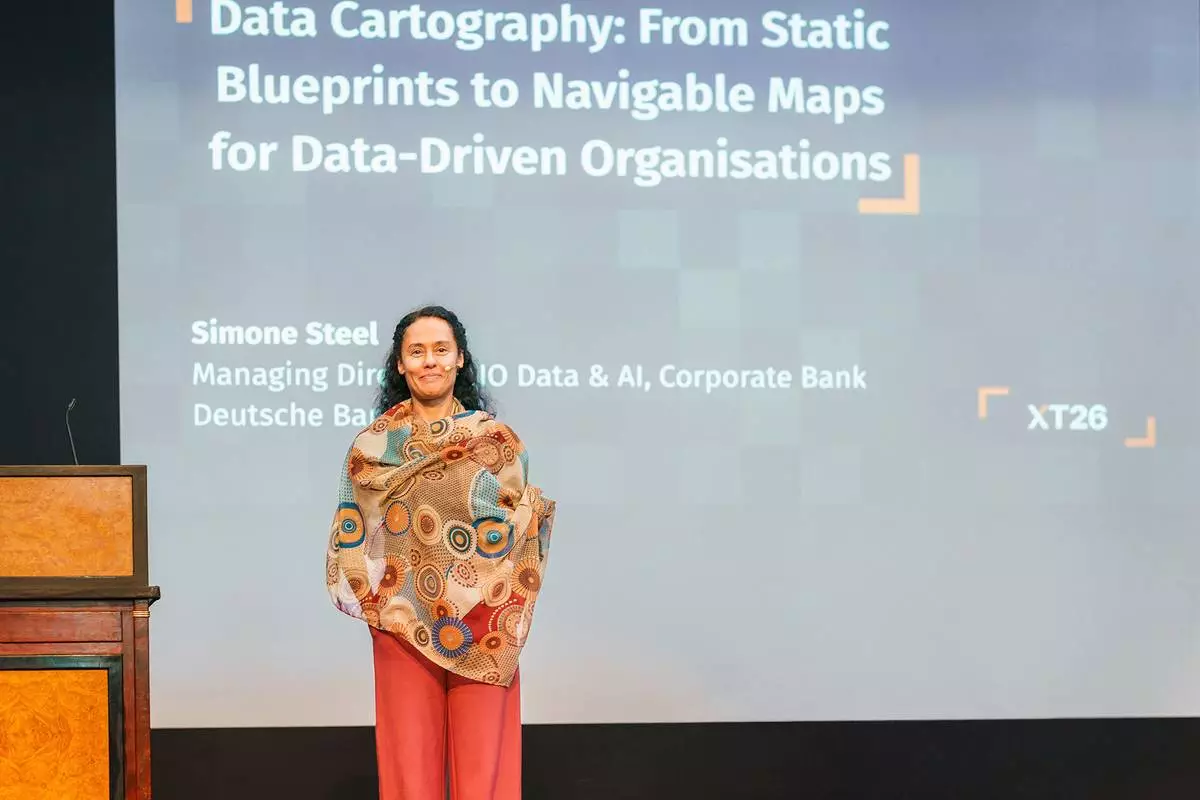
Simone Steel speaking at XT26
PARIS (AP) — France recorded its hottest day ever Tuesday as an early heat wave gripped Europe, prompting the Eiffel Tower and the Louvre museum to restrict visiting hours and disrupting school and transportation schedules in multiple countries.
Punishing temperatures extended to the United Kingdom and Spain, where weather agencies issued red alerts — like France — about the risks of extreme heat for tens of millions of people.
The record of 29.8 C (85.6 F) for France’s national thermal indicator — an average of temperatures measured at 30 weather stations — was only the latest in a series of never-before-registered highs heaped on Europe's largest country. The conditions were likely to persist at least until the weekend.
“Further record-breaking temperatures are expected, including some that could surpass all previous records, regardless of the time of year,” the Meteo France weather service said.
France's previous hottest days were recorded during heat waves of August 2003 and July 2019, with an average temperature of 29.4 C (84.9 F).
Temperature records also tumbled at individual weather stations and on consecutive days in some towns as daytime highs climbed well above 40 C (104 F), Meteo France said.
In the French capital, Gin Dujardin said the heat forced him to halt his work fixing roofs, which in Paris often have galvanized zinc coverings.
“It’s very, very hard because the zinc is very hot. The welds don’t hold,” he said. “It’s Dubai temperatures. It’s impossible.”
France has recorded 40 fatalities from drowning in the past week as people seek relief in rivers and other bodies of water, despite authorities' warnings about unsupervised swimming. Most of the drownings involved young people, Prime Minister Sébastien Lecornu said.
Meteo France said the heat wave has reached what it described as a “plateau of severity,” with unrelenting heat, day and night. A growing number of regions will tip into the red again Wednesday as the heat spreads across more than half of the country, including the northernmost tip of France, the weather service said.
Human-caused climate change is tied to increasingly extreme weather, and U.N. climate agency projections say the next five years are likely to shatter more heat records.
In a country without widespread air conditioning, schools, public transportation and sporting events have been affected. In Paris, the Eiffel Tower closed in the afternoon instead of late at night, as it usually does. The Louvre museum said it would close two hours earlier than normal from Wednesday through Saturday.
“Although parts of its historic building are naturally resilient, the museum remains vulnerable and is not sufficiently adapted to climate change,” Louvre officials said. “Heat buildup is greatest toward the end of the day and is further intensified by high visitor numbers.”
This heat wave, coming early in the summer, has already been compared to the August 2003 heat wave that roasted France with the highest temperatures in over half a century. It caused an estimated 15,000 deaths, many of them among older people in apartments and retirement homes without air conditioning.
Europe is the world’s fastest-warming continent, with temperatures increasing twice as fast as the global average since the 1980s, according to the European Union’s Copernicus Climate Change Service. Over the last four years, more than 200,000 people across Europe died from heat-related causes, and most of those deaths were preventable, the World Health Organization’s Europe office said this month.
The above-average temperatures can cause heat exhaustion and life-threatening heat stroke.
Hundreds of British schools planned to close or close early this week because of the heat, while many train services were reduced to avoid heat-related problems on the rail lines.
The Met Office, the U.K. weather agency, issued a heat warning for Wednesday and Thursday, with forecasts suggesting June’s all-time daily temperature record could be broken.
Temperatures of around 37 degrees C (98.6 F) are expected in southern England, with up to 35 C (95 F) in southeast Wales. The peak of the heat wave is now forecast for Wednesday and Thursday, when highs could reach 39 C (102.2 F) in London or southern England.
Conditions are expected to ease by Friday, the Met Office said.
On Tuesday, multiple U.K. train operators, including the express train serving London Gatwick Airport, said they were canceling or reducing services. Railway operators urged people to travel only if "absolutely necessary” on Wednesday and Thursday.
Further south, Spain faced a heat wave across parts of the Iberian Peninsula.
Spain’s national weather service, Aemet, issued red alerts Tuesday for temperatures of 44 C (111 F) in southern Andalusia as well as warnings of thermometers hitting 40 C (104 F) in the normally temperate Cantabria and the Basque Country regions along the country's northern Atlantic coast.
Aemet meteorologist Rubén del Campo said Spain, which has experienced increasingly torrid summers, is only going to get hotter because of climate change as heat waves become more frequent, longer and occur outside the traditional window of July and August.
Of the dozen heat waves Aemet has recorded in June since it started tracking them in 1975, half have occurred since 2015, del Campo said.
Human-driven climate change is heating up the atmosphere, both above Spain and in the surrounding sea waters, he said.
Copernicus, the EU weather monitoring agency, found that in Europe and globally, 2024 was the hottest year on record, and the continent experienced its second-highest number of “heat stress” days.
Scientists warn that climate change is exacerbating the frequency and intensity of heat and dryness, especially in southeastern Europe, making the region more vulnerable to health impacts and wildfires.
Associated Press journalists John Leicester in Paris, Sylvia Hui in London and Joseph Wilson in Barcelona, Spain, contributed to this report.
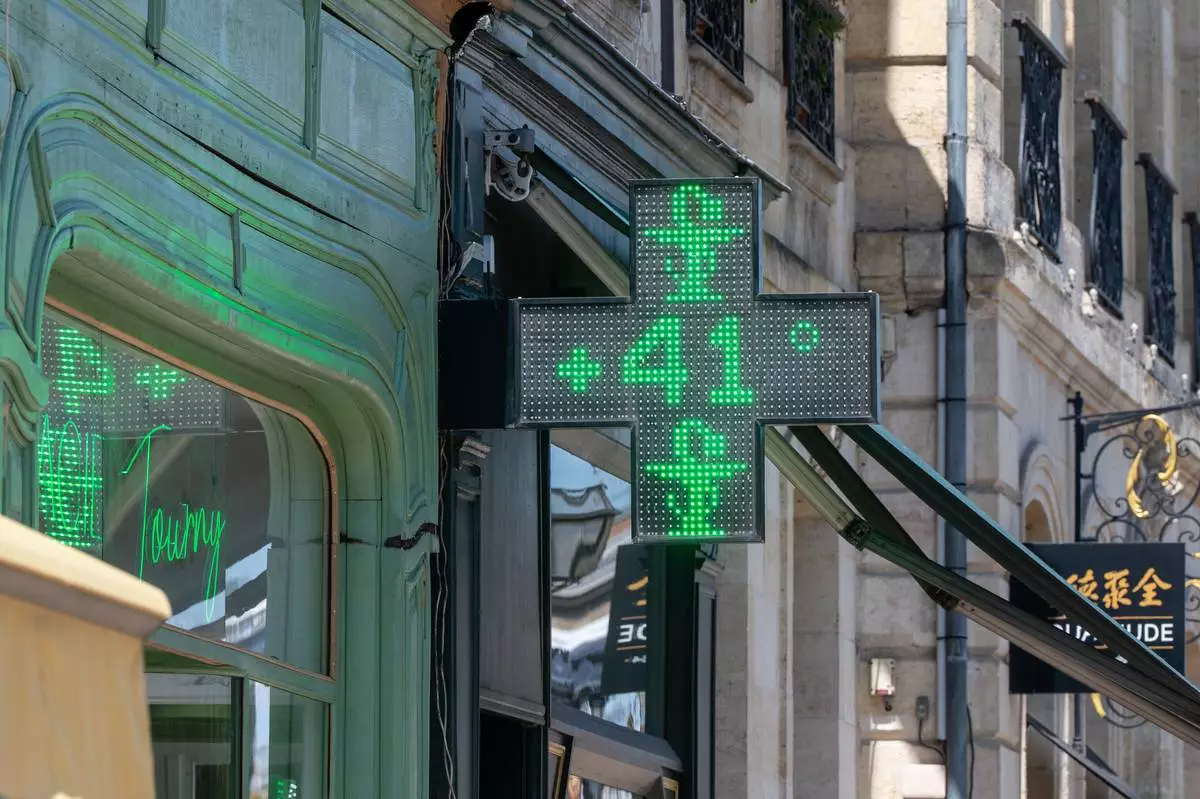
A drugstore sign shows the temperature of 41 degrees Celsius (105,8 degrees Fahrenheit) in Bordeaux, southwestern France, on Tuesday, June 23, 2026, as the national weather service, Meteo France, placed 54 departments, about half the country, under a red heat wave alert. (AP Photo/Caroline Blumberg)

Parisians bath in the Canal Saint-Martin in Paris, as the national weather service, Meteo France, placed 54 departments, about half the country, under a red heat wave alert, Tuesday, June 23, 2026. (AP Photo/Christophe Ena)

Parisians bath in the Canal Saint-Martin in Paris, as the national weather service, Meteo France, placed 54 departments, about half the country, under a red heat wave alert, Tuesday, June 23, 2026. (AP Photo/Christophe Ena )

People swim in an outdoor swimming pool in London, Tuesday, June 23, 2026 as a heat wave is predicted across Britain.(AP Photo/Alberto Pezzali)
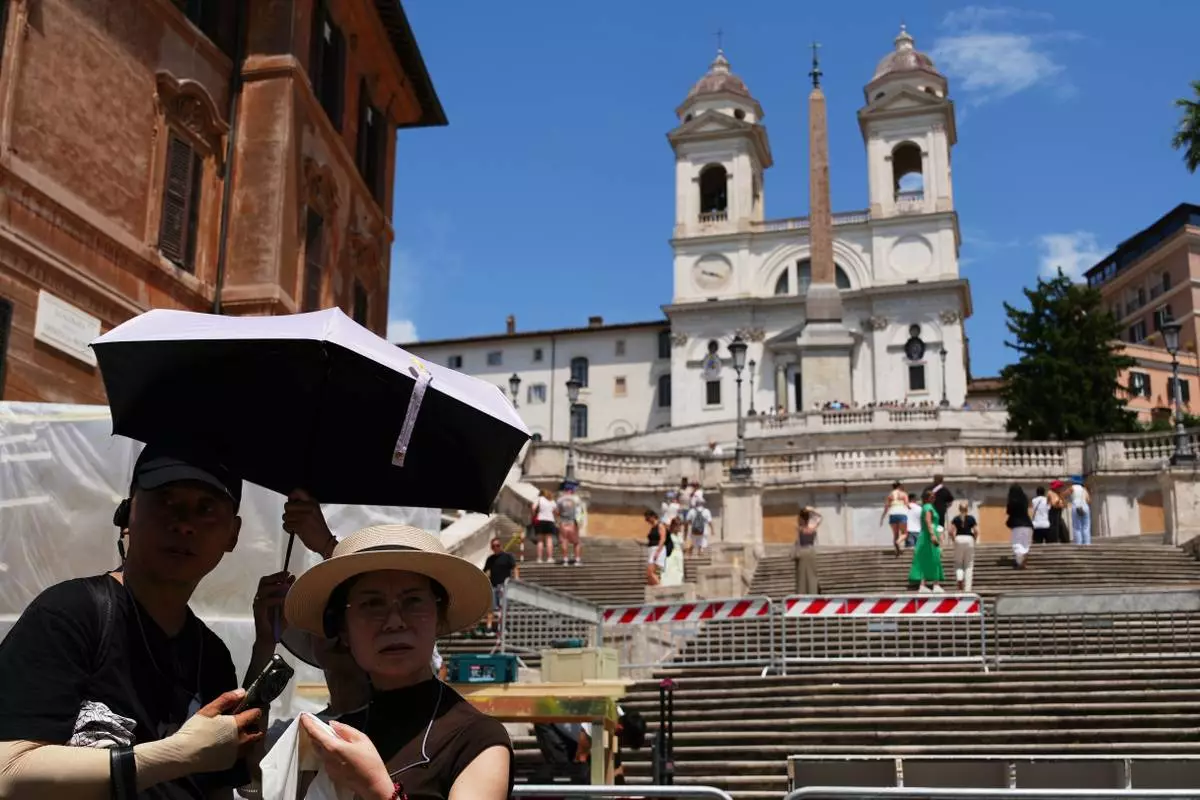
Tourists use umbrellas to shelter from the sun as they visit the historical Spanish steps in Rome, Tuesday, June 23, 2026. (AP Photo/Alessandra Tarantino)
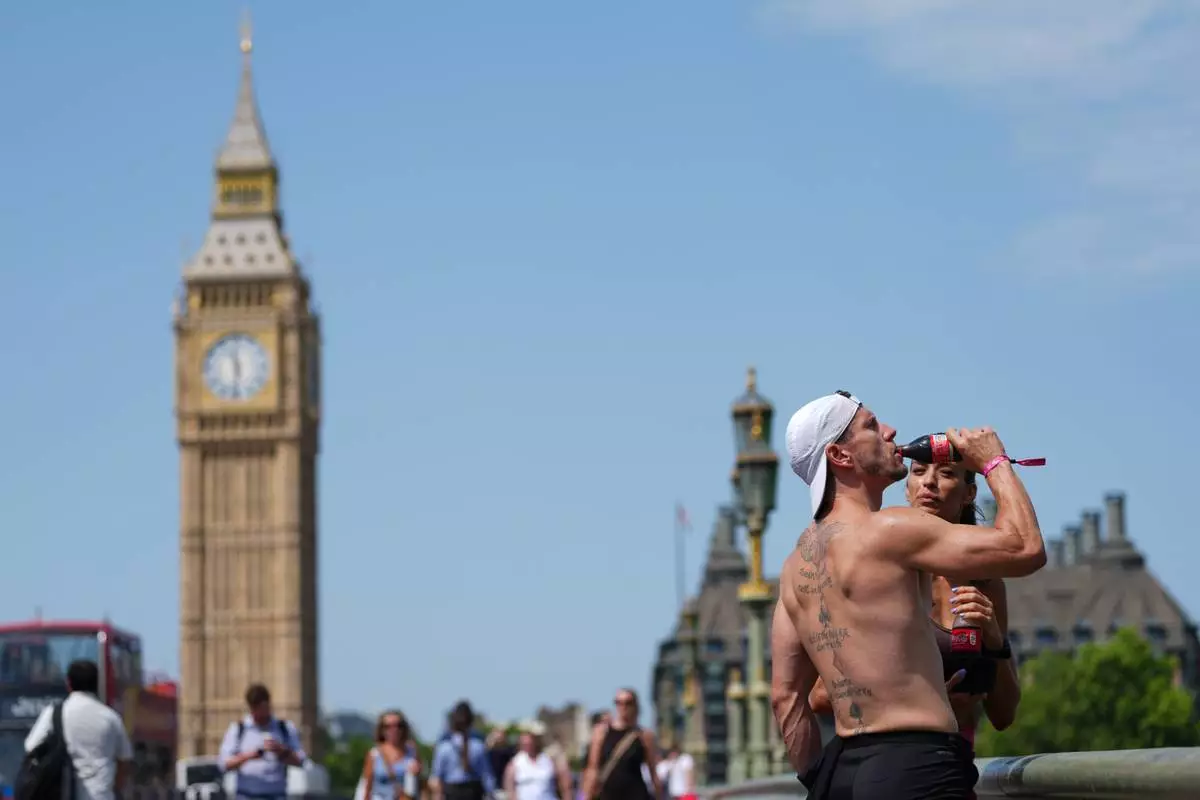
A man drinks on Westminster Bridge in London, as a heat wave is predicted Tuesday, June 23, 2026. (AP Photo/Kirsty Wigglesworth)
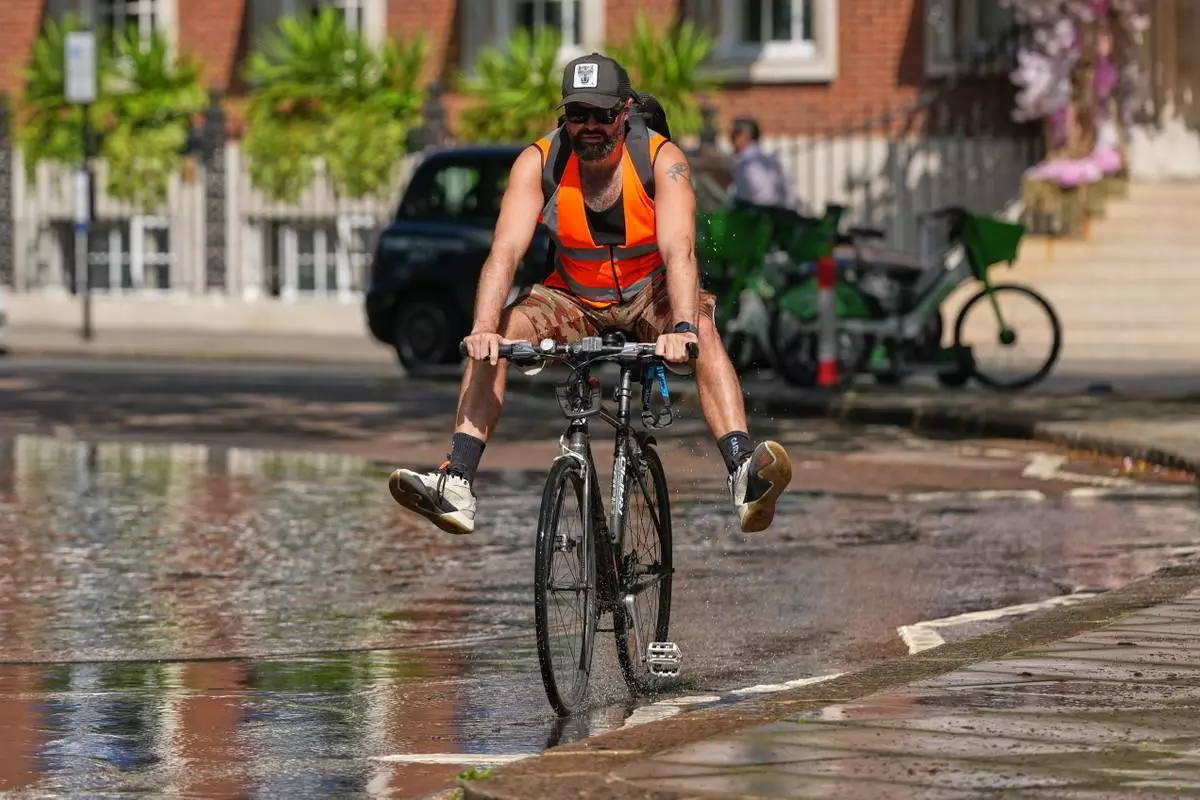
A man keeps his legs dry as he cycles through standing water in London, as a heat wave is predicted Tuesday, June 23, 2026. (AP Photo/Kirsty Wigglesworth)

An African penguin cools off in a basin in Kronber zoo, near Frankfurt, Germany, Tuesday, June 23, 2026. (AP Photo/Michael Probst)
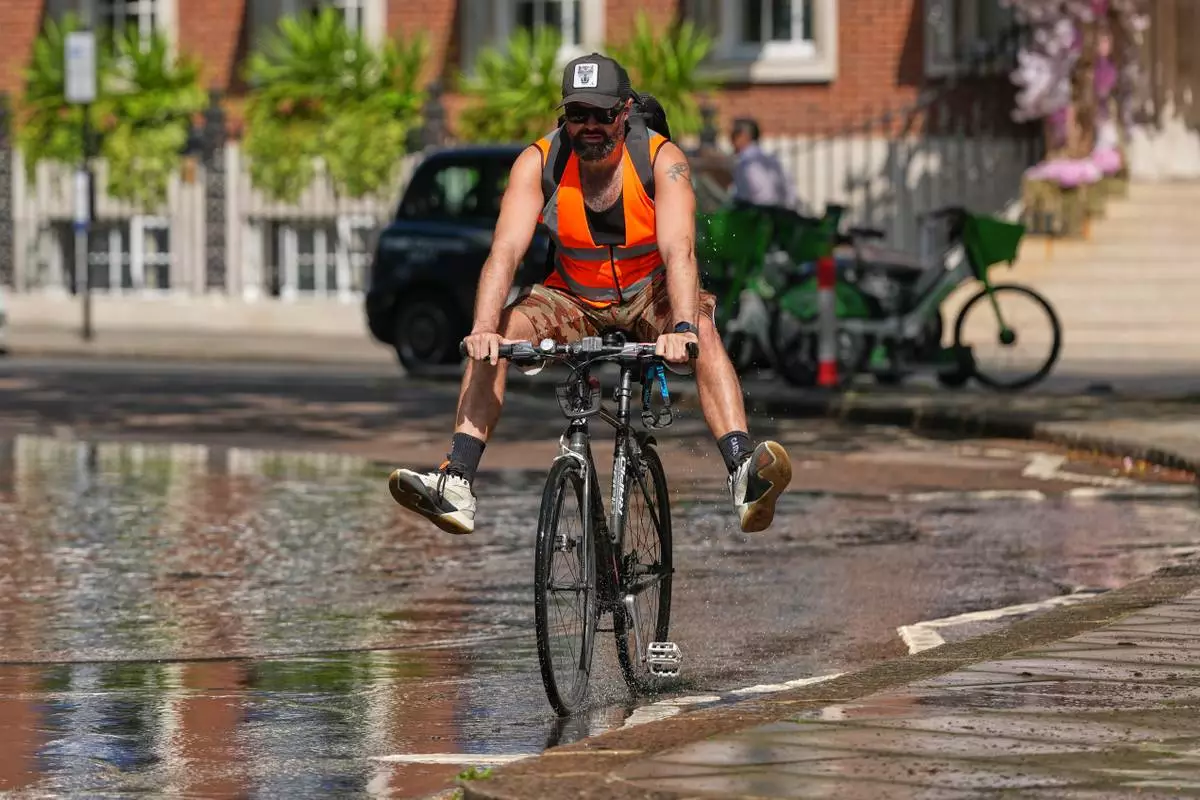
A man keeps his legs dry as he cycles through standing water in London, as a heat wave is predicted Tuesday, June 23, 2026. (AP Photo/Kirsty Wigglesworth)

People cool off in a water spray at the Eiffel Tower in Paris, Sunday, June 21, 2026. (AP Photo/Michel Euler)
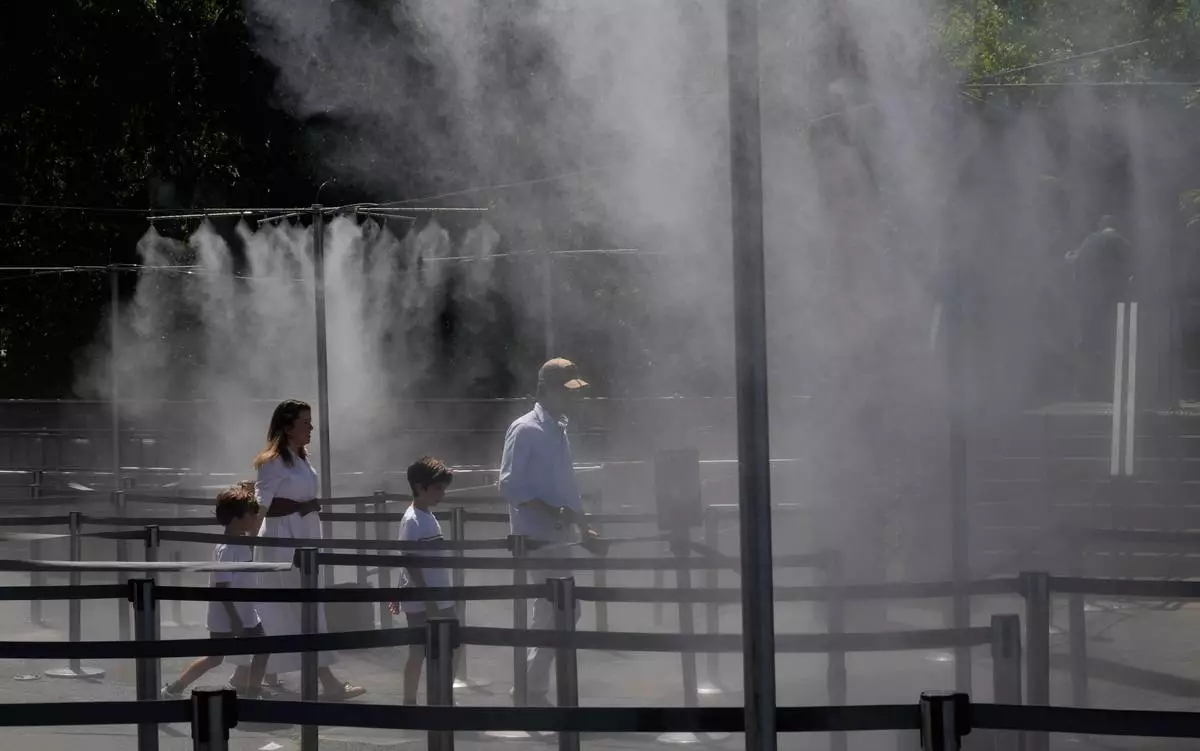
A family walks through a cooling water spray at the Eiffel Tower in Paris, Sunday, June 21, 2026. (AP Photo/Michel Euler)

A man shields himself from the sun with a scarf as he walks in the garden of the Palace of Versailles, outside Paris, during a heat wave with temperatures soaring above 40 degrees Celsius (104 Fahrenheit), Monday, June 22, 2026. (AP Photo/Thibault Camus)

Tourists with an umbrella take a photo in Paris, as France is enduring a grueling heat wave with temperatures soaring above 40 degrees Celsius (104 Fahrenheit), Monday, June 22, 2026. (AP Photo/Christophe Ena )
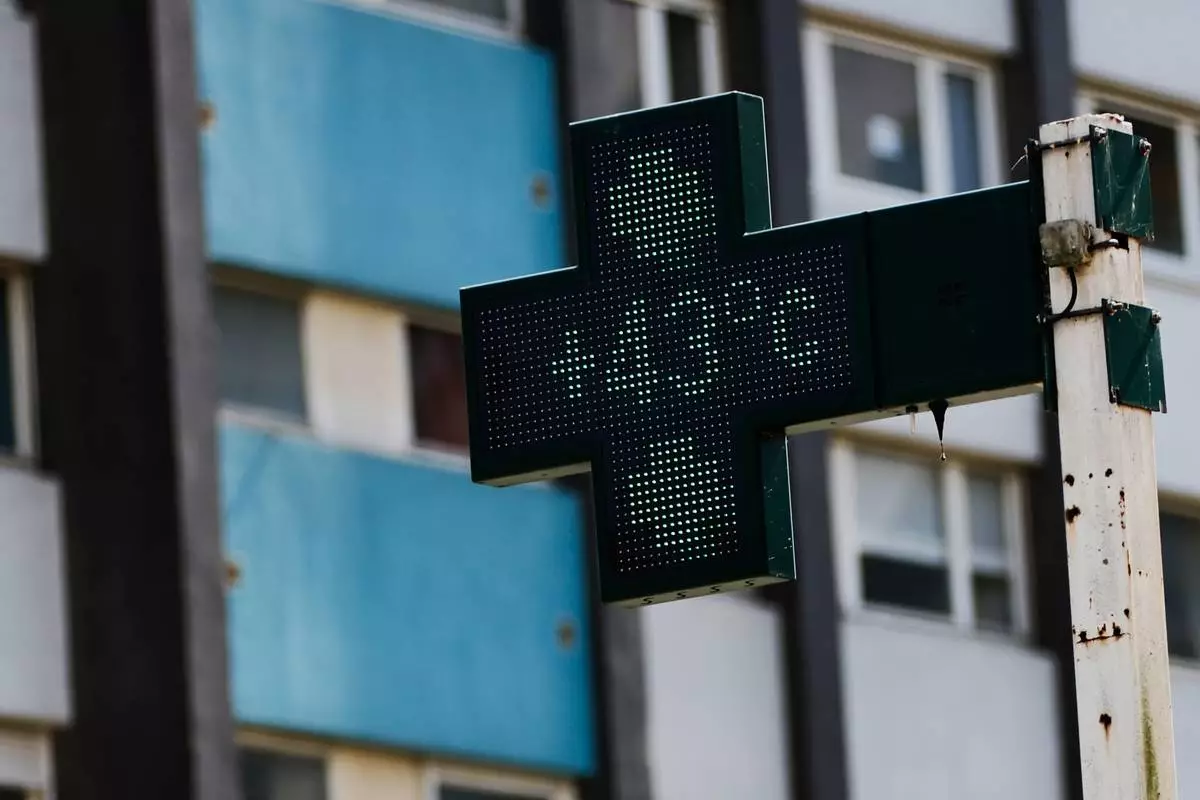
A drugstore sign shows the temperature 43 degrees Celsius (109,4 degrees Fahrenheit) in Rennes, western France, Monday, June 22, 2026. (AP Photo/Jeremias Gonzalez)