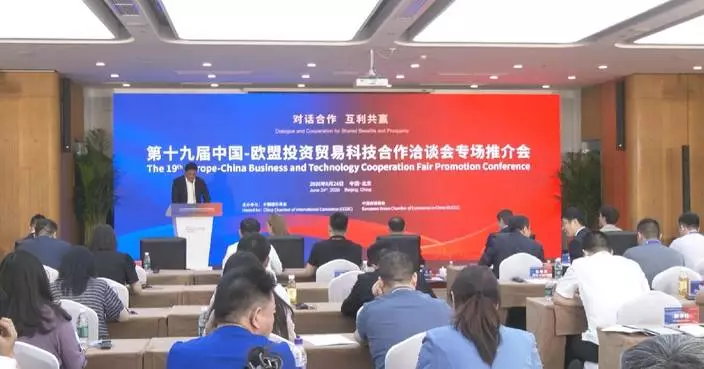
The 10th China-U.S. Civil Peace Forum was held on Wednesday in Wenzhou City, east China's Zhejiang Province, bringing together more than 100 participants from both countries, including former senior U.S. State Department officials, strategic thinkers and leading scholars.
The forum served as a platform for in-depth discussions on a new positioning of China-U.S. relations and the role of people-to-people exchanges.
Attendees noted that significant challenges remain, while the new positioning offers a positive starting point for bilateral ties. They stressed the importance of strengthening public support as a foundation for stable and sustainable relations.
Speaking from the podium at the event, David Rank, former deputy chief of mission at the U.S. Embassy in Beijing, emphasized that people-to-people exchanges represent the most enduring and flexible force for implementing the consensus reached by the two heads of state and for dispelling misunderstandings.
"And I continued as an American diplomat to come back to China every few years. And every time I came back, those people-to-people relationships that I saw start, when I was in Shanghai, they grew deeper and deeper. I think there are lots and lots of other specific things that our two countries can do to simplify the process of engaging in people-to-people exchanges," said Rank, who is now a senior fellow at Yale Jackson School of Global Affairs.
Eric Richardson, a senior fellow at the Arsenault Family Foundation China, welcomed what he described as a shared understanding between the two countries’ leaders on the importance of people-to-people ties.
"I'm particularly excited that the leaders seem to have agreed that people-to-people exchange is part of what our future relations should look like. So, constructive strategic stability on a fair and reciprocal basis should mean that more young people can exchange between universities, like the one we at today, Wenzhou-Kean University, and U.S. universities. It means that there should be more journalists like yourselves who can travel back and forth between the U.S. and China. And it means that there should be more scholars who better understand the United States and China, because all those people become cultural translators to make for good future U.S.-China relations," said Richardson, speaking on the sidelines of the event.
Officials from the International Department of the Communist Party of China also addressed the forum and emphasized the need for strengthened exchanges and mutual learning at a critical juncture in bilateral ties.
They called for enhanced strategic communication to foster rational and accurate perceptions, expanded practical cooperation to improve people's livelihood, and shoulder the historical responsibility to jointly safeguard global peace and prosperity.
Lu Kang, vice minister of the International Department of the Communist Party of China Central Committee, underlined the key obstacles that exist in China-U.S. relations.
"Misperceptions and unfounded suspicions remain key obstacles to the development of China-U.S. relations. We encourage strategic and academic communities in both countries to establish more dialogue mechanisms and communication platforms. On the basis of mutual respect, both sides should engage in full communication, accurately understand each other's core concerns, resolve doubts and differences, and guide the people of the two countries to view each other's development objectively. We must well answer the fundamental question of whether China and the United States are rivals or partners. China-U.S. cooperation has never been a zero-sum game. We should work together to expand and improve the pie of cooperation so that the people of both countries can share the benefits," said Lu.
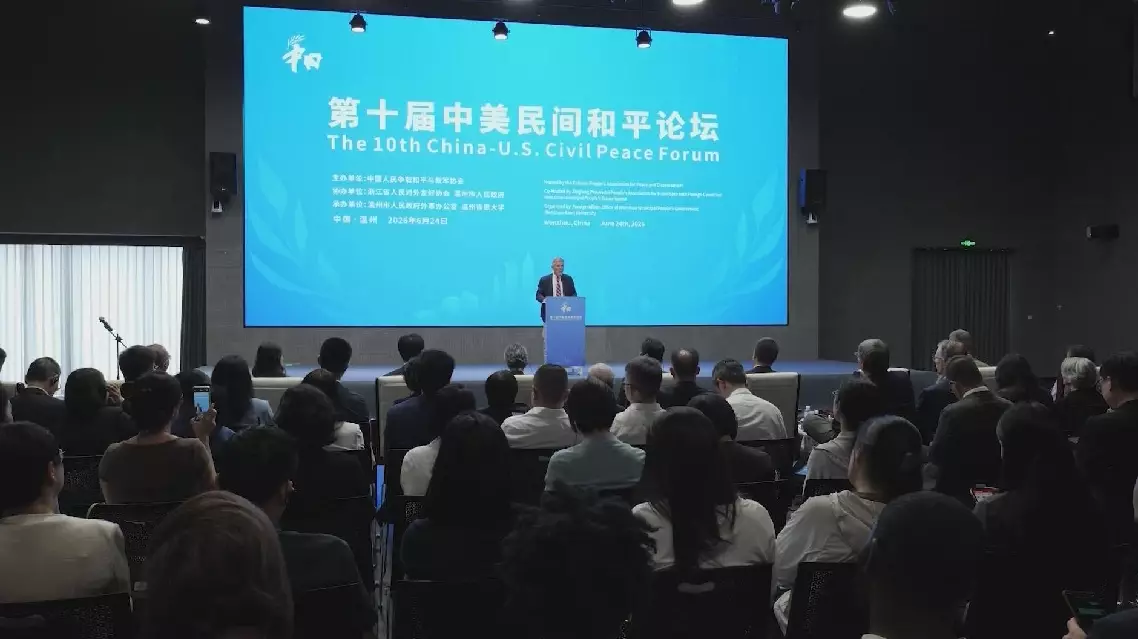
10th China-US Civil Peace Forum held in Wenzhou