LOS ANGELES--(BUSINESS WIRE)--Jun 25, 2026--
Tombot, a leader in health and wellness robotic companion animals, today announced the successful closing of a $7 million Series A3 financing round. The round includes investments from Caduceus Capital Partners, Wavemaker 360, the Lutheran Foundation for Long Term Living, and Florida Community Health Network.
This press release features multimedia. View the full release here: https://www.businesswire.com/news/home/20260622330098/en/
This financing positions Tombot to scale manufacturing, expand operational capabilities, and accelerate commercialization efforts ahead of its planned Fall 2026 customer launch. The company has already secured more than 23,000 pre-order and waitlist customers for its flagship product named “Jennie,” providing strong market validation and visibility into initial demand as it prepares for its first customer shipments.
The investment comes as demand continues to grow for innovative technologies that address loneliness, behavioral health, aging-in-place, and caregiver support. Tombot's robotic companion animals are designed to provide comfort, engagement, and emotional connection for older adults and others who can benefit from animal companionship but are unable to care for a live pet.
"This financing represents an important milestone as we transition from product development to commercial scale," said Tombot Founder and CEO Tom Stevens. "We are fortunate to have investors who recognize both the significant market opportunity and the positive social impact of companion robotics. Their support will enable us to meet growing customer demand, execute a successful market launch, and continue building a broader portfolio of products that set the bar for emotional support through technology."
The investor group brings a unique combination of healthcare providers, aging-services, and innovation expertise to Tombot's growth strategy.
"Within minutes of our conversation with Tom and seeing his robotic companion come to life, the potential impact of this technology for older adults and individuals facing cognitive challenges became immediately apparent,” said Dr. Mark Gusek, President and CEO of the Lutheran Foundation. “Given our organization’s longstanding commitment to enhancing the quality of care and well-being of older adults, we were pleased to provide launch funding to Tombot, Inc. to support the development and advancement of its lifelike robotic dog. This innovative product has the potential to transform the daily lives of individuals, families, and communities affected by mental health and cognitive challenges who are unable to safely or practically care for a live pet."
Managing Partner Ryan McKindles of Caduceus Capital Partners offered a similar take: “The convergence of an aging population, caregiver shortages, and increasing loneliness underscores the need for innovative solutions that expand access to care and support mental well-being." McKindles added, “Caduceus was honored to lead Tombot’s Series A last year, and we are pleased to continue supporting the company through this additional investment.”
Since Jennie’s emergence in the marketplace in early 2024, Tombot has generated significant market interest from consumers, healthcare providers, senior living organizations, and caregiving communities. The company enters its commercialization phase built upon an ever-expanding foundation of strategic relationships across healthcare and aging-services sectors, positioning itself to capitalize on the rapidly growing demand for companion technologies that support emotional well-being, healthy aging, and caregiver resilience.
The company’s Series A3 financing further strengthens Tombot's position at the convergence of robotics, healthcare, and consumer technology, creating a foundation for future growth as the company expands its product platform and market reach.
About Tombot:
Tombot is a Santa Clarita, CA-based robotic animal and digital health solutions company. Its first product, “Jennie”—a lifelike robotic Labrador puppy—was created to support the 300+ million seniors worldwide living with dementia or mild cognitive impairment, as well as individuals coping with anxiety, loneliness, autism, and PTSD. Exceptionally realistic and fully autonomous, Jennie mimics the movements and responses of an 8-10 week-old puppy, providing the companionship and health benefits of a live animal. With more than 23,000 pre-order and waitlist customers, Jennie has already gained global recognition for advancing robotic solutions that support emotional wellbeing.
For more information about Jennie, visit:
www.Tombot.com

"Jennie" provides emotional support and comfort to seniors experiencing dementia or mild cognitive impairment, as well as individuals coping with anxiety, loneliness, autism, and PTSD. Exceptionally realistic and fully autonomous, Jennie mimics the movements and responses of an 8-10 week-old puppy, providing the companionship and health benefits of a live animal.
WASHINGTON (AP) — The Supreme Court on Thursday allowed the Trump administration to end legal protections for migrants fleeing violence and natural disaster in Haiti and Syria, exposing hundreds of thousands more people to potential deportation.
The 6-3 decision overturns lower court orders and allows the Department of Homeland Security to swiftly end temporary protected status, a program that protects a total of 1.3 million people from 17 countries.
It marked another victory at the high court for Republican President Donald Trump's sweeping crackdown on immigration. Though the conservative-dominated court has put the brakes on some of Trump’s immigration policies over the last year, it handed him a second win Thursday in a decision clearing the way for the potential revival of a policy restricting immigrants seeking asylum.
The Republican administration argued that judges cannot second-guess immigration officials' decisions about protections that were intended to be temporary.
The court's conservative majority agreed, finding that the law creating the program keeps courts out of the process. “The Secretary’s TPS designation decisions are not subject to judicial review,” Justice Samuel Alito wrote.
Immigration lawyers said the countries at issue remain unsafe for migrants to return and they argued that the administration ended the protections in an unlawfully hasty process tinged by racial animus. During Trump's 2024 presidential campaign, he amplified false rumors that Haitian immigrants were abducting and eating dogs and cats.
The court majority, though, found that the statements from Trump and his administration were not “overtly racial." Alito said that Haitian people should not face character attacks. “But whatever one may think of the cited statements, they are insufficient to show that the termination of Haiti’s TPS designation was based on the race of the Haitian people,” he wrote.
James Percival, DHS general counsel, applauded the ruling, saying the program had, in many cases, become "de facto amnesty. This is a win for the rule of law and common sense.”
The court's three liberal justices dissented, writing that the law does allow for judges to step in if officials sidestep the process for ending the protections. Race, meanwhile, does appear to have played a role, Justice Elena Kagan wrote.
“The statements fairly shout, in their racial undertones and overtones alike, that race entered into the President’s resolve to remove Haitians from this country,” she wrote. “Respectfully, I dissent from the Court’s decision that they may instead be put on the next plane."
Lawyers for the Haitian immigrants said the Haitians would be in danger if they are sent back. “Simply put, the Supreme Court’s ruling will directly result in thousands of innocent people dying violent, needless deaths,” Geoff Pipoly and Andy Tauber said.
They urged the Senate to approve an extension of deportation protections for Haitians that's languished since it passed the House on a rare bipartisan vote in April.
Derrick Johnson, president and CEO of the NAACP, also condemned the decision.
“This ruling is a devastating betrayal of Haitian families who have lived, worked, and contributed to this country for years –- only to be cast out based on anti-Black immigration sentiment,” he said.
The Justice Department appealed to the Supreme Court after judges postponed the end of the program for about 350,000 Haitians and 6,000 Syrians. The high court sided with the administration before and allowed the end of the program for people from Venezuela.
Federal authorities deny prejudice played a role. They also cited a Supreme Court decision from Trump’s first term that rejected bias claims based on his social media posts and upheld a travel ban on several Muslim-majority countries.
Since Trump returned to the White House in January 2025, Homeland Security has ended the protections, including some that had been in place for more than a decade, for people from 13 countries.
The terminations were made even though countries such as Haiti and Syria remain dangerous, immigration lawyers said. Four Haitian women who were deported from the United States in February were found beheaded and dumped in a river several months later, lawyers said in court documents.
The United States first granted protections to Haitians in 2010 after a catastrophic earthquake and extended them multiple times amid ongoing gang violence that has displaced more than a million people, according to court documents.
Syrians were first granted protected status in 2012, during a civil war that lasted for more than a decade before the fall of President Bashar Assad’s government in late 2024.
The program was created by Congress in 1990 to prevent deportations to countries suffering from natural disasters, civil strife and other instability. It allows people already in the country to stay with work permits in increments of up to 18 months, but it does not provide a path to citizenship.
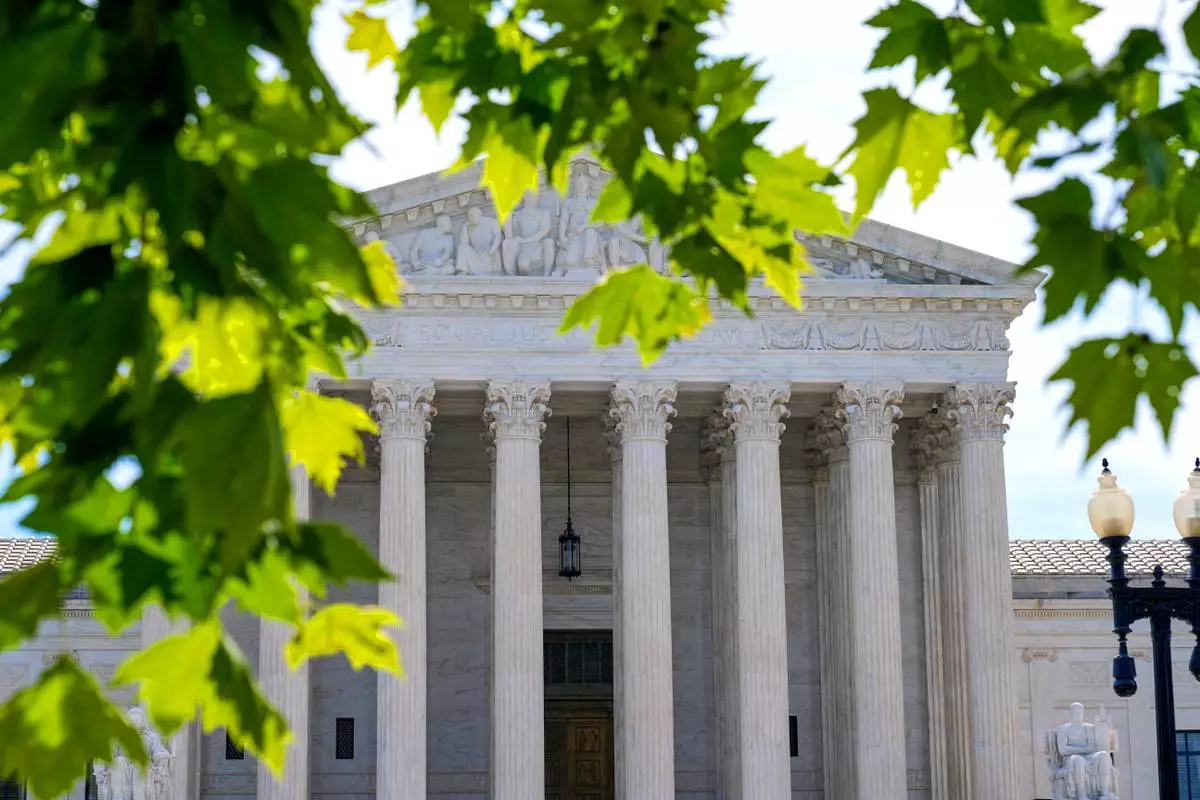
FILE - The U.S. Supreme Court is seen, June 5, 2026, in Washington. (AP Photo/Mariam Zuhaib, File)

FILE - Linda Joseph holds a candle during a vigil at the Little Haiti Cultural Complex after a federal judge blocked the Trump administration from ending temporary immigration status, or TPS, for Haitians, Tuesday, Feb. 3, 2026, in North Miami. (AP Photo/Lynne Sladky, File)