A construction site in Yining City, northwest China's Xinjiang Uygur Autonomous Region, has become an unexpected nesting ground for nearly 50,000 rosy starlings, prompting authorities to suspend work and safeguard the birds.
The site, part of a larger land improvement project in the Ili Kazak Autonomous Prefecture, has remained idle since mid-May this year, when the starlings descended en masse.
"To protect them, we've temporarily halted construction. We'll resume work in August, after the last bird has flown away," said Irpani Mirahmetjan, the project manager.
Rosy starlings are migratory birds that live in flocks and prefer to nest in arid, open areas, typically in rock piles and cliff crevices. They feed primarily on locusts, making them natural biological control agents against locust plagues, and are widely known as "grassland locust fighters."
Local authorities have suspended construction and set up warning tape and signs around the rock piles to protect the birds. Artificial nests have been installed to attract more rosy starlings, bolstering biological locust-control efforts.
"Our city has nine artificial rosy starling nesting sites. This year, more than 100,000 rosy starlings have arrived, helping to protect 20,000 hectares (300,000 mu) of grassland from locusts," said Ilaldin Yishaq, director of the wildlife office at the Yining City Forestry and Grassland Bureau.

Construction halted in China's northwest city to protect rosy starlings
A pair of protected common kestrels have turned an abandoned magpie nest on a telecom tower in Beijing's suburban Changping District into an unlikely nursery, offering a rare glimpse of birds of prey raising chicks in a built-up area.
The kestrels, a wild animal species under the second-class state protection in China, settled on the 30-meter-high tower, drawing birdwatchers and residents in the past few days.
Footage filmed by birdwatchers earlier showed an adult kestrel returning from a hunt and landing near the nest, where several fluffy chicks stretched their necks and flapped their wings as they waited to be fed.
The chicks have since shed their gray down and developed brown streaks and markings. They are now practicing flying.
"I basically come here every day now. It is very interesting to watch kestrels raise their chicks. The male bird is responsible for going out to hunt. Upon returning, he hands the food to the female, who feeds the chicks," said birdwatcher Si Shoujun.
"These are the two parent birds. The one on the left is the male, and the one on this side is the female. Today, I captured both of them in the same frame because the male returned to the nest without food. When the female saw that he came back with nothing, she tried to force him to go out and look for food, because there are still three chicks in the nest waiting for feed," Si explained.
Common kestrels are a relatively common raptor species in Beijing and are often seen in green spaces where vegetation is abundant. But nesting and raising chicks in the city's built-up areas is less common.
Beijing is now home to 531 recorded bird species, according to local authorities.
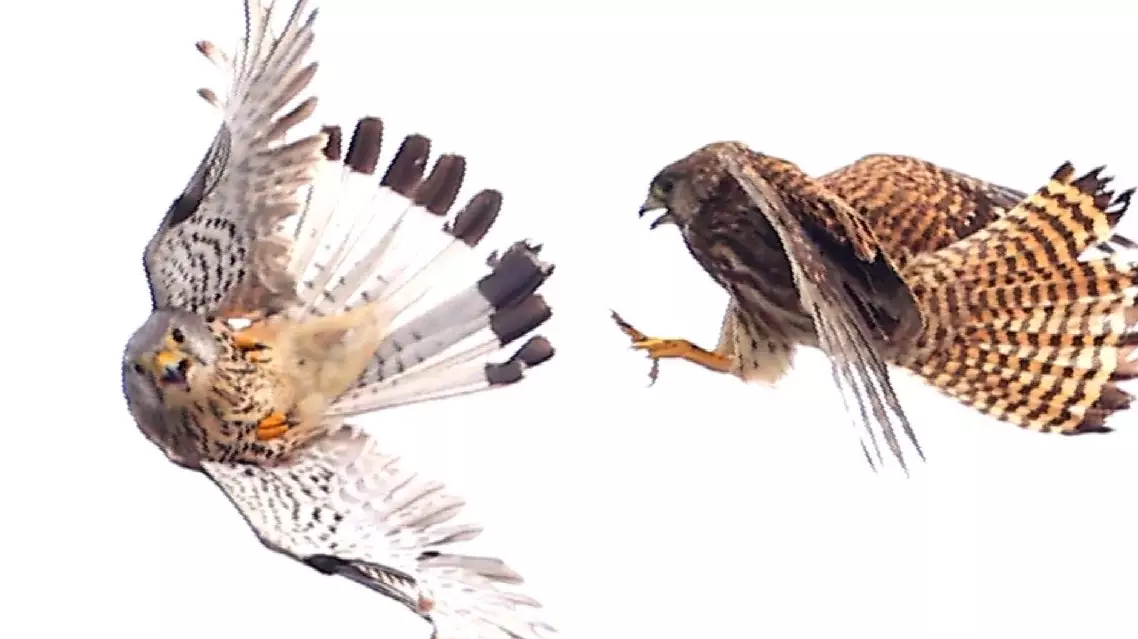
Protected kestrels turn Beijing telecom tower into unlikely nursery