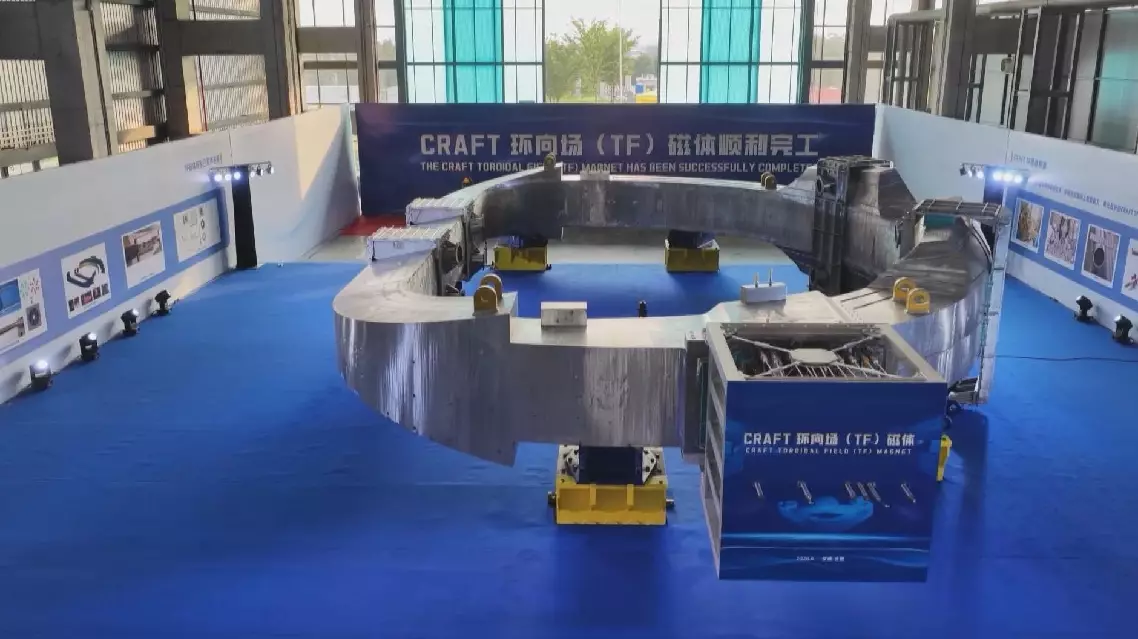
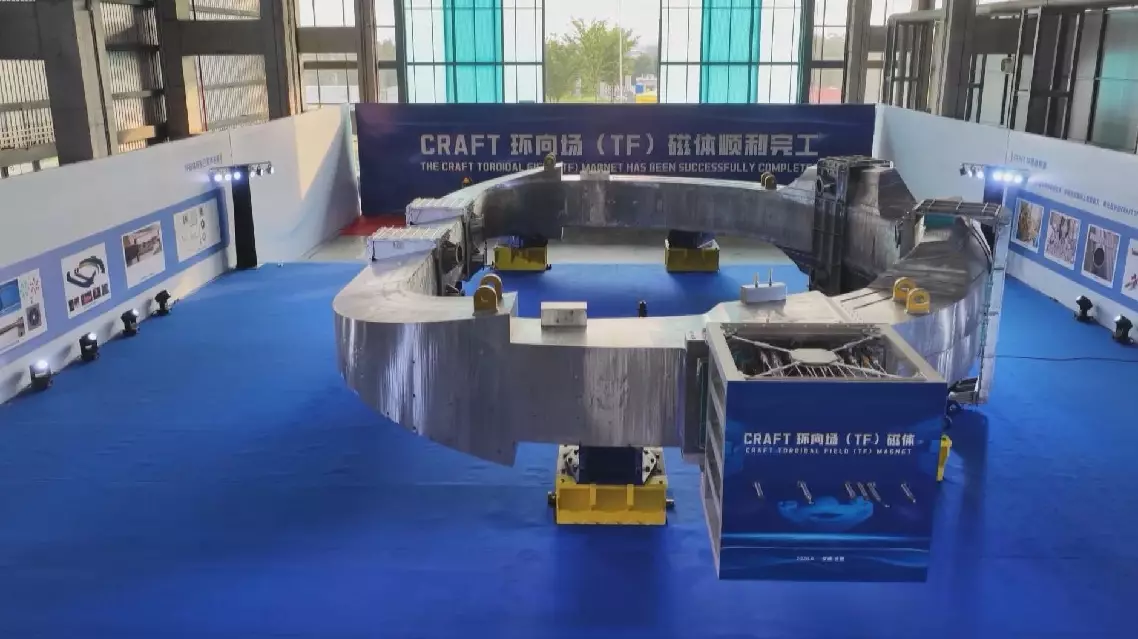
The world's largest Toroidal Field (TF) superconducting magnet for fusion reactors passed technical acceptance by an expert panel on Saturday in Hefei, capital city of east China's Anhui Province.
The volume of this magnet, weighing 582 metric tons, is 1.3 times that of the TF magnet used in the International Thermonuclear Experimental Reactor, and its energy storage capacity is three times greater, according to its developers at the Hefei-based Institute of Plasma Physics, Chinese Academy of Sciences.
The magnet, one of the most crucial components of a fusion reactor, is responsible for creating the toroidal magnetic field, which firmly constrains the plasma and reduces the impact and energy loss of high-energy particles on the vacuum chamber walls.
In the future, 16 such magnets will be combined and built together to form a complete Toroidal Field.
"Its function is to confine the plasma, preventing it from hitting the walls within the vacuum chamber. The intensity of its magnetic field is related to the temperature and density required for the plasma in the future. A ring composed of 16 coils will generate a magnetic field of 6.5 teslas," said Wu Yu, a researcher at Chinese Academy of Sciences' Institute of Plasma Physics (ASIPP).
The institute has been developing the magnet for six years.
"This coil is the heaviest in the world, with the highest energy storage capacity among all superconducting coils currently. The special stainless steel we are currently using, as well as our insulating materials and superconducting materials, are all domestically produced. This project is realized with 100 percent of domestic products," said Song Yuntao, head of the ASIPP.
It is one of the two key superconducting magnets related to fusion reactors that were announced by China on the day. The other magnet, the high-temperature superconducting central solenoid coil, completed full-condition parameter testing on the same day.
World's largest superconducting magnet for fusion reactor unveiled in China
World's largest superconducting magnet for fusion reactor unveiled in China
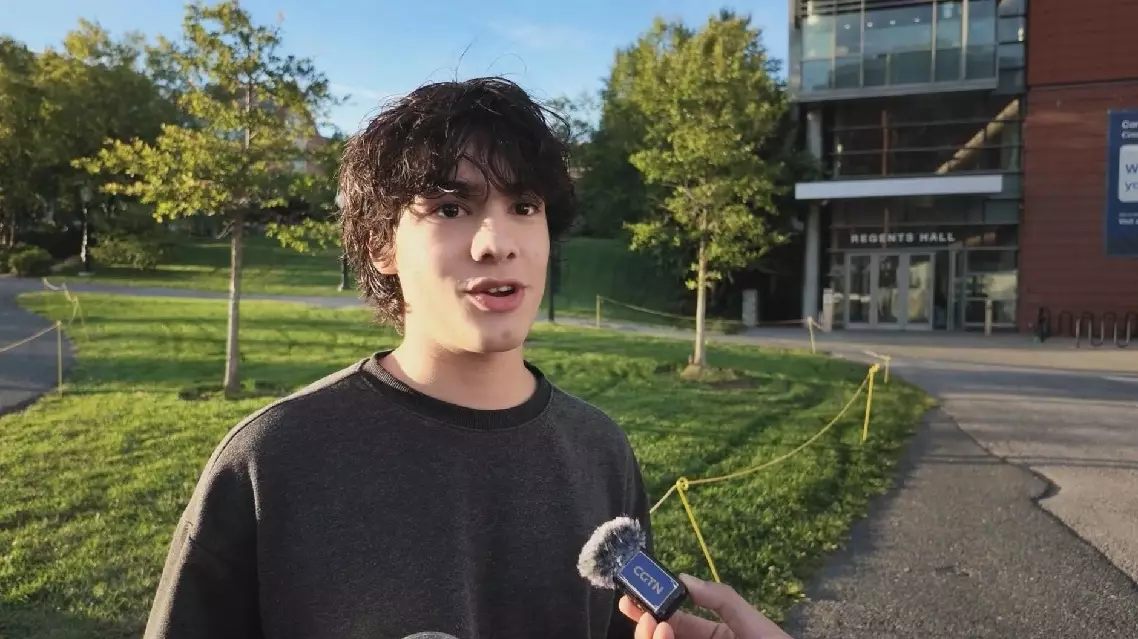
A number of university students in the U.S. capital have shared their views on China's initiative to invite 100,000 young Americans to visit the country for exchanges and study over the next five years.
The program was announced by Chinese President Xi Jinping when addressing a welcome ceremony at the White House during his visit to the United States from Wednesday to Friday.
Many of the students interviewed expressed their hope to visit some well-known places in China like Beijing, Shanghai and Guangdong.
"My dad's been to China for work, and he really loves it, so I'd love to go sometime. Maybe Shanghai. That's where my dad went, and he really liked it there," said a student.
"I've heard of Guangdong. I've heard of the basketball team," another student said.
Many of the students agreed that allowing more young Americans to experience Chinese culture in person would be beneficial for both countries.
"I think that's really cool to have the opportunity to connect with those cultures. And I really do like that idea. I think it's a great idea to invite us to China. It's great," said a student.
"I feel like the culture. I feel like getting the opportunity to immerse yourself in different cultures is really important," said another student.
"There's definitely value in traveling to other places and learning other cultures. So I think that it can be beneficial," said another one.
Even beyond cultural exchange, the students expressed their beliefs that American youth could learn a lot from Chinese society.
"I think, for me personally, it's the scale, with how many people live in China. I would definitely be interested in seeing how that functions, especially in those larger cities," said a student.
"I think I would like to know what their people are like. What are their thoughts on the world? On what the world should be like?" one student said.
"I think China's amazing. They're so far ahead. We're supposed to be the Western world, but I feel like they're so much more advanced than us in so many ways. I know AI and medicine are big things right now, and I think China has made huge advancements in that. So probably that," said a student.
The students also hope that the program will help strengthen China-U.S. relationship, promote educational exchanges, and broaden the horizons of those who take part.
"It's better for both countries to be connected and to build a better relationship over the coming years. And I think that's important to global peace and prosperity," said a student.
"I think it's really a great thing. I think different cultures, combining different cultures, and education is such a global thing, and having different students come all over the place and take classes here and there," said another student.
"There's a lot more to this world than what's right in front of us. And there's a lot to learn from different ways of seeing things around the world. So I think it could be valuable from that standpoint," a student said.
US students share views on China's plan to invite 100,000 young people for study, exchange