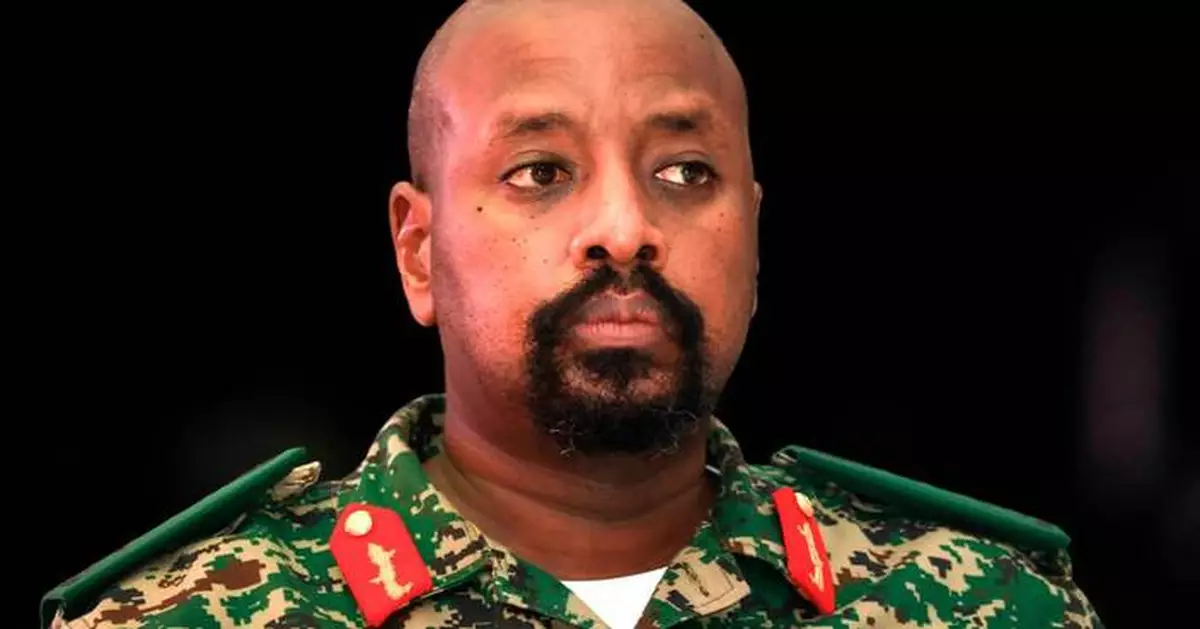
KAMPALA, Uganda (AP) — The offices of a major news organization in Uganda were shut down on the orders of the military chief, who warned Sunday that all media “will follow the rules" while asserting his authority as the East African country's de facto ruler.
Gen. Muhoozi Kainerugaba, the eldest son of President Yoweri Museveni, has served as the top military commander since 2024. In recent days, after Museveni was sworn in for a seventh consecutive term, Kainerugaba has strengthened his grip with a series of directives and orders usually reserved for the head of state.
Soldiers were deployed outside the Kampala offices of the Daily Monitor newspaper early Sunday. The paper is part of the Nation Media Group of companies whose headquarters is in Nairobi, the Kenyan capital.
“I have the power in Uganda to shut down ANY media house I want to,” Kainerugaba wrote on X, his preferred channel of communication. "I have had this power since 2017. This power was given to me by my great father.”
He added: “From now on ALL media in Uganda will follow the rules!”
The army chief said that in addition to Daily Monitor, his closure directive also targeted local broadcaster NTV, part of Nation Media Group.
The National Association of Broadcasters said in a statement that at least six publishing and broadcasting outlets — all under Nation Media Group — were closed. “We are deeply concerned about this action and its impact on the media ecosystem,” the statement said.
Kainerugaba asserts that he will succeed his father in the presidency, an increasingly likely possibility as the 81-year-old leader now relies heavily on his son’s military authority.
Earlier this month, Kainerugaba retaliated against a prominent attorney who sought to hold him accountable for his alleged role in the violation of the rights of opposition leader Kizza Besigye. He was seized in Nairobi in 2024, and has since been imprisoned on treason charges he says are politically motivated. Besigye's attorney, Erias Lukwago, was taken from his house and later charged with an offense related to the concealment of treason.
Museveni, who has ruled Uganda since 1986, has not said when he will retire. He has no rivals within the ruling party, the reason many believe the military will have a say in choosing his successor.
Kainerugaba’s associates describe him as a dedicated military officer who often eschews ostentatious displays of wealth. They say he opposes official corruption and would punish it heavily as president.
He attended military schools in the U.S. and Britain before taking charge of a presidential guard unit that has since been expanded into an elite group of special forces. In addition to his military duties, he is the founder of a political activist group known as the Patriotic League of Uganda. Its members and well-wishers range from the parliamentary speaker to government ministers.
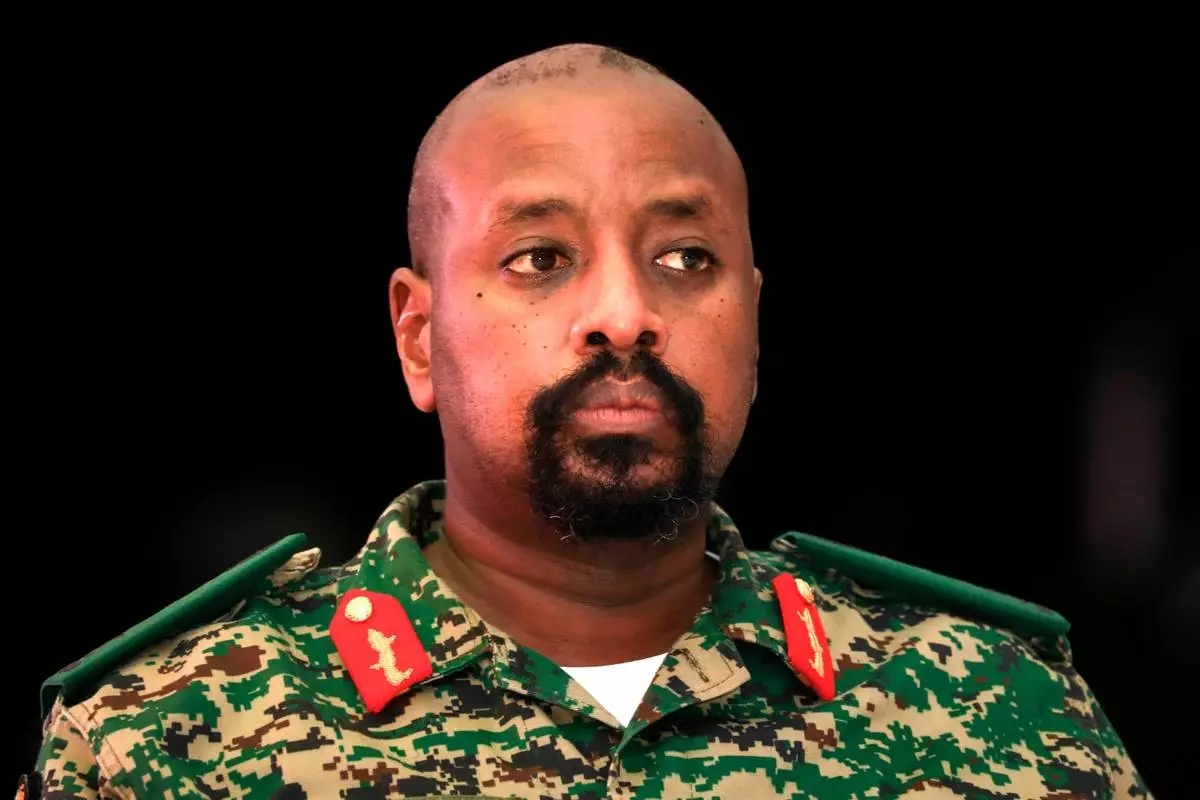
FILE - Lt. Gen. Muhoozi Kainerugaba, son of Uganda's President Yoweri Museveni, attends a "thanksgiving" ceremony in Entebbe, Uganda late Saturday, May 7, 2022. (AP Photo/Hajarah Nalwadda, File)
DUBAI, United Arab Emirates (AP) — Iran launched drone and missile attacks Sunday targeting Bahrain and Kuwait in response to U.S. airstrikes that hit the Islamic Republic, and threatened a “complete halt” could come to negotiations to end the war if Washington continues its attacks.
Efforts to reopen the Strait of Hormuz without Iran's direct oversight sparked the crossfire now gripping the region and imperiled negotiations for a lasting ceasefire. A multinational maritime body overseen by the U.S. Navy said Saturday that it would expand a route near Oman to allow for both inbound and outbound traffic, setting up a new flashpoint with Tehran.
The global community has long considered the strait an international passageway, despite its sitting in Iran and Oman's territorial waters. In recent days, Tehran has twice attacked vessels going through a route on the Omani side of the strait backed by a United Nations agency.
Iran insists that it alone must govern the strait, the narrow mouth of the Persian Gulf that once carried a fifth of the world’s oil and natural gas. Iranian Foreign Minister Abbas Araghchi reiterated the claim during a state visit to Iraq on Sunday.
“Any interference in this matter, any attempt to establish new or separate arrangements from those currently being carried out by the Islamic Republic of Iran, will only lead to further complications, delay the reopening of the Strait of Hormuz, and increase the level of tension, just as over the past two nights we witnessed incidents in the Strait of Hormuz that led to an increase in tension and confrontation,” he said in Baghdad.
The United States and Iran are still debating the terms of an interim peace deal, including issues such as getting ships through the narrow mouth of the Persian Gulf, removing U.S. blockades and sanctions, and addressing the future of Iran’s stockpile of highly enriched uranium. Under the memorandum of understanding signed earlier this month, the U.S. and Iran have 60 days to iron out the details. The strikes threaten to torpedo the deal before it can be finalized.
The Kuwaiti military said air defenses intercepted incoming Iranian drones and missiles Sunday morning, just after the U.S. strikes.
Kuwait, which hosts a major U.S. army base, said it had detected and intercepted two ballistic missiles and there were no reports of injuries or damage.
Bahrain's Interior Ministry said the Iranian strikes damaged a residential building near the international airport and no one was killed. The ministry released photos of an 8-story building, with the top floor completely destroyed, filled with rubble and its windows blown out.
Bahrain is home to the U.S. Navy’s 5th Fleet, whose base there came under repeated attack during the war. The damaged building on Sunday was not near the fleet's headquarters, in downtown Manama.
Bahrain’s Foreign Ministry issued a statement denouncing what it called “a dangerous escalation that reveals that what Tehran is doing is not a passing act, nor an isolated incident, but rather a deliberate approach and a systematic pattern of repeated aggression against the sovereignty of the kingdom, and the security of its citizens and residents.”
The strikes came after the US and Iran traded attacks over the weekend. The U.S. military’s Central Command said it struck Iranian military “surveillance infrastructure, communication systems, air defense sites, drone storage facilities and minelayer capabilities” on Sunday, following an attack on a ship at sea early Saturday morning. That ship, the Panamanian-flagged tanker Kiku, carried crude oil for the state-run energy company of Qatar, a key negotiator between Iran and the U.S.
In a social media post, Trump said the U.S. had “struck Iranian missile and drone storage locations, and coastal radar sites, for violating the Cease Fire Agreement, AGAIN!” He warned of a point where the U.S. may no longer be able to be reasonable “and will be forced to militarily complete the job.”
“If that happens, the Islamic Republic of Iran will no longer exist!” Trump wrote on Truth Social.
The incident follows a similar back-and-forth that occurred just days prior, when an Iranian drone struck a merchant vessel off the coast of Oman on Thursday, and the U.S. military retaliated with strikes
The Guard claimed responsibility for both attacks, saying it targeted Al Asad Air Base in Kuwait.
“Let the enemy know that violating the ceasefire ... will lead to a complete halt of ongoing processes,” the Guard added.
The Guard, which controls Iran's ballistic missile arsenal, answers only to Supreme Leader Ayatollah Mojtaba Khamenei and is thought to be wielding even greater influence now in the Islamic Republic.
The U.S. military said that “Iran had a chance to honor the ceasefire agreement” but “elected not to” when its forces attacked the Kiku.
According to ship-tracking websites, the Kiku appeared to be attempting to use a route established near the coast of Oman, serving as an alternative to the route sanctioned by Iran that runs through its own waters, when it was attacked.
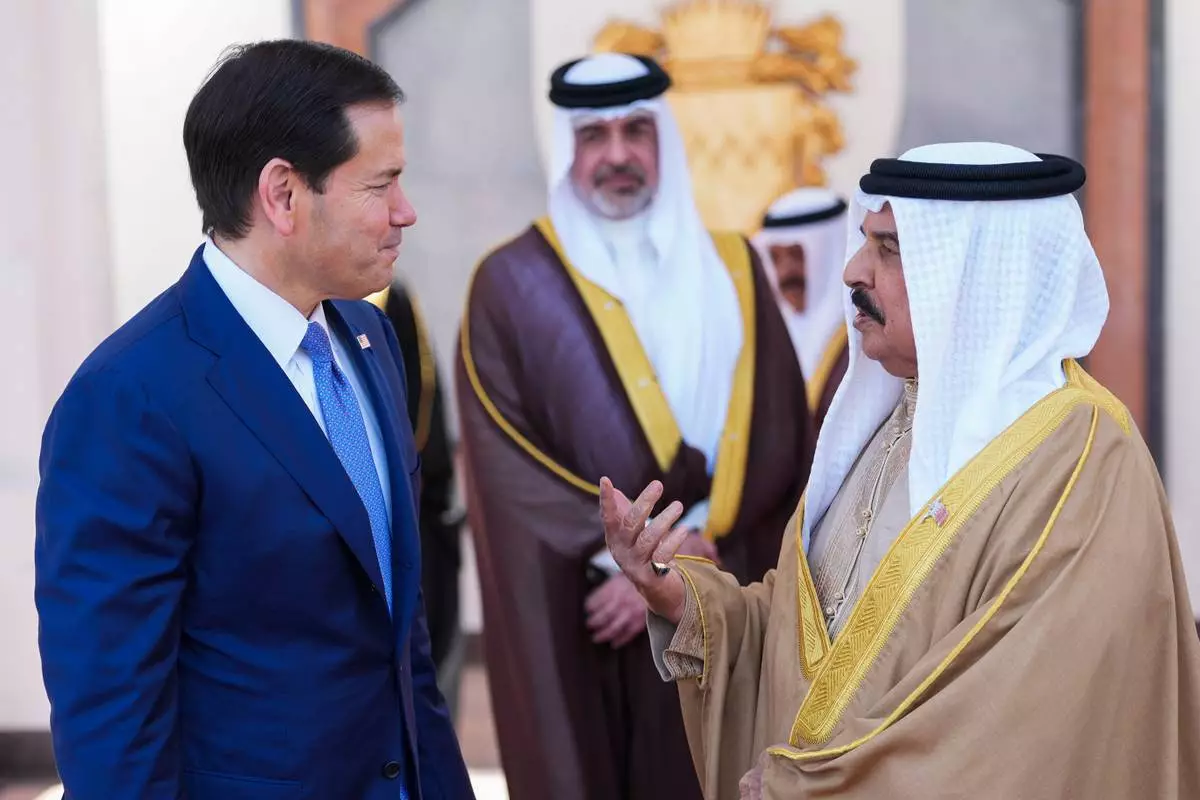
U.S. Secretary of State Marco Rubio, left, and Bahrain's King Hamad bin Isa Al Khalifa share a word after their meeting, at Al-Sakhir Palace near Zallaq, Bahrain Thursday, June 25, 2026. (Eric Lee/Pool Photo via AP)