CAPE CANAVERAL, Fla. (AP) — NASA is racing to save an aging telescope from falling back to Earth with a daring rescue mission.
The $30 million salvage operation gets underway as soon as this week with the planned launch of a robotic lifesaver.
NASA hired startup Katalyst Space Technologies to boost the Swift Observatory to a higher orbit where it can continue hunting for some of the universe’s biggest explosions. A three-armed spacecraft built by Katalyst will chase after Swift once it takes off from an atoll in the Pacific's Marshall Islands aboard an airplane-launched Pegasus rocket. Liftoff could occur as early as Tuesday.
Scanning the cosmos since its launch in 2004, Swift has been sinking faster and faster because of recent intense solar activity. It needs to get to a higher, more stable orbit as soon as possible to survive.
NASA's Hubble Space Telescope — also at risk — could be next.
Like Swift, Hubble is losing altitude as the sun erupts with one flare after another. Katalyst Space CEO Ghonhee Lee said his company's next-generation robot, still in development, could save the day for the much bigger Hubble in a couple years.
Only China has attempted a mission like the upcoming one, successfully boosting a satellite into a higher graveyard orbit four years ago.
“This is the first American space robot to go up and do anything like this,” Lee told The Associated Press. “NASA has all these big senior observatories … all of them can benefit from a service like this. So what we're proving with this mission is this is a new play in the playbook that's available.”
It will take Katalyst's autonomous spacecraft, named Link, about a month to rendezvous with Swift and catch it, and another couple months to raise its orbit from the current 224 miles (360 kilometers) to the desired 373 miles (600 kilometers).
The 1.6-ton (1.4-metric ton) gamma ray observatory must be above 185 miles (300 kilometers) for the rescue to work. It's expected to reach that point of no return in October, according to the latest estimates.
Roughly the size of a small kitchen refrigerator with a 40-foot (12-meter) solar wingspan, Link sports three arms with a reach of just over 3 feet (1 meter). Each arm has two finger-like pinching grippers that resemble the hands of a Lego mini figure.
If all goes well, Swift could be back in business by September, according to Lee.
Worth hundreds of millions of dollars, Swift was never designed to be repaired, let alone retrieved by hands — human or otherwise. That's what makes this so challenging, according to company officials, who stress there is no guarantee it will work.
NASA signed a contract with Katalyst last September with only two requests: It has to be a rush job, but please don't make things worse. Nine months later, the company is ready to rumble.
“I have to be honest. No one thought it was going to be possible. No one thought we would get as far as we’ve already gotten today,” said Shawn Domagal-Goldman, NASA's astrophysics director.
NASA has bought a little more time for Swift, turning off all scientific instruments to slow its descent. Observations ceased in February.
NASA's science mission chief Nicky Fox said it's worth the effort.
“If we let Swift reenter, we would lose that telescope. We would lose a lot of capability,” she said. “We don’t currently have the budget to build another one to replace that.”
While everything cannot be saved in space, Swift is special, said Domagal-Goldman.
True to its name, Swift is designed to pivot quickly to capture late-breaking astronomical events such as gamma ray bursts and exploding stars. With more discoveries expected by the Webb Space Telescope and soon-to-launch Roman Space Telescope, Swift, if saved, would be busier than ever as “NASA's first responder.”
Katalyst sees Swift as the jumping-off point for a new repair business in space. The company's next-generation robotic rescuer, scheduled to fly next year, will tackle satellites as high as 22,300 miles (35,800 kilometers) up. Lee envisions hundreds of robots in orbit one day, not only fixing and hoisting satellites but also refueling them and building solar farms, data centers and other platforms.
Thirty-six-year-old Hubble, which received repeat servicing by spacewalking astronauts during the shuttle era, could follow in 2028 with a life-extending Katalyst boost.
“It's a national treasure,” Fox said. “People love Hubble.”
This story corrects spacecraft name to Link.
The Associated Press Health and Science Department receives support from the Howard Hughes Medical Institute’s Department of Science Education and the Robert Wood Johnson Foundation. The AP is solely responsible for all content.

This photo provided by NASA shows Kieran Wilson, LINK’s principal investigator, and Hunter Robertson, a space systems engineer, both at Katalyst Space, standing next to their spacecraft inside the SES (Space Environment Simulator) at NASA’s Goddard Space Flight Center in Greenbelt, Md., April 17, 2026, ahead of thermal vacuum testing. (Sophia Roberts/NASA via AP)
DUBAI, United Arab Emirates (AP) — Iran launched drone and missile attacks Sunday targeting Bahrain and Kuwait in response to U.S. airstrikes that hit the Islamic Republic, and threatened a “complete halt” in negotiations to end the war if Washington continues its attacks.
Efforts to reopen the Strait of Hormuz without Iran's direct oversight sparked the crossfire now gripping the region and have imperiled negotiations for a lasting ceasefire. A multinational maritime body overseen by the U.S. Navy said Saturday that it would expand a route near Oman for both inbound and outbound traffic, setting up a new flashpoint with Tehran.
The global community has long considered the strait an international passageway, despite its sitting in Iran and Oman's territorial waters. In recent days, Iran has twice attacked vessels going through a route on the Omani side of the strait backed by a United Nations agency.
Iran insists that it alone must govern the strait, the narrow mouth of the Persian Gulf that once carried a fifth of the world’s oil and natural gas. Iranian Foreign Minister Abbas Araghchi reiterated the claim during a state visit to Iraq on Sunday.
“Any interference in this matter, any attempt to establish new or separate arrangements from those currently being carried out by the Islamic Republic of Iran, will only lead to further complications, delay the reopening of the Strait of Hormuz, and increase the level of tension, just as over the past two nights we witnessed incidents in the Strait of Hormuz that led to an increase in tension and confrontation,” he said in Baghdad.
The United States and Iran are still debating the terms of an interim peace deal, including shipping arrangements through the strait, removing a U.S. blockade and sanctions and addressing the future of Iran’s stockpile of highly enriched uranium. Under the memorandum of understanding signed earlier this month, the U.S. and Iran have 60 days to iron out the details.
The strikes threaten to torpedo the deal before it can be finalized. Continued fighting in Lebanon, where an Israeli soldier was killed by Hezbollah fire early Sunday, has also threatened the agreement.
The Kuwaiti military said air defenses intercepted incoming Iranian drones and missiles Sunday morning, just after the U.S. strikes.
Kuwait, which hosts a major U.S. Army base, said it had detected and intercepted two ballistic missiles and there were no reports of injuries or damage.
Bahrain's Interior Ministry said the Iranian strikes damaged a residential building near the international airport and no one was killed. The ministry released photos of an 8-story building, with the top floor destroyed, filled with rubble and its windows blown out.
Bahrain is home to the U.S. Navy’s 5th Fleet, whose base there came under repeated attack during the war. The damaged building on Sunday was not near the fleet's headquarters, in downtown Manama.
Bahrain’s Foreign Ministry denounced what it called “a dangerous escalation that reveals that what Tehran is doing is not a passing act, nor an isolated incident, but rather a deliberate approach and a systematic pattern of repeated aggression."
Iran's paramilitary Revolutionary Guard claimed responsibility for both attacks.
The latest U.S. strikes came after the U.S. and Iran traded attacks earlier in the weekend.
The U.S. military’s Central Command said it struck Iranian military “surveillance infrastructure, communication systems, air defense sites, drone storage facilities and minelayer capabilities” on Sunday, following an attack on a ship at sea early Saturday morning. That ship, the Panamanian-flagged tanker Kiku, carried crude oil for the state-run energy company of Qatar, a key mediator between Iran and the U.S.
In a social media post, Trump said the U.S. had “struck Iranian missile and drone storage locations, and coastal radar sites, for violating the Cease Fire Agreement, AGAIN!” He warned of a point where the U.S. may no longer be able to be reasonable “and will be forced to militarily complete the job.”
“If that happens, the Islamic Republic of Iran will no longer exist!” Trump wrote on Truth Social.
The incident follows a similar back-and-forth that occurred just days prior, when an Iranian drone struck a merchant vessel off the coast of Oman on Thursday, and the U.S. military retaliated with strikes.
Iran has consistently said the ceasefire must include a halt to fighting in Lebanon, where Israel has been battling the Iranian-backed Hezbollah militant group. Days after the U.S. and Israel launched the war against Iran in February, Hezbollah began firing at Israel in solidarity with its Iranian allies. Israel responded with an invasion that has occupied large swaths of southern Lebanon and displaced hundreds of thousands of people. Israel has said it will not withdraw its troops until Hezbollah is disarmed.
Last week, Israel and the Lebanese government signed a framework agreement to end the conflict. But their deal did not include Hezbollah or Iran. Hezbollah has criticized the deal and rejected calls to disarm.
On Sunday, Araghchi again said during a visit to Iraq that the U.S. must force Israel to halt attacks and withdraw. Israel occupies around 600 square kilometers (231 square miles) in southern Lebanon, which it says it needs as a security buffer to halt attacks from Hezbollah.
But sporadic clashes have continued between Israel and Hezbollah.
The leader of the Iran-backed group said Saturday that Hezbollah would continue fighting until Israel withdraws from Lebanon, adding that the group considers the Israeli-Lebanese agreement signed on Friday to be “nonexistent.”
The frequency of Israeli strikes in Lebanon has decreased significantly since the Iran-U.S. deal was signed in mid-June, but strikes have continued, killing at least one person Saturday, according to the Lebanese Health Ministry. Two separate Israeli strikes hit southern Lebanon on Sunday morning — one in the town of Taybeh and another in the Nabatiyeh area, according to Lebanon’s National News Agency. There was no immediate word on casualties.
Overnight, Hezbollah militants killed an Israeli soldier in the village of Deir Siryan in southern Lebanon, according to the Israeli military. Hezbollah did not comment on the incident.
__
Lidman reported from Tel Aviv, Israel. Associated Press writer Sally Abou AlJoud in Beirut contributed to this report.
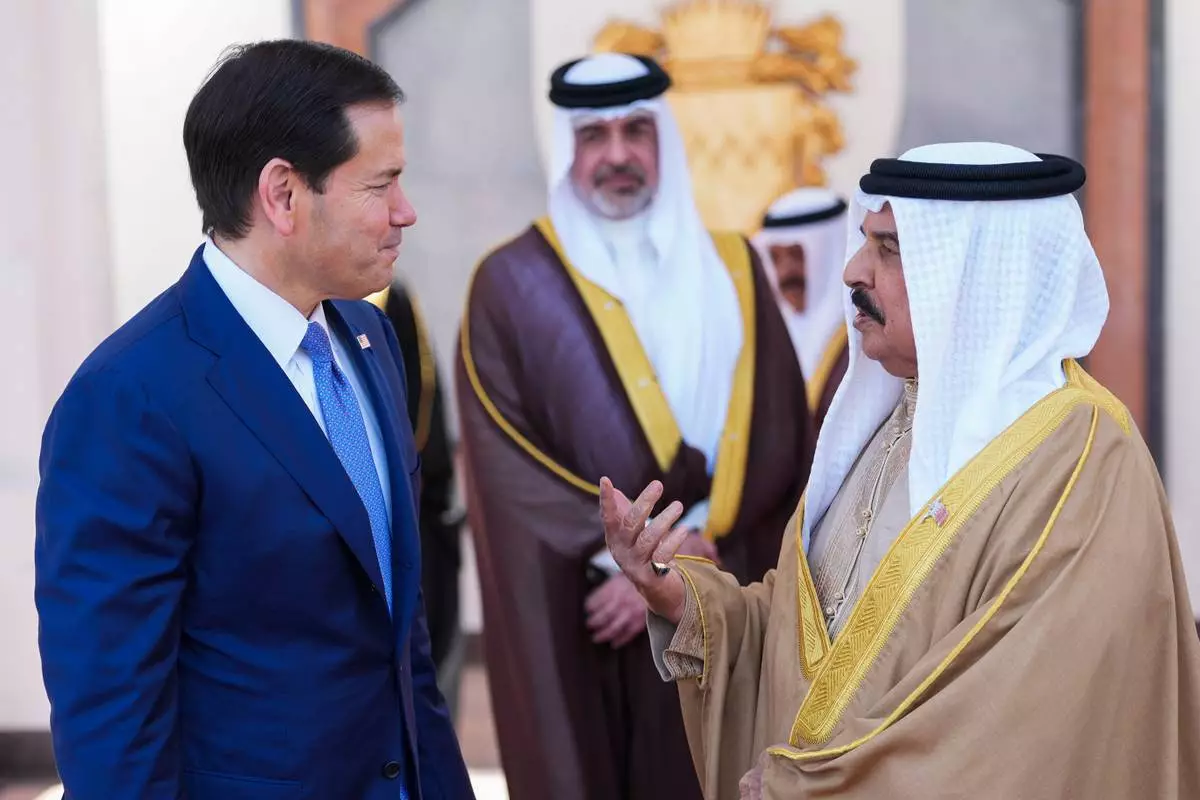
U.S. Secretary of State Marco Rubio, left, and Bahrain's King Hamad bin Isa Al Khalifa share a word after their meeting, at Al-Sakhir Palace near Zallaq, Bahrain Thursday, June 25, 2026. (Eric Lee/Pool Photo via AP)