TEL AVIV, Israel (AP) — Israel’s Cabinet unanimously approved a proposal on Sunday to designate violence against Armenians by the Ottoman Empire during World War I as a genocide.
The step, which still needs approval in Parliament, reflects deteriorating ties between Israel and Turkey. Turkey has fiercely lobbied to prevent countries from officially recognizing the mass deaths of Armenians around 1915 as a genocide, even as Armenians have pushed for it.
Historians estimate that up to 1.5 million Armenians were killed by Ottoman Turks around the time of World War I, an event widely viewed by scholars as the first genocide of the 20th century. Turkey denies that the deaths constituted genocide, saying the toll has been inflated and that those killed were victims of civil war and unrest.
For years, Israel did not officially broach the subject for fear of angering Turkey, but that relationship has soured over the past two decades, especially in recent years as the wars in Gaza, Lebanon and Iran have dragged on.
“Despite the extensive and unambiguous historical documentation, the Armenian Genocide remains to this day the subject of an institutionalized campaign of denial and minimization, including a manipulative rewriting of history, mainly by the Turkish government,” said Israeli Foreign Minister Gideon Saar, who brought the decision to the government.
He noted that Israeli leaders, including Prime Minister Benjamin Netanyahu, have previously described the violence against Armenians as a genocide. But it has never been formally recognized in a vote by Israel’s Knesset.
“It is never too late to do the right thing,” Saar said Sunday, calling it a “moral and historical duty.”
He noted that 32 countries, including the United States, Syria and Lebanon, have also classified the violence as a genocide. It was not immediately known when Sunday's decision, approved unanimously by Israel's Cabinet, would go to the parliament for approval. There was no immediate reaction from Turkey.
Israel and Turkey were once close allies, but relations soured during the rise of Turkey’s Islamist President Recep Tayyip Erdogan, leading Israel to reconsider its position.
Israel has faced repeated accusations, including from the United Nations and Turkey, that its offensive in Gaza amounts to genocide. Israel, founded in the wake of the Holocaust, denies the accusations.
Israel launched the war in response to Hamas' Oct. 7, 2023, attack. Gaza's Health Ministry, part of the Hamas government, says over 73,000 people have been killed, roughly half of them women and children. Israel says it does not target civilians and accuses Hamas of using civilians as human shields.
Last week, a team of independent experts commissioned by the United Nations accused Israel of deliberately shooting children in Gaza and repeated accusations that Israel has carried out a genocide. Israel called the report a “libelous sham.”
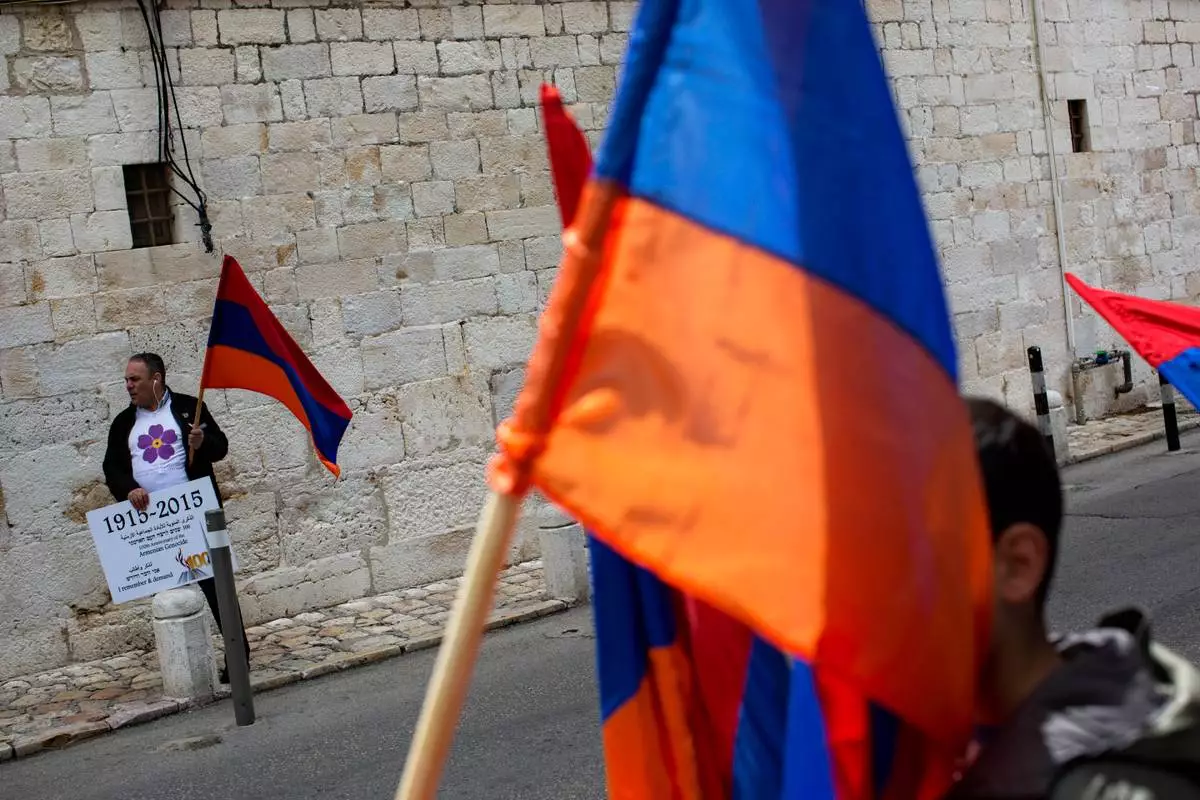
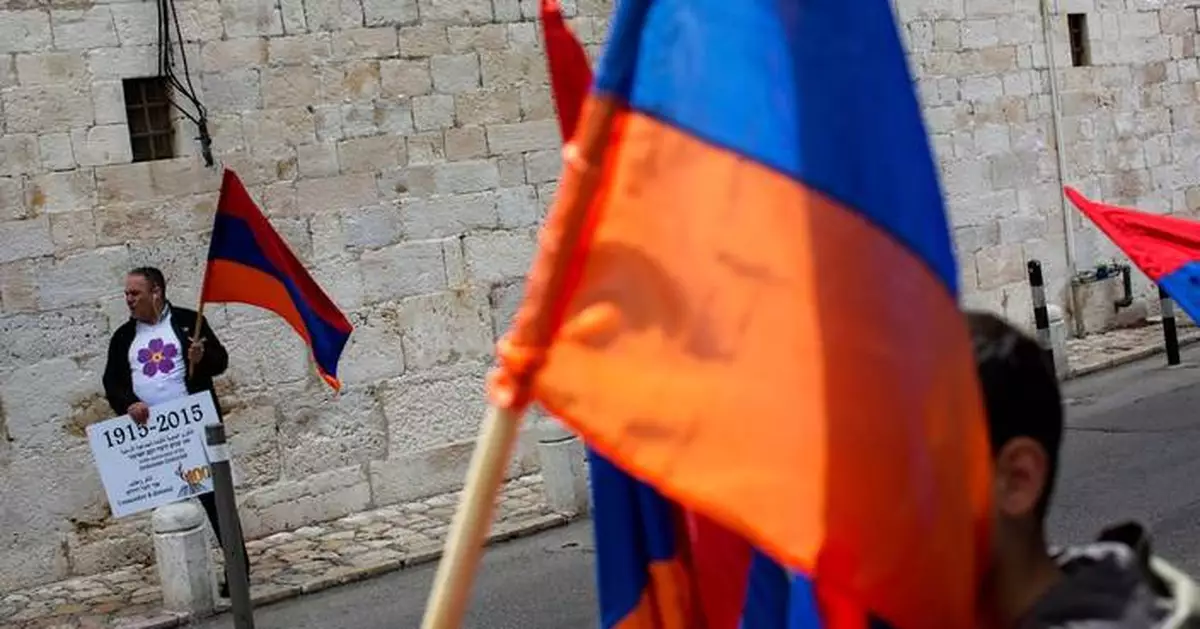
FILE - Armenians hold their national flag during a ceremony to commemorate the mass killings of Armenians by the Ottoman Empire, in Jerusalem, Israel, Friday, April 24, 2015. (AP Photo/Oded Balilty, File)
KYIV, Ukraine (AP) — Ukraine kept up its heavy drone assault on Russia, setting fire to a major oil refinery in the south and killing at least two people, Russian authorities said Sunday.
Ukraine has markedly stepped up its long-range attacks on Russian military industries and energy facilities in recent months, aiming to cut Moscow’s revenue for its invasion — now in its fifth year — and make Russians feel the consequences.
The campaign has choked Russian fuel supplies and military deliveries. According to Western analysts, it has also slowed Moscow’s efforts on the battlefield, heaping pressure on the Kremlin to come to the negotiating table.
“Our ‘long-range sanctions’ reached two oil refineries in Russia,” Ukrainian President Volodymyr Zelenskyy wrote on the Telegram messaging app on Sunday. “Each (strike) means a reduction in the resources that fuel the Russian war machine, and another step toward peace.”
Debris from downed Ukrainian drones sparked a blaze at the refinery in Slavyansk-na-Kubani, a town in Russia's Krasnodar region, east of occupied Crimea, according to Gov. Veniamin Kondratyev. The falling debris killed one person in Slavyansk and wounded another in a nearby village, according to regional authorities.
The Slavyansk site is one of southern Russia’s major refineries, processing close to 4 million tons of crude per year, according to its operator’s website. It is also a key source of petroleum products intended for export through Russia’s Black Sea ports, including fuel oil, naphtha and marine fuel.
Photos and videos circulating on Russian social media showed a thick cloud of smoke over what users said was the Slavyansk facility. The Associated Press was not immediately able to verify the images.
Zelenskyy also claimed that a second Russian refinery, in the Yaroslavl region around 700 kilometers (435 miles) from the Ukrainian border, was hit during the nighttime strikes.
There were no immediate reports from Russian authorities about the strike on the Yaroslavl refinery. Local Gov. Mikhail Evraev reported on Sunday morning that some roads between Moscow and the region's capital, Yaroslavl, were temporarily closed due to “an enemy attack by Ukrainian drones”.
Yaroslavl's airport also briefly closed overnight, along with others in southern and western Russia, according to the country's civil aviation agency.
For months, Ukraine has been stepping up attacks on energy facilities deep inside Russia, arguing the sector both funds and directly fuels the Kremlin's invasion. Despite a raft of Western sanctions, Moscow remains among the world's top exporters of oil and natural gas.
More recently, Ukraine has attempted to choke off fuel deliveries to Crimea, the Black Sea peninsula Moscow illegally annexed from it in early 2014. Last weekend, Kremlin-installed officials in Crimea suspended gasoline sales to civilians, after Kyiv's targeting of supply routes triggered the worst energy crisis there since the annexation.
Russian Deputy Prime Minister Alexander Novak said Sunday that Moscow was actively reviewing agreements to export fuel to avoid compromising domestic needs.
“There is no ban on intergovernmental agreements at the moment. In each instance, we work with the partners with whom these agreements have been concluded to assess the current situation and requirements,” Novak told reporters.
Civilian fuel sales were also being restricted in Russia’s Irkutsk region in Siberia, thousands of kilometers (miles) from the Ukrainian border, local Gov. Igor Kobzev announced on Sunday.
Drivers will be barred from buying more than 50 liters (13 gallons) of fuel per vehicle per day at state-run Rosneft gas stations in the province, Kobzev said, adding that other gas stations may set lower limits.
At least two private gas station networks in Siberia — KreisNeft in the Irkutsk region and Elke Auto in the Tomsk region farther west — said earlier this month that they were limiting sales due to supply disruptions.
Elsewhere, Ukrainian drone strikes killed one person and injured another in Russia’s border region of Belgorod, its acting Gov. Alexander Shuvayev reported on Sunday.
Russia’s Defense Ministry said its forces shot down 213 Ukrainian drones during the night, including over Russia, occupied Crimea and the Black and Azov seas.
Meanwhile, Russia attacked Ukraine with 142 long-range strike drones and eight missiles overnight, according to the Ukrainian air force. Of those, 125 drones and seven missiles were struck down, the air force said.
Follow the AP’s coverage of the war in Ukraine at https://apnews.com/hub/russia-ukraine
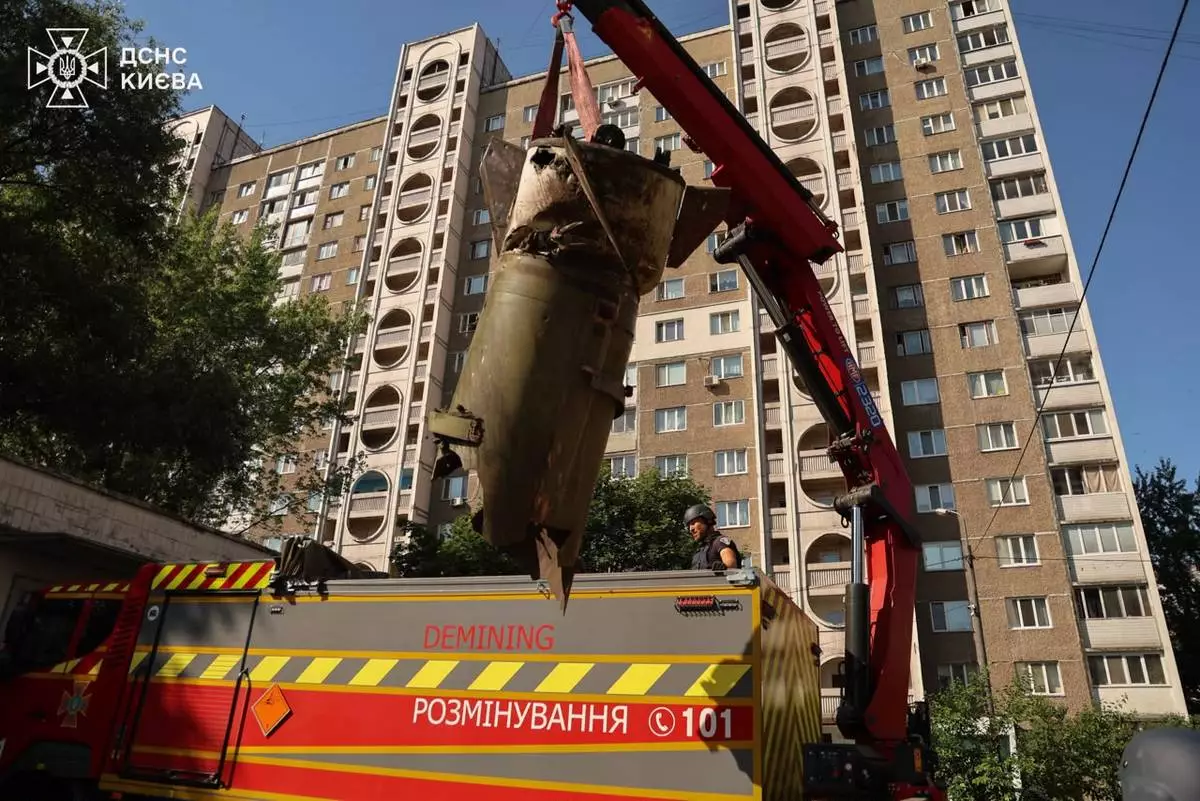
In this photo provided by the Ukrainian Emergency Service, sappers remove a fragment of the Russian missile in a residential neighbourhood following an air attack in Kyiv, Ukraine, Sunday, June 28, 2026. (Ukrainian Emergency Service via AP)
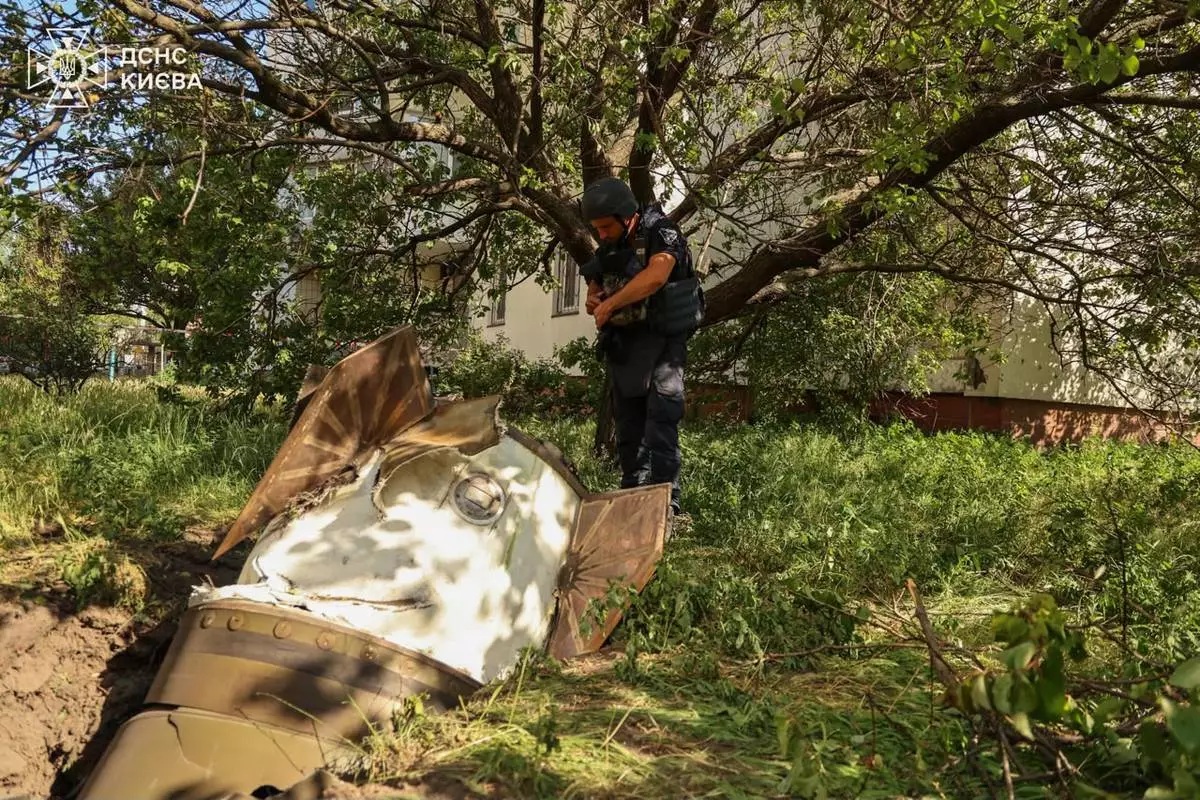
In this photo provided by the Ukrainian Emergency Service, a sapper examines a fragment of the Russian missile in a residential neighbourhood following an air attack in Kyiv, Ukraine, Sunday, June 28, 2026. (Ukrainian Emergency Service via AP)