Skip to Content Facebook Feature Image

Output at China's difficult-to-recover heavy oilfield surpasses 10 mln tonnes

China

China

China

Output at China's difficult-to-recover heavy oilfield surpasses 10 mln tonnes

2026-06-29 14:42 Last Updated At:15:43

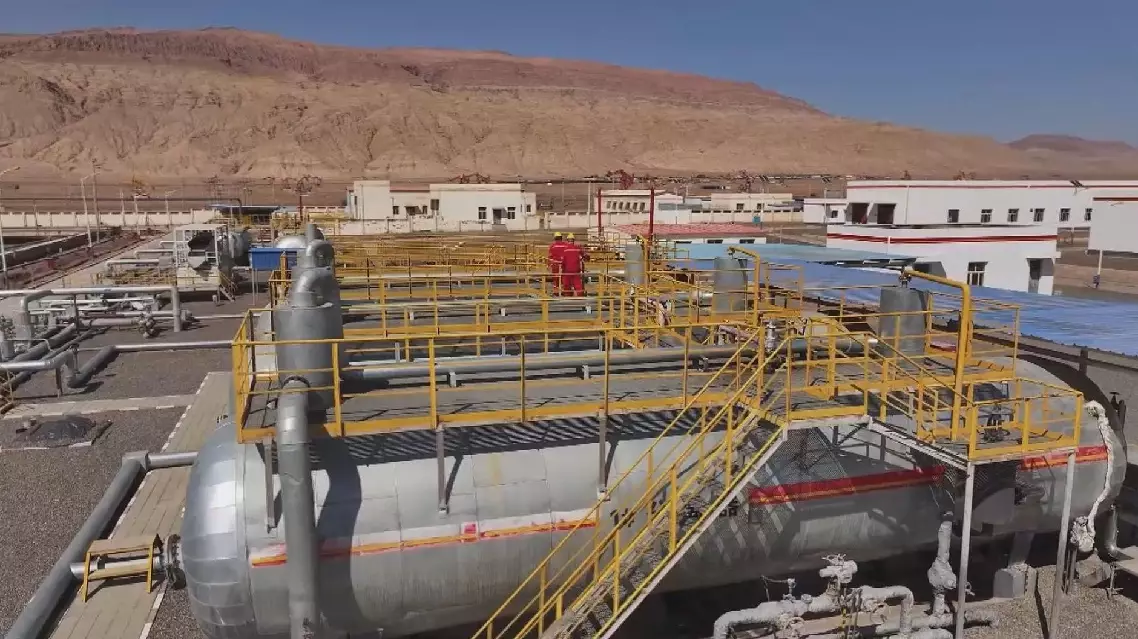
Technological breakthroughs in recovering ultra-deep extra-heavy oil had enhanced output at northwest China's Lukeqin Oilfield to over 10 million tonnes, said China National Petroleum Corporation (CNPC) on Monday.

Ultra-deep extra-heavy oil is an extremely hard-to-recover petroleum resource buried thousands of meters underground.

It's more than 100 times thicker than regular crude oil and is like black sludge, barely flowing at all at normal temperatures.

Located in the hinterland of the Turpan Basin, Xinjiang Uygur Autonomous Region, the heavy oil reservoirs of the Lukeqin Oilfield are generally buried deeper than 2,300 meters, with the maximum depth reaching 5,200 meters.

"Crude oil at the Lukeqin Oilfield features high density, high viscosity and high pour point, which constitute a world-class challenge for oil and gas development," said Wang Sheng, staff member at the reservoir geology research department of Lukeqin oil production management area.

According to oil production experts, as it is impossible to recover heavy oil reservoirs at Lukeqin Oilfield by traditional methods, they had innovated their crude oil development technologies to enhance the output.

"We innovate our technologies by injecting thin oil into the wellbore, enabling the heavy oil, which is too viscous to flow or be lifted, to be steadily pumped to the surface from 3,000 meters underground. The oil recovery factor of the oilfield has risen by 11 percentage points compared with the initial stage of development," said Zou Chenglin, executive director at the Lukeqin oil production management area.

The technological breakthrough helped enhance the annual output of Lukeqin Oilfield from 30,000 tonnes to a peak of 800,000 tonnes.

The annual output at the oilfield has remained at over 400,000 tonnes for 10 consecutive years.
Output at China's difficult-to-recover heavy oilfield surpasses 10 mln tonnes


Output at China's difficult-to-recover heavy oilfield surpasses 10 mln tonnes
Outdoor film screenings are drawing large crowds to some of Beijing’s most significant historic and industrial landmarks this summer, bringing audiences to centuries-old architecture and a repurposed industrial park.

The New Zealand film "1978" had its global premiere Saturday night at the foot of a cooling tower beside Big Air Shougang during the 10th China-New Zealand Film Carnival, running Friday through Monday.

The screening took place in Shougang Park, a former steel mill transformed into a cultural and sports hub that served as a venue for the 2022 Beijing Winter Olympics. The site's industrial relics, including massive blast furnaces and cooling towers, now provide a backdrop for events blending heritage with modern entertainment.

Meanwhile, crowds gather every weekend for nighttime screenings at the Bell and Drum Towers, which sit at the northern end of Beijing's Central Axis. The 13th-century structures served as the official timekeepers for the Yuan, Ming and Qing dynasties and are part of the site added to the UNESCO World Heritage List in 2024.

"I think combining historical architecture with film is a brilliant idea. It blends cultural elements with artistic inspiration, giving a sense of blending history and modernity," said Zhao Qian, an audience member at a screening.

The weekend screenings at the Bell and Drum Towers, ongoing for several months now, will continue through the National Day holiday in October with diverse offerings, including animated family films and Chinese-style films.

"The screenings encourage visitors to appreciate the beauty of the ancient architecture, particularly the Bell and Drum Towers, breathing new life into old buildings through film and other art forms," said Yuan Jian, deputy general manager of the Creative Integration Department of the Fanghu Zhaowen (Beijing) Culture Technology Company.

Open-air screenings turn Beijing's historic, industrial sites into summer cinemas

Open-air screenings turn Beijing's historic, industrial sites into summer cinemas

Recommended Articles