GENEVA (AP) — Chelsea evaded more serious UEFA sanctions Tuesday for overspending, while its sister club Strasbourg got the heaviest fine of 13 million euros ($14.8 million) among 14 clubs that broke financial monitoring rules.
Aston Villa was ordered to pay 7.5 million euros ($8.6 million), which was about one-third less than its UEFA financial sanction last year.
One year ago, Chelsea was fined 31 million euros ($35.5 million) and was set stricter financial targets, which the club just missed by spending more than 70% of its revenue on wages and transfers in 2025, UEFA said.
Chelsea was fined just 1 million euros ($1.14 million) Tuesday, with a further 2 million euros deferred, after a season in which it won the Club World Cup and got almost $115 million from FIFA.
UEFA deferred a conditional fine for Villa, twice that of the sum paid, in order to meet targets next year when the new Europa League title holder will play in the Champions League.
UEFA praised Chelsea and Villa for making financial progress while urging both clubs toward “continuing to significantly decrease their squad cost ratio in 2026.”
Chelsea, however, should see a big revenue drop because the team will not play in the Champions League or any European competition next season after a 10th-place finish in the Premier League.
Chelsea did earn about $90 million in June in compensation from Manchester City for hiring its former coach Enzo Maresca and the sale of Spain defender Marc Cucurella to Real Madrid.
Strasbourg, which is owned by Chelsea’s holding company BlueCo, also has a deferred fine of 12 million euros ($13.7 million). The French club also was told by UEFA to “significantly decrease” players costs for 2026, when it will not play in European competitions.
Strasbourg likely earned about 15 million euros ($17.1 million) from UEFA for reaching the Conference League semifinals this season captained by Emmanuel Emegha, who is now joining Chelsea.
Other fines ordered Tuesday include 7 million euros ($8 million) for Fenerbahce, and 6 million euros ($6.85 million) for each of Newcastle, Juventus and Fiorentina. Nottingham Forest was ordered to pay 2.5 million euros ($2.85 million)
Juventus and Newcastle both missed break-even targets across the three previous years under the “football earnings rule,” UEFA said, and both agreed a three-year settlement deal to meet financial targets.
Both played in the lucrative Champions League this season but failed to qualify for the next edition. Juventus, which placed sixth in Serie A, will play in the second-tier Europa League and Newcastle did not qualify for any European competition.
UEFA agreed a system in 2009 — then known as “Financial Fair Play” — in the wake of the global financial downturn to monitor income and spending by clubs which qualify for European competitions.
Supporters of the project say it has helped stabilize spending on transfer and wages within club's means.
Critics say it protected storied clubs with an established global fan base, and limits ambitious and emerging clubs with wealthy owners from spending heavily to make progress.
The heaviest fines in the first round of monitoring in 2014 were paid by Abu Dhabi-backed Man City and Qatar-owned Paris Saint-Germain. Both clubs won their first Champions League titles in, respectively, 2023 and 2025.
AP soccer: https://apnews.com/hub/soccer

FILE - Aston Villa's John McGinn prepares to lift the trophy after the Europa League final soccer match between Freiburg and Aston Villa in Istanbul, Turkey, May 20, 2026. (AP Photo/Francisco Seco, File)

FILE - Chelsea team members, accompanied by President Donald Trump, celebrate with the championship trophy after the Club World Cup final soccer match between Chelsea and PSG in East Rutherford, N.J., July 13, 2025. (AP Photo/Jacquelyn Martin, File)
WASHINGTON (AP) — The Supreme Court on Tuesday erased limits on how much political parties can spend in coordination with candidates for Congress and president, striking down a federal election law that is more than 50 years old.
Prodded by a Republican-led lawsuit that includes Vice President JD Vance, the court's six conservative justices were again in the majority of the latest decision that upended congressionally enacted limits on raising and spending money to influence elections. The court’s 2010 Citizens United decision opened the door to unlimited independent spending in federal elections.
The limits on party spending stem from a desire to prevent large donors from skirting caps on individual contributions to a candidate by directing unlimited sums to the party, with the understanding that the money will be spent on behalf of the candidate.
The Supreme Court had previously upheld the limits, in 2001.
But Justice Brett Kavanaugh, writing for the court, said that decision was wrong and should be overruled. “In short, constitutional text, history and precedent establish that the political-party coordinated-expenditure limits violate the First Amendment,” Kavanaugh wrote.
Justice Elena Kagan's dissent for the three liberal justices said the court “ushers in untold harm” by enabling parties to funnel large contributions to individual candidates, far in excess of what donors can give those candidates directly.
National parties now will be able to make direct contributions to candidates’ campaigns,
The decision is likely to give Republicans at least a short-term boost because they maintain a sizable cash advantage over Democrats.
The Republican National Committee and its Senate and House campaign fundraising arms have dwarfed Democrats’ in the months before congressional elections where the GOP is defending narrow majorities in both houses.
At the end of May, the RNC reported having more than $125 million to spend, its highest-ever cash on hand total, according to its most recent Federal Election Commission filing in May. Meanwhile, the National Republican Senatorial Committee had more than $48 million on hand in its most recent report and the National Republican Congressional Committee had more than $81 million.
In the same period, the Democratic National Committee had $14.4 million on hand, while the Democratic Senatorial Campaign Committee had roughly $37 million and the Democratic Congressional Campaign Committee, roughly $73 million.
The Republican committees for House and Senate candidates filed the lawsuit in Ohio in 2022, joined by Vance, then a senator from Ohio, and then-Rep. Steve Chabot.
After President Donald Trump took office for his second term, the Federal Election Commission dropped its defense of the law and joined with Republicans in urging that it be overturned.
Democrats had called on the court to uphold the law, even though there is wide agreement that the spending limits have hurt political parties in an era of unlimited spending by other organizations.
Last year, the coordinated party spending for Senate races ranged from $127,200 in several states with small populations to nearly $4 million in California, the most populous state. For House races, the limits were $127,200 in states with only one representative and $63,600 everywhere else.
Entrenched divisions between liberal and conservative justices over campaign finance restrictions were on display when the court heard arguments in December.
“Every time we interfere with the congressional design, we make matters worse,” said Justice Sonia Sotomayor, a dissenter in Citizens United and the court’s other campaign money cases.
By contrast, Justice Samuel Alito, a member of the Citizens United majority, described the decision as “much maligned, I think unfairly maligned.” The effect of the decision was to ”level the playing field,” Alito said, by expanding the right to spend freely that had previously belonged only to media companies.
Associated Press writer Thomas Beaumont contributed to this report.
Follow the AP's coverage of the U.S. Supreme Court at https://apnews.com/hub/us-supreme-court.
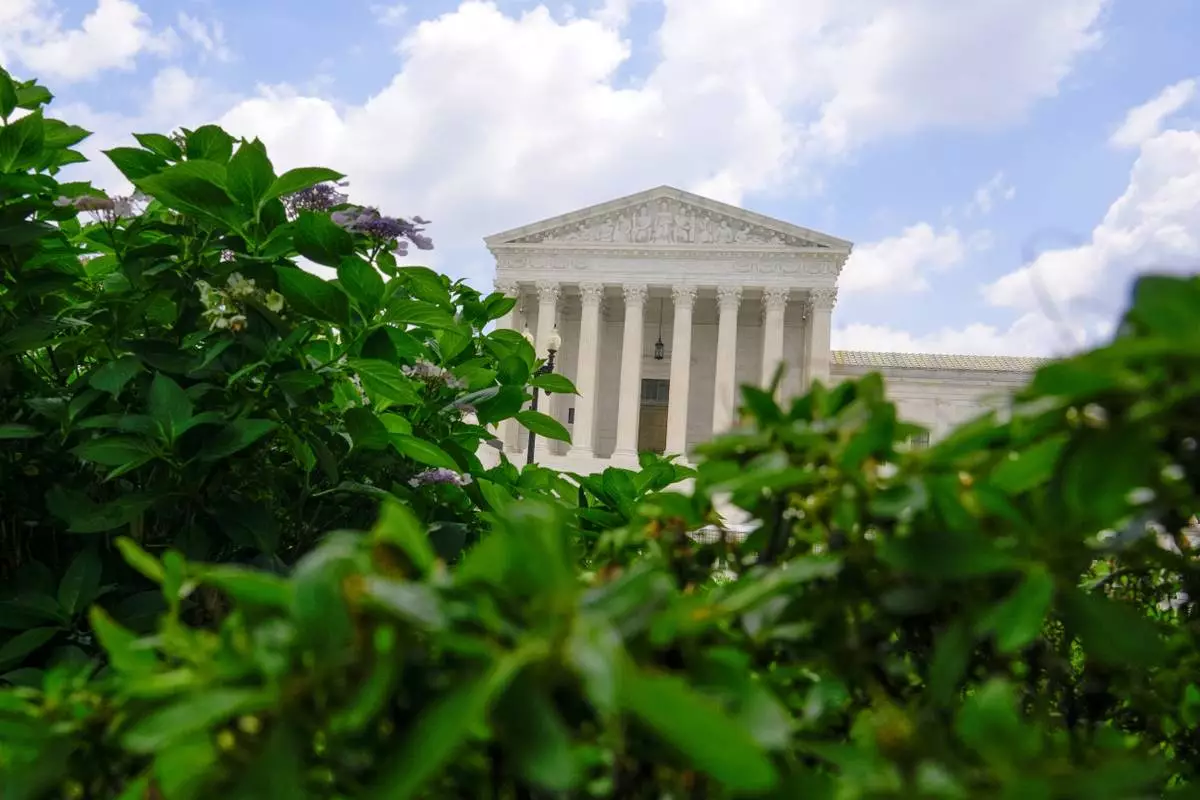
The U.S. Supreme Court is seen Monday, June 29, 2026, in Washington. (AP Photo/Mariam Zuhaib)