In the evening, Canton Tower illuminated a congratulatory display celebrating Lingnan’s achievement of retaining the world’s No. 1 position in SDG 4: Quality Education in the Times Higher Education (THE) Sustainability Impact Ratings 2026, screening the achievements of Hong Kong’s higher education sector to communities across the Greater Bay Area.

Lingnan University organises a seminar titled “The Present and Future of Liberal Arts Education through the Lens of Lingnan History” at Yuanzhi Business School in Guangzhou. From left: Ms Zhu Ke, Head and Chief Correspondent (Hong Kong SAR) of the Communication Centre of Guangdong Radio and Television Station; Prof S. Joe Qin, President and Wai Kee Kau Chair Professor of Data Science; Prof Xu Zidong, Senior Lingnan Scholar of the Lingnan University Institute for Advanced Study; Prof Lau Chi-pang, Special Advisor to the President on Publicity cum Director of Communications and Public Affairs of Lingnan University.
The event was attended by Mr Patrick Chong Kong-sang, Deputy Director of the Hong Kong Economic and Trade Office in Guangdong of the HKSAR Government, who took part in the exchange session. The seminar featured Prof S. Joe Qin, President and Wai Kee Kau Chair Professor of Data Science of Lingnan University; Prof Lau Chi-pang, Special Advisor to the President on Publicity cum Director of Communications and Public Affairs of Lingnan University, and Chairman of the Legislative Council Panel on Education; Prof Xu Zidong, Senior Lingnan Scholar of the Lingnan University Institute for Advanced Study; and Ms Zhu Ke, Head and Chief Correspondent (Hong Kong SAR) of the Communication Centre of Guangdong Radio and Television Station. Drawing on perspectives from history, culture, and educational development, the speakers discussed how liberal arts education could meet the talent development needs of the digital era.
Click to Gallery
Lingnan University organises a seminar titled “The Present and Future of Liberal Arts Education through the Lens of Lingnan History” at Yuanzhi Business School in Guangzhou. From left: Ms Zhu Ke, Head and Chief Correspondent (Hong Kong SAR) of the Communication Centre of Guangdong Radio and Television Station; Prof S. Joe Qin, President and Wai Kee Kau Chair Professor of Data Science; Prof Xu Zidong, Senior Lingnan Scholar of the Lingnan University Institute for Advanced Study; Prof Lau Chi-pang, Special Advisor to the President on Publicity cum Director of Communications and Public Affairs of Lingnan University.
Canton Tower illuminates a congratulatory display celebrating Lingnan retaining the No. 1 position globally in SDG 4: Quality Education in the THE Sustainability Impact Ratings 2026, and screening the achievements of Hong Kong’s higher education sector to communities across the Greater Bay Area.
Canton Tower illuminates a congratulatory display celebrating Lingnan retaining the No. 1 position globally in SDG 4: Quality Education in the THE Sustainability Impact Ratings 2026, and screening the achievements of Hong Kong’s higher education sector to communities across the Greater Bay Area.
From left: Prof Qiu Xueqing, President of Guangdong University of Technology; Prof S. Joe Qin, President and Wai Kee Kau Chair Professor of Data Science at Lingnan University; Prof Wang Hengyin, Secretary of the CPC Committee of South China Normal University; Prof Zhang Hong, Vice President of Jinan University.
From left: Prof Qiu Xueqing, President of Guangdong University of Technology; Prof S. Joe Qin, President and Wai Kee Kau Chair Professor of Data Science at Lingnan University; Prof Wang Hengyin, Secretary of the CPC Committee of South China Normal University; Prof Zhang Hong, Vice President of Jinan University.
Canton Tower illuminates a congratulatory display celebrating Lingnan retaining the No. 1 position globally in SDG 4: Quality Education in the THE Sustainability Impact Ratings 2026, and screening the achievements of Hong Kong’s higher education sector to communities across the Greater Bay Area.
Mr Patrick Chong Kong-sang, Deputy Director of the Hong Kong Economic and Trade Office in Guangdong of the HKSAR Government said: “With the Government's full commitment to developing Hong Kong into an education hub, coupled with the support of a series of policy measures, Hong Kong's higher education system has again excelled. According to the latest 2027 World University Rankings published by Quacquarelli Symonds (QS), an international higher education institution, the eight universities funded by the University Grants Committee (UGC) have achieved outstanding results, with five of them maintaining their positions among the world's top 100, fully demonstrating the international outlook and excellence of Hong Kong’s higher education sector. The HKSAR Government is actively advancing the ‘Study in Hong Kong’ brand, with the aim of developing Hong Kong into an international higher education hub and attracting more outstanding students to pursue their studies in Hong Kong. The Government will also continue to strengthen cooperation with cities in the Guangdong–Hong Kong–Macao Greater Bay Area, facilitating the two-way flow of talents within the region. We welcome Lingnan University’s continued active participation and effort in the educational collaboration and talent exchange within the Greater Bay Area.”
In his opening remarks, Prof S. Joe Qin mentioned that Lingnan’s origins can be traced back to Guangzhou, making it particularly meaningful to discuss the future of education on this special anniversary, saying “The National 15th Five-Year Plan calls for the coordinated advancement of our strengths in education, science and technology, and talent development. This reflects society’s growing need for research talent equipped with cultural literacy, innovative capabilities, and a strong sense of social responsibility. Universities should encourage younger generations to study history and strengthen their cultural foundations. This helps them build critical thinking and discernment in an increasingly complex and rapidly changing digital age, allowing them to anchor themselves in Hong Kong while developing a true understanding of our nation’s development.”
Prof Lau Chi-pang, who is also Professor of the Department of History, said that Lingnan University’s development bears witness to the long-standing and close cultural and educational ties between Guangzhou and Hong Kong, adding “Lingnan’s historical origins can be traced back to the Christian College in China, founded in Guangzhou in 1888. During its 138-year history, the University was forced to relocate three times during the War of Resistance Against Japanese Aggression before eventually being re-established in Hong Kong, and undergoing successive stages of development. Even in the most challenging circumstances, generations of faculty members and students remained steadfast in their pursuit of knowledge and commitment to education, and this spirit remains worthy of our appreciation and inheritance today.”

Canton Tower illuminates a congratulatory display celebrating Lingnan retaining the No. 1 position globally in SDG 4: Quality Education in the THE Sustainability Impact Ratings 2026, and screening the achievements of Hong Kong’s higher education sector to communities across the Greater Bay Area.

Canton Tower illuminates a congratulatory display celebrating Lingnan retaining the No. 1 position globally in SDG 4: Quality Education in the THE Sustainability Impact Ratings 2026, and screening the achievements of Hong Kong’s higher education sector to communities across the Greater Bay Area.
Prof Xu Zidong, said “The historical origins and intellectual continuity between Lingnan University in Hong Kong today and the original Lingnan University founded in Guangzhou over a century ago are not sustained by the legacy of any single eminent scholar. Nor are they defined solely by Prof Chen Yinke’s distinctive historiographical approach of mutual illumination between poetry and history, which integrates literary imagination with historical enquiry. Rather, what continues to sustain the Lingnan academic tradition is the enduring spirit of ‘independence of mind and freedom of thought’, which, in the contemporary age of artificial intelligence, is finding renewed resonance and intellectual vitality.”
Every half hour, from 7:00 to 9:30pm, Guangzhou Tower illuminated the message: “Lingnan University retains World No. 1 in Quality Education in the THE Sustainability Impact Ratings 2026.” The display highlighted the strength of Hong Kong’s higher education sector, demonstrating the city’s unique advantages of “enjoying strong support of the Motherland and being closely connected to the world” and “One Country, Two Systems”, while contributing to China’s endeavour to becoming a leading nation in education, science and technology, and talent development.

From left: Prof Qiu Xueqing, President of Guangdong University of Technology; Prof S. Joe Qin, President and Wai Kee Kau Chair Professor of Data Science at Lingnan University; Prof Wang Hengyin, Secretary of the CPC Committee of South China Normal University; Prof Zhang Hong, Vice President of Jinan University.

From left: Prof Qiu Xueqing, President of Guangdong University of Technology; Prof S. Joe Qin, President and Wai Kee Kau Chair Professor of Data Science at Lingnan University; Prof Wang Hengyin, Secretary of the CPC Committee of South China Normal University; Prof Zhang Hong, Vice President of Jinan University.
Ms Zhu Ke, said "Originating in Guangzhou and now deeply implanted in the Greater Bay Area, Lingnan University finds immense significance in preparing for the future of liberal arts education on this HKSAR Establishment Day. The special illumination of Canton Tower to celebrate Lingnan ranking first internationally for Quality Education is not only an important milestone for the University, but also a testament to the cultural and educational strength of the GBA. As a media professional, I firmly believe that our responsibility lies in connecting the GBA through vibrant and compelling narratives, and I look forward to exploring more communication channels, so that the younger generation can see the continuity of the Lingnan heritage and the infinite possibilities of the GBA higher education in the digital era."
Lingnan achieved another historic breakthrough in the THE Sustainability Impact Ratings 2026, rising to 63rd place globally and entering the top 100 for the first time. The University also retained its world No. 1 position in SDG 4: Quality Education for the second consecutive year. In addition, Lingnan ranked first in Hong Kong in six Sustainable Development Goals (SDGs), while seven SDGs were placed among the top 100 worldwide.
In recent years, Lingnan has actively promoted the integration of “Liberal Arts Education + Technology”. It was among the first universities in the world to provide free access to generative artificial intelligence tools for all students and staff, and to make AI literacy a compulsory course to support equal learning. Lingnan also encourages interdisciplinary research and humanitarian innovation and technology to address pressing societal challenges and reach the United Nations SDGs. In this manner, Lingnan is cultivating a new generation of research talent equipped with innovative capabilities and a universal outlook for the digital age.

Canton Tower illuminates a congratulatory display celebrating Lingnan retaining the No. 1 position globally in SDG 4: Quality Education in the THE Sustainability Impact Ratings 2026, and screening the achievements of Hong Kong’s higher education sector to communities across the Greater Bay Area.
Lingnan University won a record number of awards at the 6th Asia Exhibition of Innovations and Inventions Hong Kong (AEII), held on 19 and 20 November, with all 10 of its research projects receiving honours. Participating in the event for the third consecutive year, the University competed alongside inventors and scholars from around the world and won a total of 10 awards out of over 140 entries, including two Gold Award with Congratulations of Jury, one gold, five silver, and two bronze medals. “GeoAI Mosquito Risk Prediction Platform — Kill, Monitor, Identify & Forecast”, developed by the Division of Science; and “IDShield: AI Behavioural Fingerprinting for Anonymous Dialogue Decode” developed by the School of Data Science, received the Gold Award with Congratulations of Jury. “PCG.ME: Infinite Game Co-Creation Platform with Behaviour-Adaptive AI”, developed by the School of Data Science as well, received a Gold Medal.
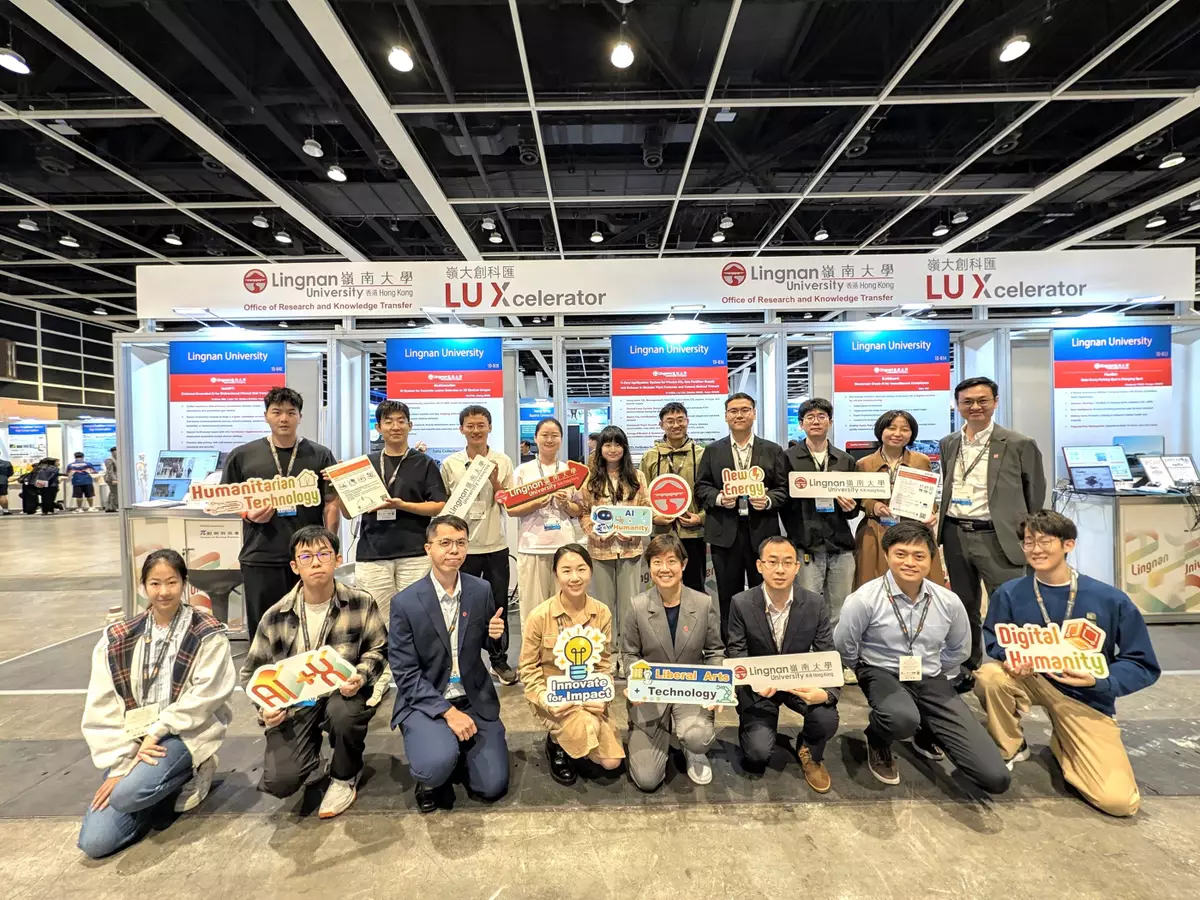
Lingnan University secures a record 10 awards at the 6th Asia Exhibition of Innovations and Inventions Hong Kong. Photo source: LU
The winning projects span a wide range of applications, including environmental sustainability, digital healthcare, security and privacy, smart construction, AIoT technology, and creative education, and demonstrate the practical applications of Lingnan’s “Liberal Arts + Technology” and “AI+” development strategies to innovators across Asia, while showcasing their potential for real-world implementation.
The project “GaitGPT: Evidence-Grounded AI for Bidirectional Clinical Gait Translation”, led by Prof S. Joe Qin, President and Wai Kee Kau Chair Professor of Data Science at Lingnan University, together with a team of scholars and graduates from the Division of Artificial Intelligence of the School of Data Science, received a Silver Medal.
President Qin congratulated the interdisciplinary research teams on receiving the recognition, noting that the number of award-winning Lingnan research projects driven by the core strategies of “Liberal Arts + Technology” and “AI+” has reached a new record high this year. He said, “Amid recent public discussions regarding a potential AI bubble, the key to unlocking the tangible value of AI lies in how humans comprehend and apply this technology. This includes harnessing AI to assist academia in exploring new research frontiers and discovering novel solutions to complex problems across different disciplines. The more rapidly technological innovation accelerates, the more it requires the guidance of humanistic knowledge, critical thinking, and ethical awareness. Lingnan will continue to champion our ‘Liberal Arts + Technology’ philosophy, positioning our humanistic foundation as the ‘navigator’ of technological innovation to ensure that it progresses in tandem with human needs.”
The projects awarded the Gold Award with Congratulations of Jury are the “GeoAI Mosquito Risk Prediction Platform — Kill, Monitor, Identify & Forecast”, developed by the Division of Science; and “IDShield: AI Behavioural Fingerprinting for Anonymous Dialogue Decode”, developed by the School of Data Science. “PCG.ME: Infinite Game Co-Creation Platform with Behaviour-Adaptive AI”, developed by the School of Data Science as well, received a Gold Medal.
The five Silver Medal-winning projects include “GaitGPT: Evidence-Grounded AI for Bidirectional Clinical Gait Translation”, led by President S. Joe Qin; “C-Zero AgriSystem: Precise CO2 Gas Fertiliser Supply and Exhaust System for Modular Plant Factories”, developed by the Wu Jieh Yee School of Interdisciplinary Studies; “FlexiBot: Make Every Parking Spot a Charging Spot”, developed by the Division of Science; “StorySketcher: A Multi-Agent AI System for Child-Led Co-Creative Storytelling”, developed by the Department of Digital Arts and Creative Industries; and “BuildGuard: Blockchain Oracle AI for Instant Secure Compliance”, developed by the School of Data Science.
The two Bronze Medal-winning projects were “Smart Writing Teacher: AI-driven Robot-assisted Calligraphy Teaching System”, developed by the School of Data Science; and “MedCenterDet: AI System for Accurate Lesion Detection in 3D Medical Images”, developed by the Wu Jieh Yee School of Interdisciplinary Studies.
The AEII, organised by the Hong Kong Exporters’ Association in partnership with Palexpo, the organiser of the International Exhibition of Inventions Geneva, is an annual event dedicated exclusively to showcasing Asian innovations, promoting cross-regional knowledge exchange, and establishing closer commercial partnerships. The award winners were selected by an international 40-member jury, who assessed originality, creativity, inventiveness, technical practicality, and symbolic significance.
List of winning projects and descriptions:
Awards: Gold Award with Congratulations of Jury
Project Title: GeoAI Mosquito Risk Prediction Platform — Kill, Monitor, Identify & Forecast
Winning Lingnan Faculty and Staff:
• Prof Paulina Wong Pui-yun, Head and Associate Professor (Presidential Early Career Scholar) of the Division of Science and Programme Director of the Master of Science in Sustainability and Environmental Analytics Programme
• Prof Tang Xiaopeng, Assistant Professor (Presidential Early Career Scholar) of the Division of Science
• Mr Wang Fangyu, PhD Student in the Division of Science
Project Description: This platform is the Hong Kong SAR's first mosquito forecasting system to combine geospatial artificial intelligence (GeoAI), artificial intelligence of things (AIoT), and geospatial science and multimodal signal fusion technique. By deploying solar-powered smart mosquito traps and meteorological stations, it collects and identifies real-time data on mosquito species and weather conditions, and generates a Mosquito Risk Index and heat maps, forecasting mosquito abundance levels three days in advance. The technology has already been implemented in several Hong Kong Housing Society estates, enabling proactive mosquito prevention.
Key Features
• Dynamic Predictive Prevention: The smart traps eliminate mosquitoes and record catch numbers and species data, while meteorological stations capture real-time weather information such as temperature, relative humidity, and rainfall. Together, they generate a Mosquito Risk Index and risk maps, enabling frontline property management staff to deploy resources earlier in high-risk areas.
• Intelligent Mosquito Species Identification: Leveraging advanced AI and multimodal signal fusion technology, the system automatically identifies different mosquito species, including vectors for dengue fever and chikungunya, providing robust scientific evidence to support more targeted, species-specific support for prevention and control policies.
• Solar-Powered Operation: Requiring only a few hours of indirect sunlight to sustain a full week of operation, the traps use built-in lithium batteries designed to withstand all weather conditions.
• Sustainable Green Solution: A 100 per cent solar-powered system equipped with battery storage, engineered for seamless integration into urban ecosystems. It delivers resilience against extreme weather conditions while driving significant operational cost savings.
Awards: Gold Award with Congratulations of Jury
Project Title: IDShield: AI Behavioural Fingerprinting for Anonymous Dialogue Decode
Winning Lingnan Faculty and Staff:
• Prof Shen Jiaxing, Assistant Professor of the Division of Artificial Intelligence of the School of Data Science and Programme Director of the Master of Science in Data Science Programme
• Wang Wenxuan, PhD student in the Division of Artificial Intelligence of the School of Data Science
• Liu Zirui, PhD student in the Division of Artificial Intelligence of the School of Data Science
• Kou Haoxuan, PhD student in the Division of Artificial Intelligence of the School of Data Science
Project Description: Removing names, account details, or IP addresses does not necessarily make an AI conversation anonymous. Across repeated interactions, users may leave behind distinctive “behavioural fingerprints” through their topics of interest, writing style, interaction patterns, and personality-related expressions. These subtle signals can allow separate anonymous conversations to be linked to the same individual, creating a largely overlooked privacy risk.
IDShield addresses this vulnerability through a working, locally operated privacy gateway positioned between a user application and an external AI service. Before a prompt leaves the user’s or organisation’s trusted environment, IDShield detects personally identifiable information and identity-revealing content, pseudonymises protected values, and rewrites potentially linkable content and writing-style signals. It then performs safety checks for semantic fidelity, formatting, protected fields, and residual privacy risk. Information required to complete the task can subsequently be restored locally after the external AI service returns its response. The system does not require the underlying language model to be modified or retrained. Its current research prototype operates through a Python API and command-line interface and can function as middleware for enterprise model APIs and conversational AI systems.
Key Features
• Evidence-based behavioural fingerprint assessment: IDShield is evaluated against a dedicated attack model that measures whether anonymous conversations can be linked across sessions through content, writing style, interaction patterns, and personality-related signals. This provides a measurable technical indicator of privacy risk rather than relying solely on the removal of obvious identifiers.
• Proactive, locally controlled de-identification: Unlike conventional privacy measures that focus mainly on masking accounts, names, or IP addresses, IDShield processes prompts before they are transmitted to an external AI service. It combines local detection, reversible pseudonymisation, and controlled rewriting to reduce both explicit and behavioural identity signals.
• Privacy protection with built-in utility safeguards: IDShield verifies semantic preservation, formatting, protected fields, and residual risk before releasing a transformed prompt. Unsafe transformations can trigger a fallback procedure or be blocked, while task-critical protected values can be restored locally after the AI response is received.
• Model-independent integration: IDShield can operate as a privacy middleware layer without modifying or retraining the target language model. The prototype can be integrated with enterprise APIs, including OpenAI, Azure OpenAI, and other model providers, as well as organisation-operated conversational AI systems.
• Technical evidence for privacy and AI-governance reviews: IDShield does not certify or guarantee legal compliance. Instead, it produces technical evidence that may support organisational reviews under the GDPR and, where applicable, the EU AI Act. Its risk measurements, pseudonymisation records, safety checks, residual-risk assessments, and privacy-preserving audit records may contribute to data-minimisation, privacy-by-design, security, impact-assessment, risk-management, and technical-documentation processes.
Awards: Gold Medal
Project Title: PCG.ME: Infinite Game Co-Creation Platform with Behaviour-Adaptive AI
Winning Lingnan Faculty and Staff:
• Prof Liu Jialin, Associate Professor of the Division of Industrial Data Science of the School of Data Science and Programme Director of the Master of Science in Smart City Technologies and Applications Programme
• Ms Li Yuchen, Assistant Research Officer of the Division of Industrial Data Science of the School of Data Science
Project Description: PCG.ME is a human-AI, collaborative, web-based platform for game creation. Users simply explain their requirements in everyday language or adjust intuitive controls, and the platform uses AI to automatically generate, evaluate, and refine levels and rules. Creators maintain full supervision and editing capabilities throughout, ensuring that game design is no longer constrained by technical barriers.
Key Features
• Multiple AI Testing: Combining AI playtesting, automated fine-tuning to balance difficulty and engagement, and leveraging large language models, generative models, reinforcement learning, and multi-objective optimisation to translate creative ideas into substantive game content, the platform delivers experiences that are both playable and original.
• Behaviour-Adaptive Adjustment: The system observes and analyses player interactions in real time, dynamically generating novel subsequent game content to allow the game world to evolve alongside the player.
• Creator-led: Emphasising designer involvement at every stage, all AI-generated candidate options can be inspected, compared, and refined by creators, ensuring that creative control remains firmly in human hands.
• Player-led: Enhancing player engagement, not only are the game contents adaptively generated based on player experience, but the platform also allows the player to create his/her own game.
Awards: Silver Medal
Project Title: GaitGPT: Evidence-Grounded AI for Bidirectional Clinical Gait Translation
Winning Lingnan Faculty and Staff:
• Prof S. Joe Qin, President and Wai Kee Kau Chair Professor of Data Science
• Prof Yu Lisha, Assistant Professor of Teaching of the Division of Artificial Intelligence of the School of Data Science and Programme Director of the Doctor of Artificial Intelligence Studies Programme
• Mr Zhang Weijian, Graduate of the Division of Artificial Intelligence of the School of Data Science
• Mr Hou Haochen, Graduate of the Division of Artificial Intelligence of the School of Data Science
Project Description: GaitGPT is an AI-powered gait analysis system that bridges the longstanding gap between qualitative clinical descriptions and quantitative gait indicators. By connecting three core pillars, users seeking health insights, professionals providing expertise, and multi-sensor data streams, through a patented constraint-enforced architecture. GaitGPT makes professional gait assessment and management explainable, reliable, and evidence-based for everyone, everywhere.
Key Features
• Evidence-Threshold Gating: A three-gate architecture that sequentially enforces evidence sufficiency, measurement feasibility, and biomechanical coherence before any output is generated, preventing unsupported or clinically inconsistent recommendations.
• Bidirectional Translation Engine: Translates in both directions between clinical semantic phrases and quantitative gait indicators, grounded in a structured evidence graph rather than unconstrained language generation.
• Dual-View Reporting with Privacy-First Design: Delivers both professional-facing and data-facing outputs with full audit trails, supported by a self-hosted architecture that ensures data sovereignty across lab, clinic, and home settings.
Awards: Silver Medal
Project Title: C-Zero AgriSystem: Precise CO2 Gas Fertiliser Supply and Exhaust System for Modular Plant Factories
Winning Lingnan Faculty and Staff
• Prof Chen Xi, Chair Professor of Interdisciplinary Studies of the Wu Jieh Yee School of Interdisciplinary Studies
• Dr Liu Lixi, Research Officer of the Wu Jieh Yee School of Interdisciplinary Studies
• Dr Deng Xiaobin, Research Assistant Professor of the Wu Jieh Yee School of Interdisciplinary Studies
• Dr Wang Xueru, Visiting Postdoctoral Fellow of the Wu Jieh Yee School of Interdisciplinary Studies
Project Description: Indoor farming is expanding to support global food supply, but the high costs of constant consumption of commercial carbon dioxide remain a major challenge. The C-Zero AgriSystem is a carbon-neutral solution specially designed for stacked indoor planting systems. It provides precise carbon dioxide (CO2) gas fertilisation for plants by directly capturing storage, and recycling CO2 within the indoor farm. The system captures CO2 from the surrounding air and collects the gas naturally released by crops at night. It then automatically supplies this recycled CO2 in accordance with the farm's lighting cycles and the plants' specific growth stages, effectively turning waste gases into a practical farming resource.
Key Features
• Integrated Sourcing & Dark-Period Storage: Direct Air Capture (DAC) modules capture CO2 from air and from plant respiration during dark periods. This CO2 is stored and automatically released during the day when plants need it most for photosynthesis.
• Precision Growth-Stage Supply: Using real-time monitoring and gas-path switching, the system delivers the exact amount of CO2 required for different crop growth stages. This prevents unnecessary CO2 loss during ventilation and optimises the use of resources.
• Sustainable Operational Savings: By recycling CO2 internally, farms no longer need to purchase and transport heavy CO2 cylinders. This modular system ensures a self-sufficient gas supply, lowering daily operating costs while enhancing facility safety.
Awards: Silver Medal
Project Title: FlexiBot: Make Every Parking Spot a Charging Spot
Winning Lingnan Faculty and Staff:
• Prof Tang Xiaopeng, Assistant Professor (Presidential Early Career Scholar) of the Division of Science
• Mr Wang Fangyu, PhD Student in the Division of Science
Project Description: As the adoption of electric vehicles accelerates, the scarcity of parking bays and the underuse of overnight charging points have become daily frustrations for drivers. FlexiBot is an intelligent robotic solution designed to provide wireless charging for electric vehicles in any parking space. Able to navigate freely around car parks and slide underneath vehicles to dock automatically, it is compatible with all electric vehicle brands and delivers a seamless park-and-charge experience. The system also features intelligent scheduling, automatically avoiding peak electricity hours to reduce grid load and save costs.
Key Features
• Flexible Autonomous Charging: The robot navigates automatically to the vehicle's location to deliver a charge, allowing a single unit to service several vehicles. This eliminates the expensive infrastructure modification costs associated with traditional car park trenching and cable laying.
• High Compatibility: Compatible with all electric vehicle brands due to dedicated adapters, the system operates safely and conveniently, supported by a dedicated mobile app.
• Intelligent Scheduling: By automatically arranging charging times and making optimal use of overnight off-peak periods, the system increases operational efficiency by approximately 300 per cent while optimising energy use.
Awards: Silver Medal
Project Title: StorySketcher: A Multi-Agent AI System for Child-Led Co-Creative Storytelling
Winning Lingnan Faculty and Staff:
• Prof Xu Xian, Assistant Professor of the Department of Digital Arts and Creative Industries
Project Description: This platform uses AI-guided questioning to turn children's drawings into unique stories. Once a story is complete, it automatically generates an animated short film complete with lively narration within minutes, turning imagination into a visual work that can be shared and enjoyed, stimulating children's narrative creativity, logical thinking, and verbal ability, and making creation both effortless and enjoyable.
Key Features
• Inquiry-Based Inspiration: Acting as a collaborative partner, the system translates visuals into a short film with subtitles while asking questions to inspire children to extend their storylines. This helps them to construct a complete narrative framework step-by-step, yet ensures the direction of the story remains entirely up to the child.
• Co-Creation and Multilingual Learning: Designed around a drawing board interface that is simple and straightforward, the platform can be operated independently by children, but remains intuitive enough for parental guidance and companionship, allowing families to enjoy the fun of collaborative creation together. The system also supports multilingual output in Chinese, English, French, and other languages, turning the creative process into a cross-lingual learning experience.
Awards: Silver Medal
Project Title: BuildGuard: Blockchain Oracle AI for Instant Secure Compliance
Winning Lingnan Faculty and Staff:
• Prof Mike Wu, Assistant Professor of the Division of Industrial Data Science of the School of Data Science
Project Description: This invention combines secure, tamper-proof blockchain technology with intelligent, AI-driven auditing to provide direct compliance verification for cross-border offsite manufacturing, including Modular Integrated Construction (MiC). The system transmits diverse data types securely into a highly encrypted blockchain ledger for real-time analysis, guaranteeing that records remain tamper-proof. It also transforms traditional paper-based manual inspections into instantaneous digital workflows, addressing issues of low data credibility, human error, and difficult retrospective tracing. This supports the large-scale development of offsite manufacturing, ensuring compliance with the latest regulatory requirements and safeguarding engineering quality.
Key Features
• Real-Time Compliance Auditing: By training AI models to analyse multi-modal production floor data in real time, the system performs expert-level compliance checks autonomously.
• Blockchain Tamper-Proof Mechanism: By integrating blockchain oracle technology, inspection data are securely transmitted to a blockchain ledger, guaranteeing authentic and immutable audit results.
• Streamlined Inspection Workflows: By converting time-consuming manual compliance checks into instantaneous digital processes, the system facilitates offsite manufacturing efficiency and high-capacity production.
Awards: Bronze Medal
Project Title: Smart Writing Teacher: AI-driven Robot-assisted Calligraphy Teaching System
Winning Lingnan Faculty and Staff:
• Prof Hou Zhimin, Assistant Professor of the Division of Industrial Data Science of the School of Data Science
• Mr Zhang Tiancheng, Research Assistant of the Division of Industrial Data Science of the School of Data Science
Project Description: Mastering traditional Chinese brush calligraphy requires precise spatial awareness and delicate control of brush pressure, and usually dedicated one-on-one tutoring. The “Smart Writing Teacher” is an AI-driven robotic system designed to address this by combining computer vision, intelligent modelling, and physical robotic guidance. The system physically guides learners through the stroke paths and pressure techniques of brush calligraphy.
Key Features
• Personalised Brush Guidance: Using computer vision, the system analyses a master calligraphy sample and the learner's natural writing style to generate customised 3D practice paths that teach proper brush techniques while preserving the user's individual handwriting style.
• Real-Time Tactile Feedback: A robotic arm provides physical support that adjusts automatically. If a learner strays from the correct path or applies the wrong brush pressure, the arm provides firmer guidance. As the learner improves, it reduces physical support, helping them build genuine muscle memory.
• Targeted Practice & Tracking: The system evaluates the learner's performance stroke by stroke. It identifies specific mistakes and automatically creates customised practice routines, allowing users to master difficult strokes more efficiently.
Awards: Bronze Medal
Project Title: MedCenterDet: AI System for Accurate Lesion Detection in 3D Medical Images
Winning Lingnan Faculty and Staff:
• Prof Pan Fei, Assistant Professor of the Wu Jieh Yee School of Interdisciplinary Studies
• Mr Zeng Qiang, PhD student in the Wu Jieh Yee School of Interdisciplinary Studies
Project Description: MedCenterDet is an intelligent analysis algorithm for 3D medical images such as CT and MRI scans. Unlike traditional methods that can only roughly outline lesion areas or organs, this algorithm acts like a precise \"smart radar\" that can directly lock onto the centre of the target.
Key Features
• Smart locking and flexible adaptation: This algorithm does not rely on any fixed templates or assumptions. Instead, it directly finds the \"core coordinates\" of each organ or lesion area and automatically adjusts the judgement range according to its actual size. Regardless of the target's size or shape, it achieves precise localisation.
• Powerful background filtering and auto-correction: Medical scan images often contain complex background information such as bones and blood vessels, which can cause visual confusion. This algorithm effectively eliminates noise, focuses on the actual lesion areas, and can automatically detect and correct minor positional deviations.
• Efficient and time-saving, reducing doctors' burden: The algorithm runs efficiently with low computational demands, greatly reducing the time doctors spend on manual annotation, accelerating the image analysis process, and taking a crucial step towards future fully automated diagnosis.
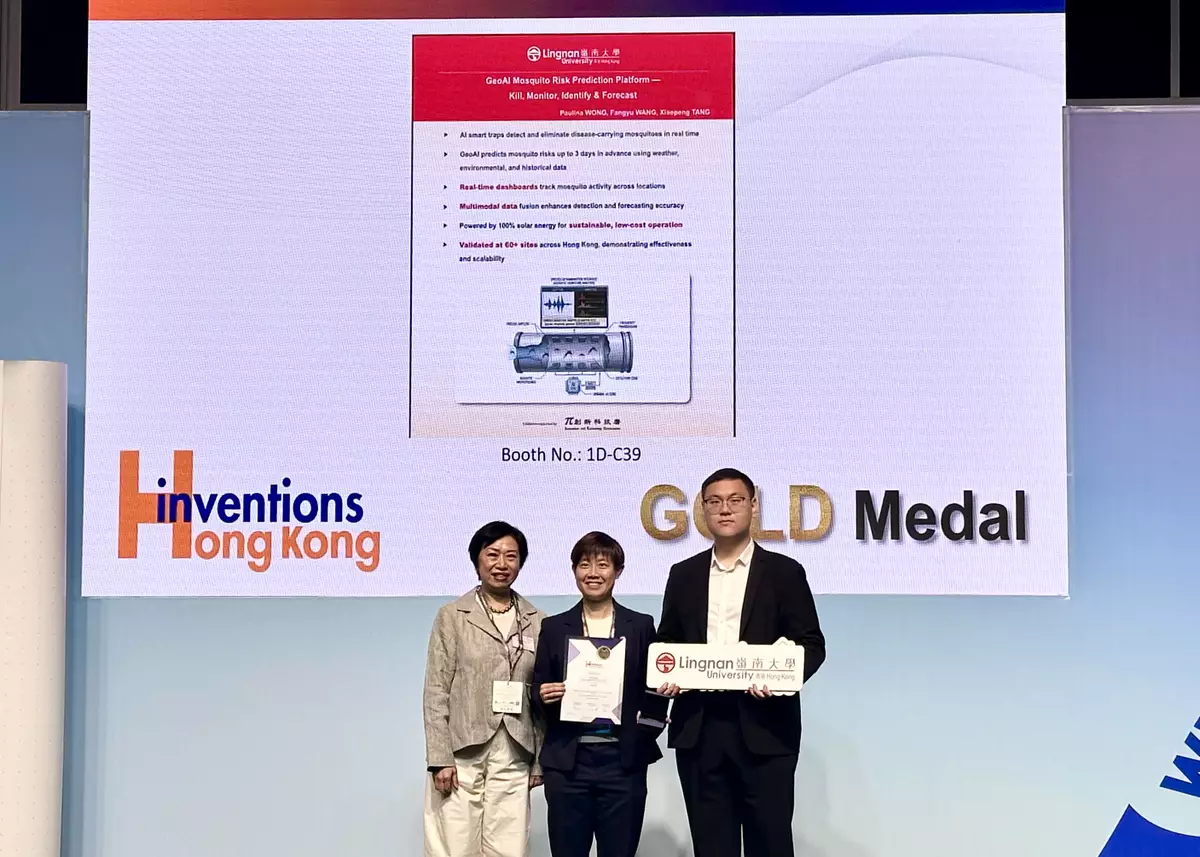
The Gold Award with Congratulations of Jury, “GeoAI Mosquito Risk Prediction Platform — Kill, Monitor, Identify & Forecast”, led by Prof Paulina Wong Pui-yun, Head and Associate Professor (Presidential Early Career Scholar) of the Division of Science and Programme Director of the Master of Science in Sustainability and Environmental Analytics Programme (middle); and Mr Wang Fangyu, PhD Student in the Division of Science (right). Photo source: LU
The Gold Award with Congratulations of Jury, “GeoAI Mosquito Risk Prediction Platform — Kill, Monitor, Identify & Forecast”, led by Prof Paulina Wong Pui-yun, Head and Associate Professor (Presidential Early Career Scholar) of the Division of Science and Programme Director of the Master of Science in Sustainability and Environmental Analytics Programme (middle); and Mr Wang Fangyu, PhD Student in the Division of Science (right).
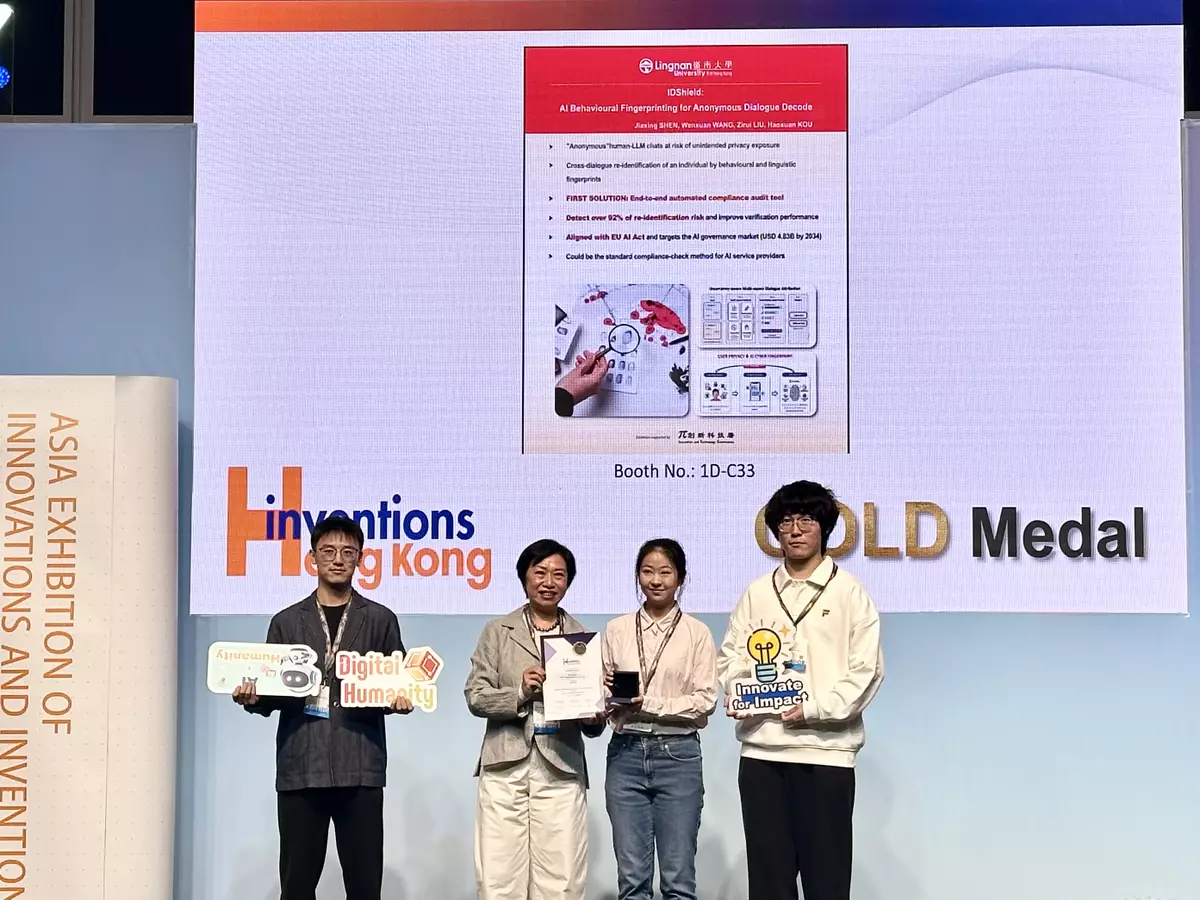
Another Gold Award with Congratulations of Jury, “IDShield: AI Behavioural Fingerprinting for Anonymous Dialogue Decode”, led by the Division of Industrial Data Science of the School of Data Science. Wang Wenxuan, PhD student in the Division of Artificial Intelligence of the School of Data Science (left); Liu Zirui, PhD student in the Division of Artificial Intelligence of the School of Data Science (second from right); and Kou Haoxuan, PhD student in the Division of Artificial Intelligence of the School of Data Science (right). Photo source: LU
Another Gold Award with Congratulations of Jury, “IDShield: AI Behavioural Fingerprinting for Anonymous Dialogue Decode”, led by the Division of Industrial Data Science of the School of Data Science. Wang Wenxuan, PhD student in the Division of Artificial Intelligence of the School of Data Science (left); Liu Zirui, PhD student in the Division of Artificial Intelligence of the School of Data Science (second from right); and Kou Haoxuan, PhD student in the Division of Artificial Intelligence of the School of Data Science (right).
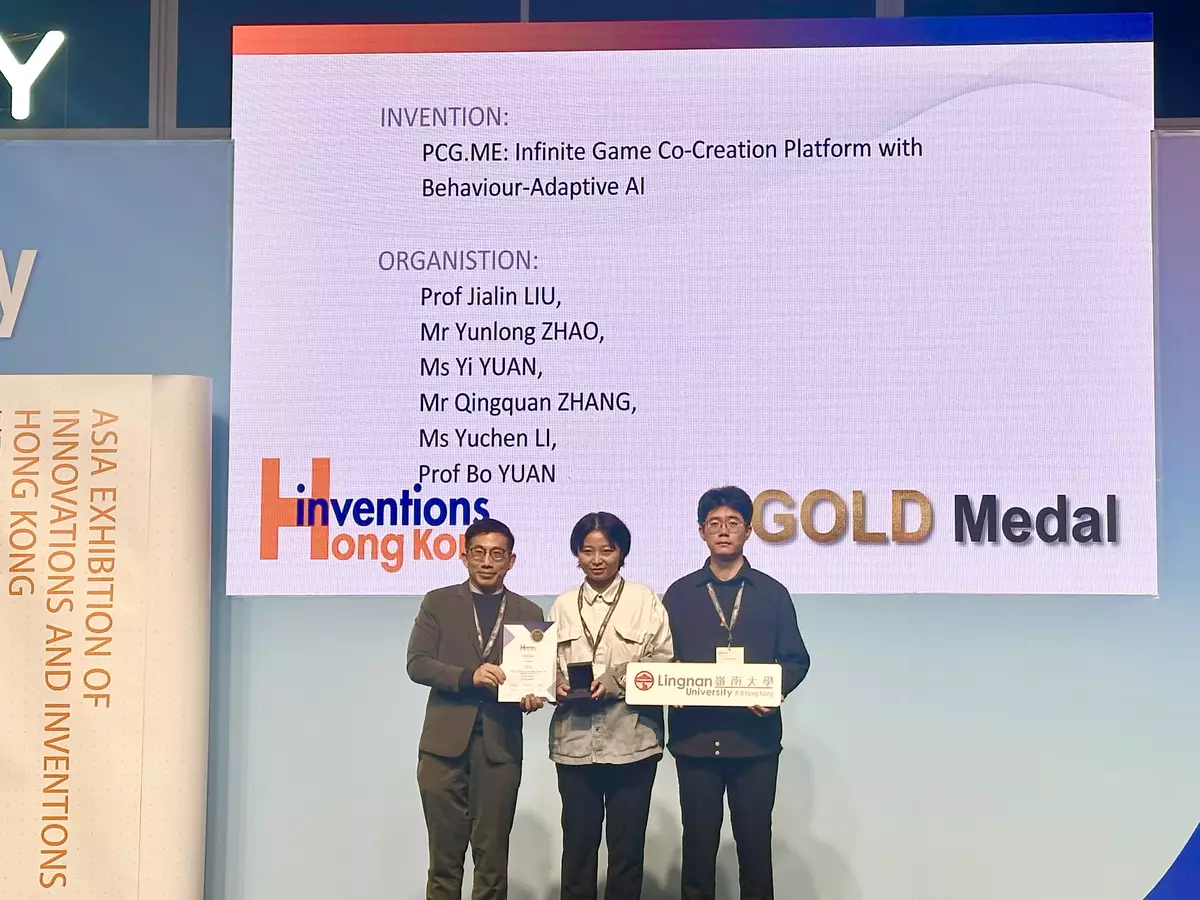
Another Gold Medal-winning project, “PCG.ME: Infinite Game Co-Creation Platform with Behaviour-Adaptive AI”, led by the Division of Industrial Data Science of the School of Data Science. Ms Li Yuchen, Assistant Research Officer of the Division of Industrial Data Science of the School of Data Science (middle); and Mr Zhang Qingquan, Assistant Research Officer of the Division of Industrial Data Science of the School of Data Science (right). Photo source: LU
Another Gold Medal-winning project, “PCG.ME: Infinite Game Co-Creation Platform with Behaviour-Adaptive AI”, led by the Division of Industrial Data Science of the School of Data Science. Ms Li Yuchen, Assistant Research Officer of the Division of Industrial Data Science of the School of Data Science (middle); and Mr Zhang Qingquan, Assistant Research Officer of the Division of Industrial Data Science of the School of Data Science (right).