Shenzhen, one of China's most dynamic cities and a popular tourist destination, saw a surge in passenger traffic on Wednesday as the summer air travel rush officially got underway.
The annual summer travel season in China's aviation sector runs 62 days through August 31, fueled by strong demand for family holidays, cooler-weather escapes and overseas trips.
At the Shenzhen Bao'an International Airport, check-in counters and departure halls were bustling from early morning. While business routes to major hubs like Beijing and Shanghai remained busy, the most notable jump came from flights to major tourist attractions. Services from Shenzhen to Urumqi in Xinjiang in the northwest and Weihai in Shandong in the east, for instance, were reporting load factors above 95 percent.
"I'm taking my son to explore the beach and see what northern coastline looks like. We know it's going to get even busier in peak summer season, so we took some time off early to beat the crowds," said one traveler who's heading to the coastal city of Weihai.
The number of children traveling alone is also increasing as airlines enhance their unaccompanied minor service.
"We're seeing many more students on study tours, family groups, and unaccompanied minors. Last year, we could carry up to eight unaccompanied children per flight. Now it's 15. We have dedicated crew looking after them. The numbers are climbing day by day, and we expect this trend to continue even more obviously over the next two weeks," said Zhang Xiaoying, a senior flight attendant with China Southern Airlines' Shenzhen branch.
The arrivals hall was equally packed, with a steady stream of visitors touching down in Shenzhen. According to online travel platforms, the city ranks among this summer's top destinations, alongside Shanghai, Chengdu, Beijing, Urumqi, and Sanya.
Among the arriving passengers was a primary school student traveling alone from Wuhan in central China.
"I'm not afraid to fly alone. The crew are there with me. I'm here to visit my grandpa and have some fun," said the boy.
Another young traveler had a very specific mission in Shenzhen: "I'm heading to Huaqiangbei. I'm really into electronics, like the microcontroller development boards. If there are cheap ones, I'll grab some to play with."
Data from Tongcheng Travel show that the average price for domestic flights during the 2026 summer travel season is approximately 925 yuan (about 136 U.S. dollars), up about 4 percent year on year. International flights are averaging around 1,300 yuan (190 U.S. dollars), an 11 percent increase over last summer. Budget-conscious travelers can still find a limited number of lower-priced tickets for the first week of July and the last week of August.
Major carriers have boosted their capacity to meet the summer travel surge, and the Shenzhen Bao'an International Airport has shifted into the peak-season mode, with 1,313 takeoffs and landings scheduled for Wednesday alone.
"We've been working with airlines to adjust our domestic and international routes. We've launched or increased flights to popular domestic destinations like Yining, Dali, Xishuangbanna and Hailar. We're seeing traveler enthusiasm rising fast through booking channels," said Zhang Zhe, head of market development at Shenzhen Airport (Group) Co., Ltd.
The summer peak season for railway also kicked off on Wednesday. Between July 1 and August 31, the country's rail network is expected to handle 1.01 billion passenger trips, averaging 16.29 million per day.
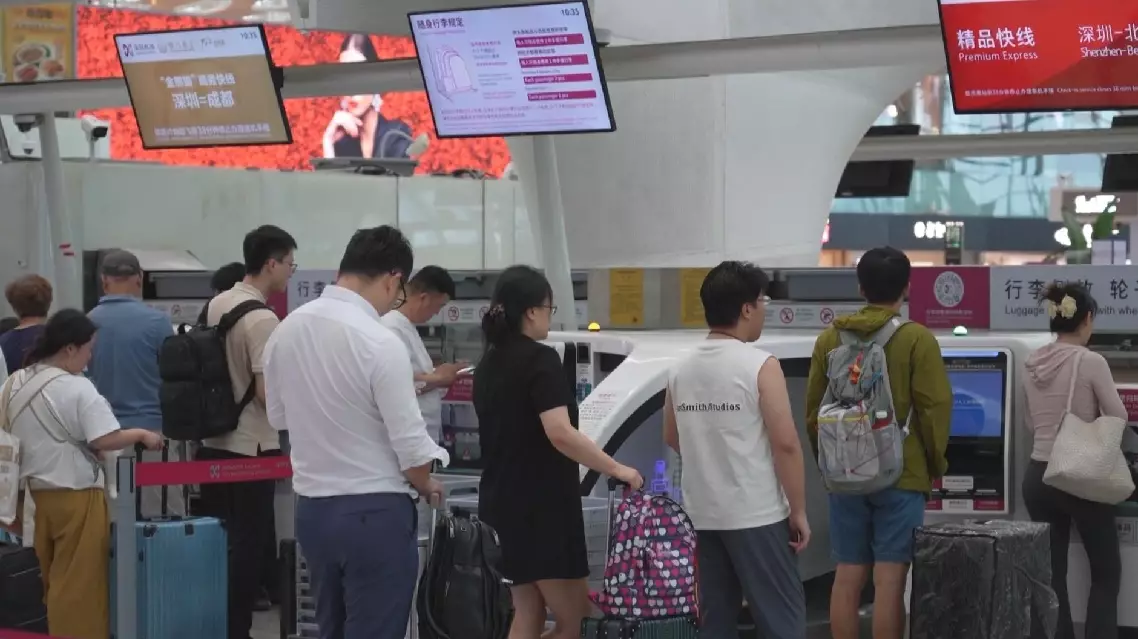
Shenzhen airport sees near-capacity flights as summer travel rush begins