CINCINNATI (AP) — An Ohio judge will make a ruling next week on a preliminary injunction request from 24 men's and women's college basketball players suing the NCAA, claiming the new age-based model unfairly shuts them out of further competition.
Judge Christopher Wagner, who previously denied a temporary restraining order hours after the lawsuit was filed, said Wednesday during a hearing that his written order will be made on July 9.
The lawsuit was filed shortly after the NCAA Division I Cabinet approved a monumental change in eligibility rules last month.
“When each plaintiff completed their fourth season of competition during the 2025-26 academic year, they had every reason to know it was the end of the line and time to make way for the next generation of college athletes,” the NCAA wrote in a filing.
The plaintiffs are seeking to be eligible to play a fifth year during the upcoming season, representing athletes who graduated from high school in 2022 and began their college sports careers that fall and never redshirted.
“Each plaintiff was harmed each time he or she competed in a basketball game against a fifth or sixth-year player without being offered the same opportunity to compete in a fifth season themselves,” attorney Ryan Downton wrote in a filing.
The NCAA now allows athletes five seasons of competition over a five-year period that begins with their full-time enrollment or the academic year following their 19th birthday, whichever occurs first.
The move will all but eliminate waivers or redshirt years for extended eligibility except for religious missions, pregnancy or active-duty military service. Extensions will no longer be considered for athletes who are injured.
Athletes whose eligibility expired by spring 2026 under the traditional model — four years of competition over five years — will not be allowed a fifth year of competition under the new rules that go into effect this fall.
Similar lawsuits are being filed in other states.
The Division I Cabinet has said in a statement posted on X that it was aware of legal action challenging its decision and that “we do not intend to change course.”
AP college sports: https://apnews.com/hub/college-sports
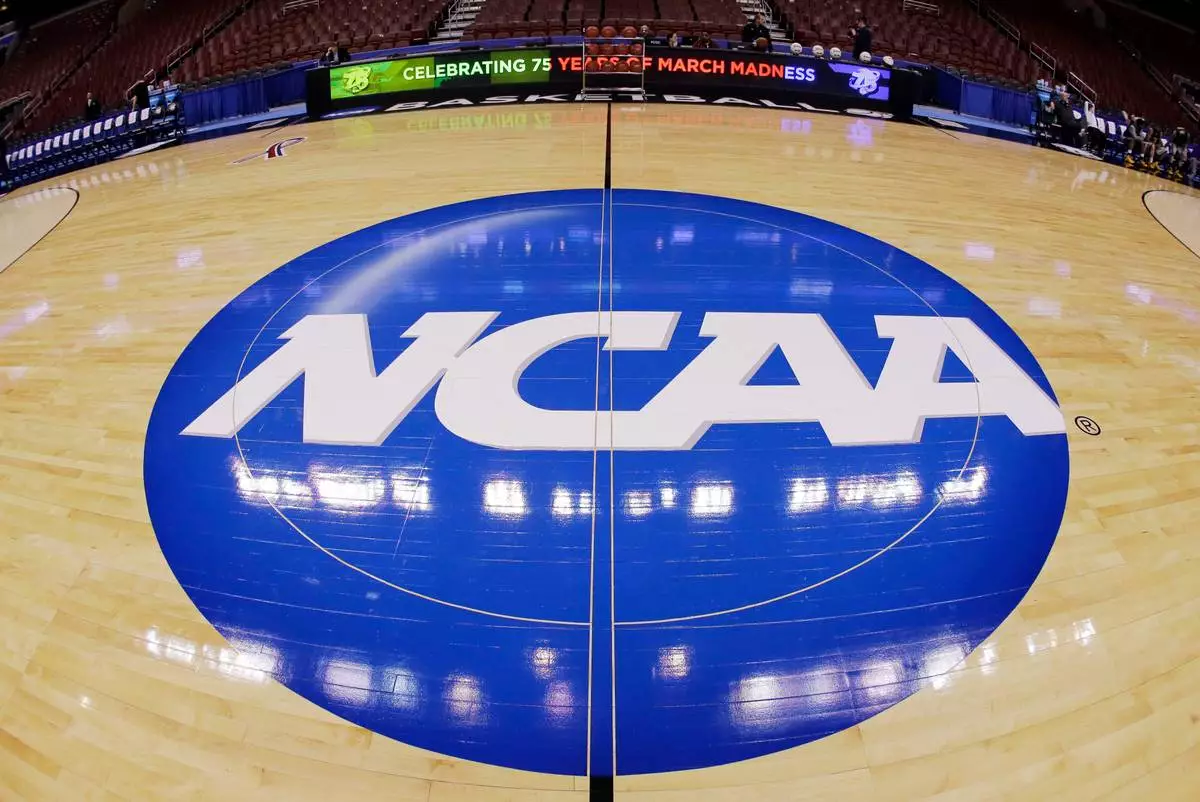
FILE - This photo taken with a fisheye lens shows the NCAA logo displayed at mid-court before Albany's practice for a second-round game of the NCAA college basketball tournament March 21, 2013, in Philadelphia. (AP Photo/Matt Slocum, File)
Multiday warnings of extreme heat landed in New York, Boston and Philadelphia on Wednesday as sultry weather pushed east just ahead of Fourth of July celebrations in a region that revels in its role as a historic hub of U.S. independence.
Temperatures in the high 90s Fahrenheit (30 degrees Celsius) were forecast for the Northeast; Philadelphia and Boston could top 100 by Thursday. Throw in humidity, and the real-feel heat index will be even higher at times, the National Weather Service said.
A heat dome — high-pressure systems above a region that trap heat and humidity — has been smothering parts of the U.S., from the Midwest to the East Coast. It will add much discomfort amid 250th anniversary parades, ship flotillas, outdoor concerts and, in Boston, a popular public reading of the Declaration of Independence from a historic balcony Saturday.
New York Mayor Zohran Mamdani advised residents to stay cool inside and avoid “extraordinary temperatures.”
“To be breaking into triple digits over the course of these many next days — it is of immense concern given that too often the heat is something that is underestimated,” Mamdani said.
In Hamptonburgh, New York, air conditioning failed on a bus carrying Junior ROTC cadets, resulting in multiple heat-related illnesses, Orange County authorities said. Some cadets were taken to hospitals as a precaution.
Humidity is not uncommon in the Northeast. But Dr. Alexander Azan of NYU Langone Health in New York said high air temperatures and humidity are a dangerous combination.
“Their body doesn’t have that level of acclimatization to respond appropriately to the heat, and so heat stress in the form of what we call heat exhaustion, and in more severe cases, heat stroke, can occur at much lower temperatures than we see in people who live in the South,” Azan said.
Experts say cities in particular are at greater risk.
“The concentration of concrete, asphalt, steel, all of those materials help to retain heat,” said Vijay Limaye, a climate scientist at the Natural Resources Defense Council. “The number on your phone may actually not reflect the true temperature profile that you’re going out into.”
New York City said more than 200 teams of government workers and volunteers will check on homeless people and encourage them to get inside. There will be hundreds of cooling centers, from the Javits Center convention hall to vans to outdoor spots with misting fans.
The phone seemed like it wouldn't stop ringing at Acme Ice Co. in Cambridge, Massachusetts, which delivers ice to bars and restaurants in the Boston area. The owner, Marc Savenor, said this week's stretch of hot weather is an “ice man's dream.”
“What could an ice man ask for? ... I’ve hired a couple extra drivers. I’ve put on an extra couple trucks. I put ice in different freezers so I don’t run out,” Savenor said. “After my ice is depleted here, we go pick up another load, bring it back, and we deliver it everywhere.”
The American Kennel Club’s Museum of the Dog in New York is allowing visitors to bring their dogs to cool off, through Sunday. Executive Director Christopher Bromson said he got the idea from seeing his own Newfoundland sprawled on the museum’s cool floor.
“I thought every dog should have access to this,” he said.
In Washington, D.C., where the high temperature was 95 F (35 C), thirsty children reached for cold water from U.S. Park Police as they waited in line for the Ferris wheel on the National Mall.
In the Midwest, meanwhile, heat risks remained. Taylor Harnist, whose Cincinnati business installs and repairs air conditioners, said he was trying to keep his employees comfortable with breaks, water and electrolyte drinks.
“You get an attic job when it’s this hot, we do them but it’s strenuous,” Harnist said. “It’s so hot the attics will reach temperatures of 145 degrees.”
Jeff Schlegelmilch, associate professor at Columbia University Climate School, said heat is one of the easiest things to attribute to climate change.
“We have seen a continued increase in longer summers, hotter temperatures, hotter temperatures earlier on, more evaporation of moisture, higher humidity — effects like that,” he said.
Associated Press reporters Jennifer Peltz in New York, Rodrique Ngowi in Cambridge, Massachusetts, and Scott Bauer in Madison, Wisconsin, contributed to this report.

Stephanie McCallister holds a cold bottle of water to her husband Don McCallister's neck as they wait in line for the ferris wheel at the Great American State Fair on the National Mall, Wednesday, July 1, 2026, in Washington. (AP Photo/Jen Golbeck)
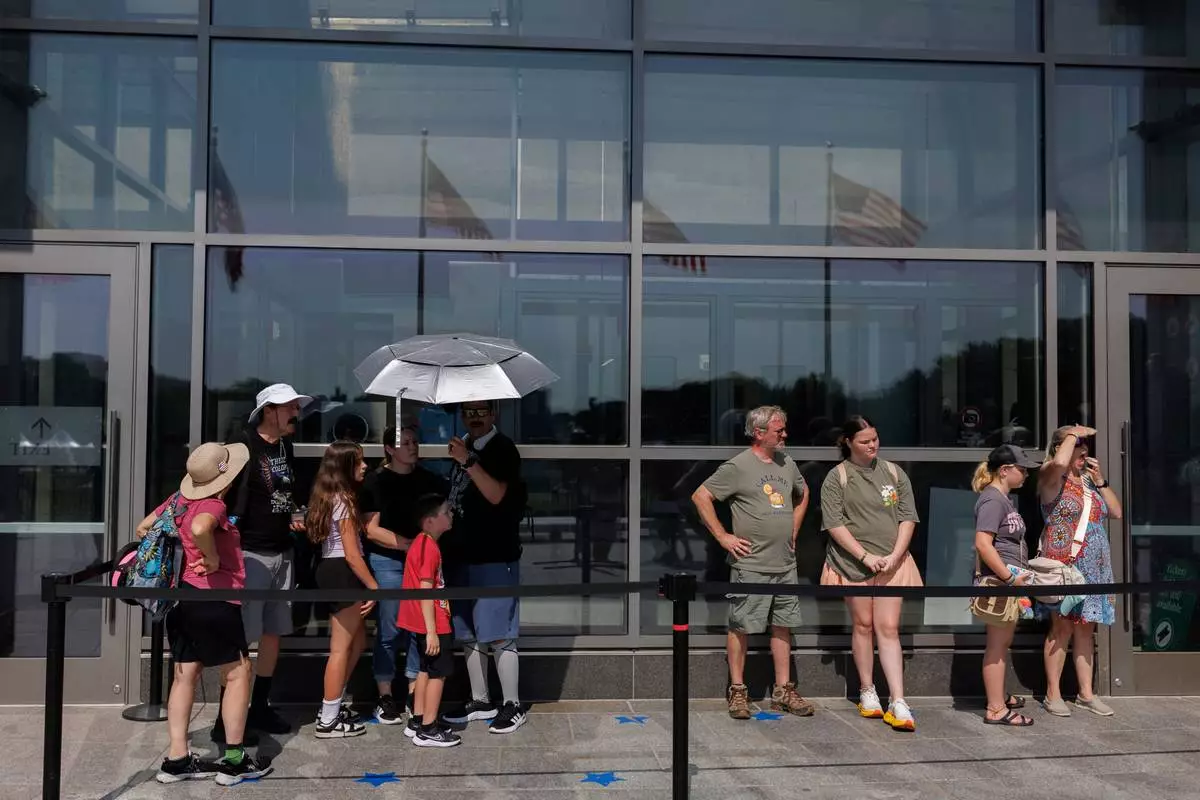
Visitors wait to enter the Washington Monument, Wednesday, July 1, 2026, in Washington. (AP Photo/Tom Brenner)
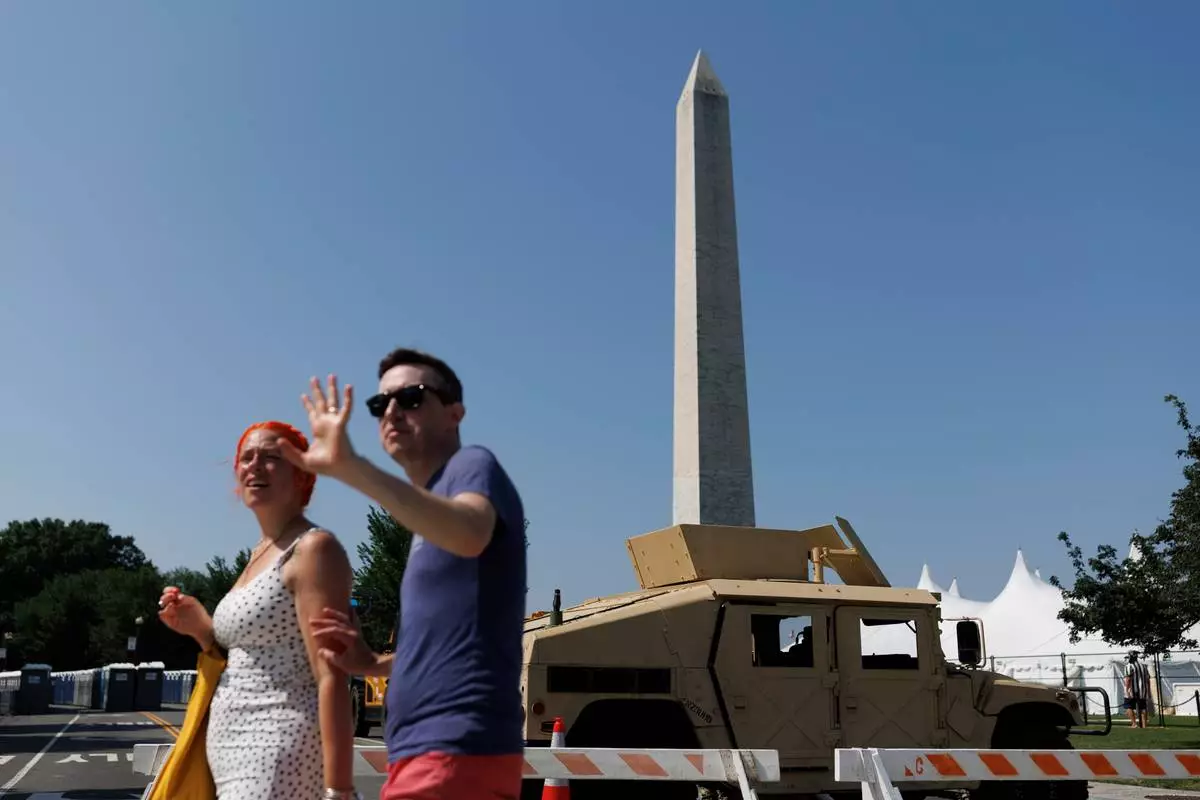
People cross 15th Street Northwest as a National Guard Humvee blocks the roadway, Wednesday, July 1, 2026, in Washington. (AP Photo/Tom Brenner)

Children reach for cold bottles of water from U.S. National Park Police Officer R. Douglass as they wait in line for the ferris wheel at the Great American State Fair on the National Mall, Wednesday, July 1, 2026, in Washington. (AP Photo/Jen Golbeck)