A young official of the Communist Party of China (CPC) from a once inaccessible village has been dedicated to developing his hometown and leading villagers in combating poverty and pursuing a prosperous life.
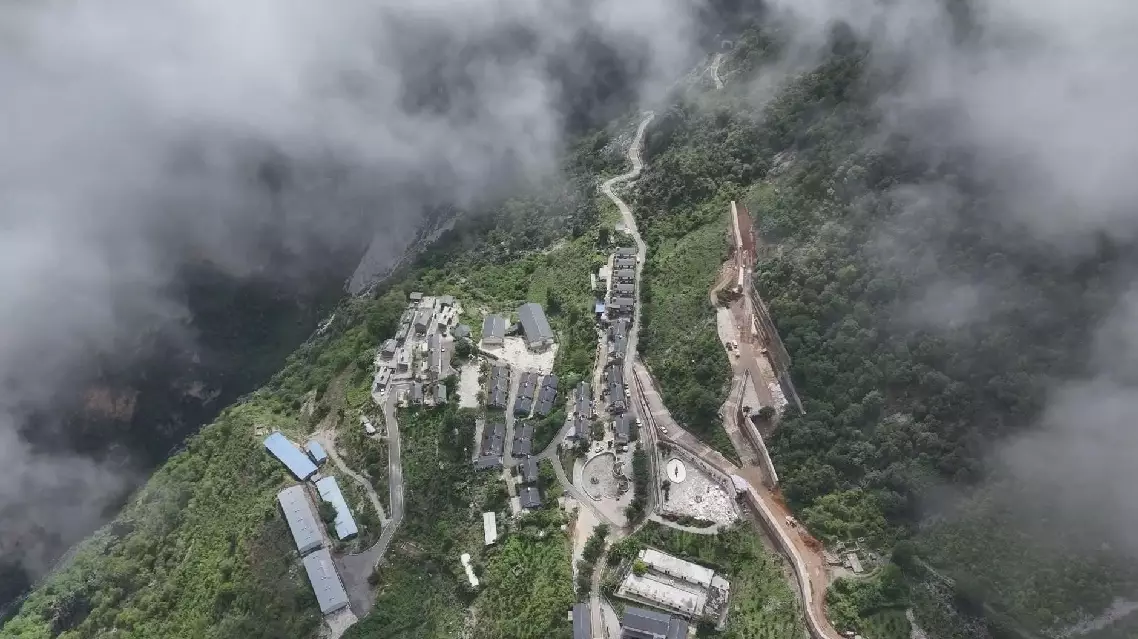
Deep in the mountains of Liangshan Yi Autonomous Prefecture of southwest China's Sichuan Province, Abuluoha Village, whose name means "a place few people ever reach" in the local Yi language, has long been known as the last village in China to gain road access.
Jilie Ziri, the first college student from this village, now serves as the Party secretary of the village.
"When I was a child, I had to walk about five hours to get to school. There was no road. I had to climb over mountains. During the rainy season, my brother and I carried machetes to clear the overgrown mountain path. The most dangerous part was crossing the river on a hand-pulled cable. Once, a steel wire pierced straight through my hand. I couldn't let go, because if I did, I would've fallen into the river below," he said.
Having endured those hardships himself, the young man knows exactly what was holding his village back.
After graduating from college in 2017, he turned down job opportunities in the city and returned home, determined to transform his hometown.
"A road was something three generations of our villagers had dreamed of. Without one, development was almost impossible. After I came back, I kept working with different government departments, hoping we could make that dream come true," he said.
However, carving a road along steep cliffs was an enormous engineering challenge, and a heavy-lift helicopter had been deployed to airlift construction equipment into the village.
The road was officially opened on June 30, 2020, but it is not the end of the journey.
With transportation no longer a barrier, Jilie Ziri turned his attention to creating new opportunities for villagers.
"Agricultural experts told me that our climate and altitude were perfect for growing navel oranges. The government helped provide seedlings, and I also worked with companies to introduce drip irrigation. Today, we have about 23 hectares of orchards, and last year they generated around 16,000 U.S. dollars in sales," he said.
Jilie Ziri's commitment to his hometown has inspired another young villager to come back. The 25-year-old Ada Niuse now works as the village accountant.
Ada Niuse also serves as a guide at the village exhibition hall, where old photographs remind him just how much life has changed.
"This photo shows my home, and this is me as a child. It was summer. We sat there to keep cool, while our livestock stayed underneath. And that child was about my age. We just ate our meals like that. We never imagined we'd one day have proper tables and chairs," he said.
For Jilie Ziri, helping improve people's lives is more than a job; it is what being a grassroots Party member truly means.
"As grassroots Party members, we are the closest link between the Party and the people. Our responsibility is to put what we've learned to good use, help government policies take root, and bring real change to places that need it most," he said.
Young village official dedicated to transforming once-roadless village
India is grappling with the economic fallout of the Iran conflict, as disruptions to global oil supplies push fuel prices higher and poor rainfall adds pressure on household expenses.
In Mumbai, residents said daily grocery bills have climbed noticeably in recent weeks. Dry weather and crop losses have disrupted supplies of fruits and vegetables, while higher fuel prices have increased transportation and distribution costs, adding pressure across the supply chain.
"I can see how the price, more than 10 percent is going up within a month. Last month, I picked up, it was 40 rupees (about 0.42 U.S. dollars), okay. Today, it took 50 rupees. Similarly, other foods also. Of course, vegetable also going up," said Shravani, a local resident.
Since the war began, compressed natural gas (CNG) prices in India have risen between 7 and 10 percent. Diesel prices, closely linked to commercial transport, have increased by as much as 9 percent. The higher fuel costs are feeding into broader price increases beyond the pump.
Fast-moving consumer goods companies have responded by either raising prices by 3 to 5 percent or reducing product sizes, a practice known as grammage cuts, meaning consumers end up paying the same price for less.
As supply chains become more expensive, fast-moving consumer goods companies have responded either by raising prices by 3 to 5 percent or by reducing product quantities through grammage cuts, meaning consumers end up paying the same price for less.
India's retail inflation climbed to a 16-month high in May, driven largely by rising food and fuel prices. While easing global energy prices could provide some relief, below-average rainfall threatens to offset those gains by limiting agricultural output.
Rural areas, where incomes are closely tied to farming, are already feeling the strain more acutely than cities. Agriculture accounts for around 18 percent of India's GDP and employs roughly 43 percent of the population. Any decline in farm incomes can directly affect domestic consumption and overall economic growth.
Lower crop yields could further push up food prices, an issue India's central bank said it is monitoring closely. Economists said any revision to India's growth forecasts will likely depend on how the monsoon season develops and whether rainfall shortfalls persist.
"Specifically, vegetable price inflation and all we have seen it to be very volatile. But again, if you go with our historical experience with poor monsoon, it's not that all years of weak monsoon have been associated with high inflation. Government does intervene through various measures, through reducing import duty on some components or with export restrictions," said Rajani Sinha, chief economist of the CareEdge Ratings, one of India's leading credit rating agencies.
While policy measures and government interventions may help soften supply shocks, they are unlikely to provide immediate relief from mounting pressure on household budgets.
As the geopolitical effects of the West Asia conflict intersect with increasingly unpredictable climate patterns at home, the real challenge for Indian policymakers will be sustaining economic growth while easing the cost burden on ordinary citizens.

Conflict in Iran, weak monsoon squeeze Indian households with rising costs