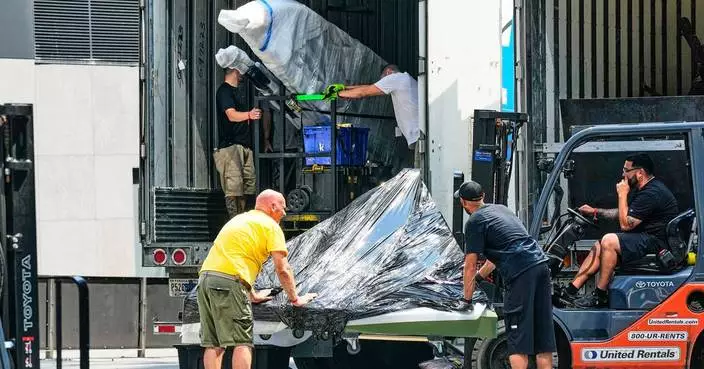
CONCORD, N.H. (AP) — Heat as oppressive as British colonial rule is bearing down on the eastern U.S. heading into the long Fourth of July weekend, prompting some communities to cancel, postpone or otherwise alter their Independence Day plans.
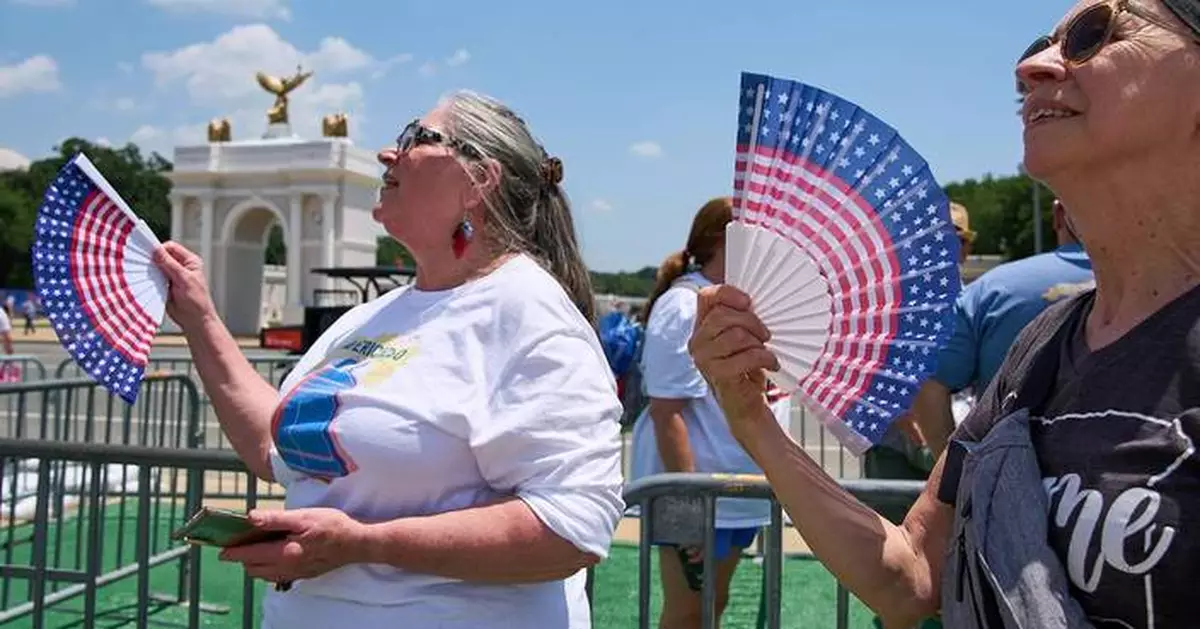
Dangerous, record-breaking heat will continue across much of the central and eastern U.S. through Friday and will continue along the East Coast through the weekend, the National Weather Service said Thursday. Temperatures in the high 90s Fahrenheit (30 degrees Celsius) were forecast for the Northeast; Philadelphia and Boston could top 100. Humidity is expected to make it feel even hotter, all but ensuring that sweat will dampen spirits at many celebrations marking 250 years of American independence.
“Anywhere you go in southern New England, you will be dealing with dangerous heat today, tomorrow and Saturday,” said Bryce Williams, a meteorologist with the weather service.
In Boston, entrance to the Boston Pops Fireworks Spectacular will start at 4 p.m. instead of noon on Saturday because of the heat. In Philadelphia, officials shortened the route of a Thursday morning parade, canceled an afternoon all-American Block Party, and pushed back the start times of an evening picnic and concert at Independence Mall.
In Lower Windsor Township, Pennsylvania, an America 250 celebration including food trucks, games and the highway department's dump truck has been rescheduled for July 8. In Norristown, Pennsylvania, officials canceled a parade set for Saturday, citing the safety of residents, participants and first responders, though evening fireworks and an afternoon party featuring games, food, and music will go on as scheduled.
“The parade is one of our community’s most beloved traditions, and we share in the disappointment of its cancellation, especially as we celebrate America’s 250th birthday,” Interim Municipal Administrator Jayne Musonye said.
Gettysburg National Military Park in Pennsylvania moved outdoor events indoors. Amtrak, meanwhile, canceled some train routes due to the heat Thursday, including the Acela between Boston and Washington, and said others may operate with reduced speeds resulting in delays through Saturday.
A heat dome — high-pressure systems above a region that trap heat and humidity — has been smothering parts of the U.S., from the Midwest to the East Coast. Beyond the holiday festivities, officials in many communities are taking steps to keep residents safe, including opening cooling centers. In Boston, several air-conditioned museums are offering free admission to city residents, and in Providence, Rhode Island, city pools and waterparks have extended their hours.
As the heat bore down on New York, Mayor Zohran Mamdani urged people conserve energy by setting their air conditionings to 78 degrees — a step previous mayors, including former Mayor Rudy Giuliani, have advised — in order to avoid stressing the power grid. Nevertheless, the request drew a round of jeers from the Democratic mayor’s conservative critics online.
Florida Gov. Ron DeSantis, a Republican who pokes at the mayor often on social media, responded on X “Is this what was meant by the warmth of collectivism?,” spinning a phrase the democratic socialist employed in his inaugural address back at Mamdani.
The operators of the electric grids in New York state, New England and one stretching across 13 mid-Atlantic and Midwestern states all projected that electricity demand would peak on Thursday before falling back slightly on Friday. They have not issued emergency calls to reduce consumption, however, and industry analysts say system planners prepare for such circumstances.
PJM Interconnection, which operates the grid that serves 65 million people from New Jersey to Illinois, said Thursday’s projected peak would set an all-time high for summer electricity demand, last set in 2006. That peak is well above what PJM had projected it would see this summer, but it said it had a cushion of energy capacity above that peak.
Associated Press writers Anthony Izaguirre in New York, Michael Casey in Boston and Marc Levy in Harrisburg, Pennsylvania, contributed to this report.
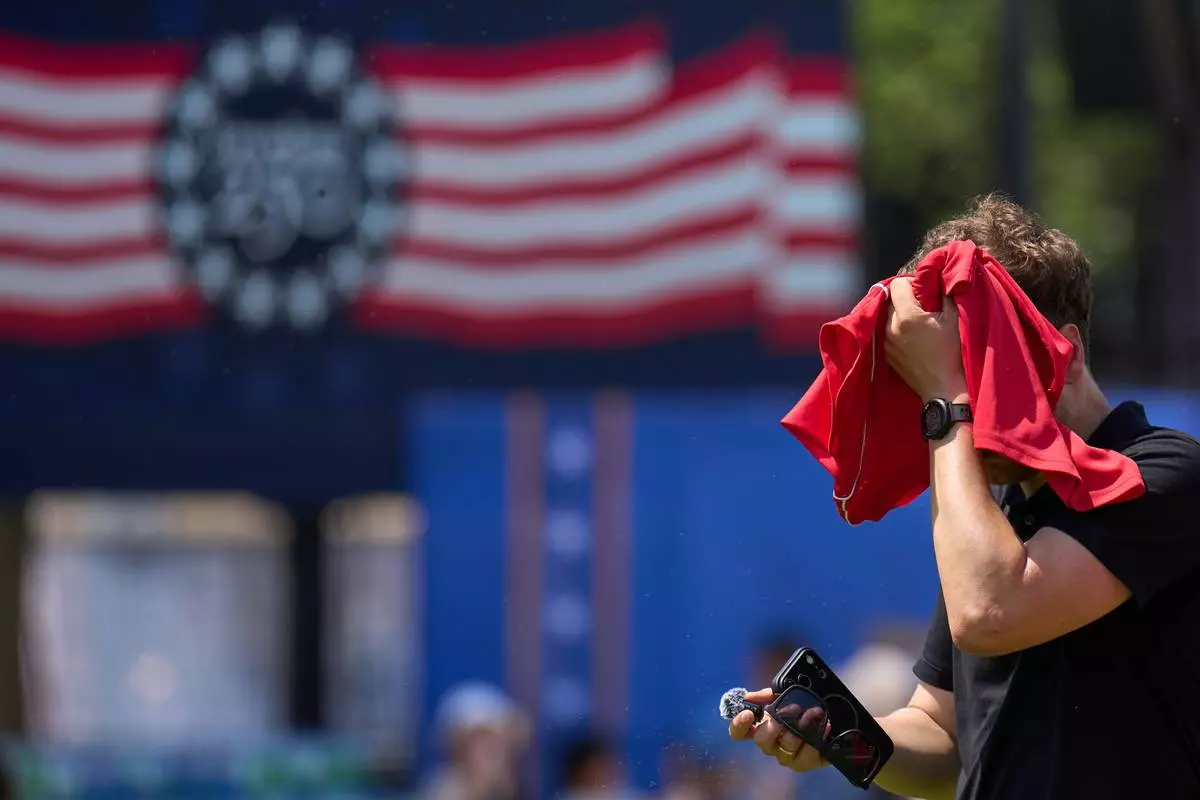
A man wipes sweat off of his head while attending the Great American State Fair, on the National Mall, Wednesday, July 1, 2026, in Washington. (AP Photo/Jacquelyn Martin)
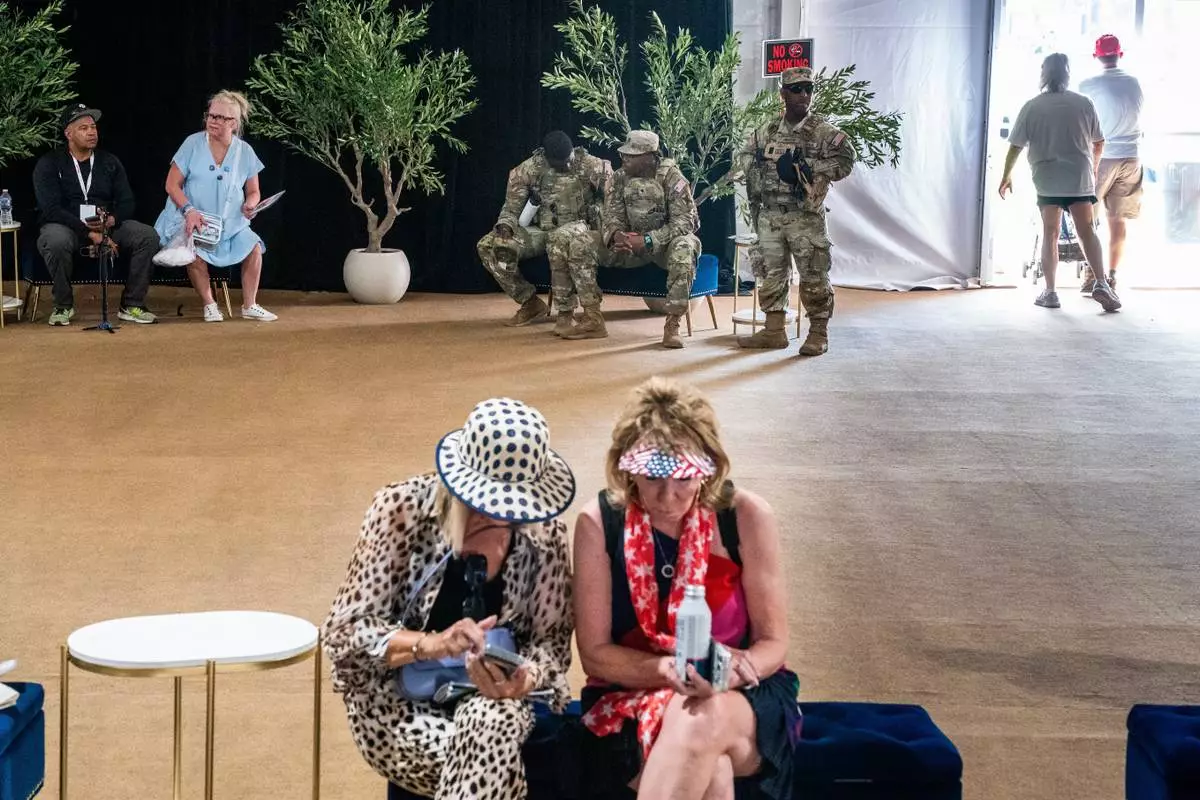
Visitors and members of the National Guard rest in the shade of a tent while attending the Great American State Fair on the National Mall, Wednesday, July 1, 2026, in Washington. (AP Photo/Nathan Howard)
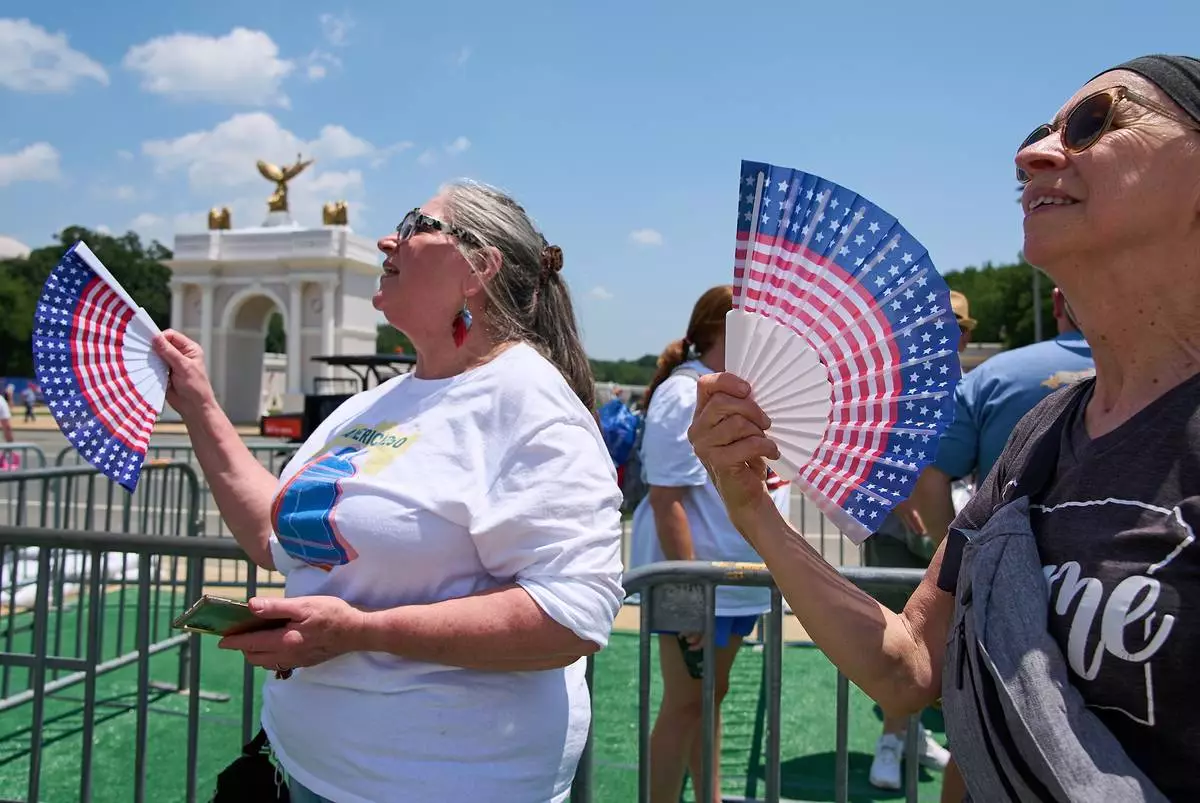
Mickelina Papotto, of Salem, Ore., left, and Lorie Odegaard, of Gaithersburg, Md., fan themselves while waiting in line for the ferris wheel at the Great American State Fair on the National Mall, Wednesday, July 1, 2026, in Washington. (AP Photo/Jacquelyn Martin)
Lulu Gribbin was 15 when she survived a shark attack off the coast of Florida. She lost her left hand, part of her right leg and almost her life.
What she didn’t know when she entered the water on that day in 2024 was that another woman had been bitten by a shark 90 minutes earlier and just 3 miles (4.8 kilometers) down the beach. Had she known about the earlier attack, there is no way she would have been swimming, she said.
Gribbin’s story has inspired new federal legislation to authorize emergency alerts to mobile phones to warn beachgoers when a shark has bitten someone in the area.
President Donald Trump last week signed “Lulu’s Law,” which requires the Federal Communications Commission to allow the emergency messages. The legislation, which Gribbin advocated for, authorizes the warnings by classifying a shark attack as an event for which an emergency alert can be issued. It is up to states to implement the warnings. Gribbin’s home state of Alabama approved such a warning system last year.
“It’s really just common-sense legislation. It says that whenever there has been a shark attack in a certain area where you are near, it will send an alert to your phone, exactly like how an Amber Alert system works when a child is abducted,” she said.
Gribbin said she hopes the alert system will help prevent attacks like hers. “I definitely see this law working in the future and I'm really excited to hopefully save lives,” she said.
Gribbin was one of three people bitten by a shark on June 7, 2024, off the Florida Panhandle.
She was on a mother-daughter trip to the Florida Panhandle. Gribbin said she and her friend had been diving for sand dollars.
“All of the sudden my best friend yelled, ‘Shark!’ and so we all started swimming for our lives,” Gribbin recalled. She said she remembered that sharks are attracted to frantic splashing and yelled for everyone to be calm. Gribbin, who was closest to the shark, was bitten.
“The shark bit off my hand first, and I raised my arm out of the water, and there was just flesh and bone there,” Gribbin said. The shark then latched onto her leg. A man punched the shark off her and strangers on the beach rushed to help. She was flown by helicopter to a nearby hospital.
Doctors were able to save the teen's life but had to amputate part of her right leg.
In the hospital, Gribbin made a deliberate decision to choose joy and to never give up.
She initially struggled knowing, “that I only have two regular limbs, and that my life would be completely different.”
“I would cry, and I would ask my mom, ‘Why is it happening to me?’ And on that day, we put a Bible verse on my bedside table that said, ‘With God, all things are possible.’ And then she told me that what you look like doesn’t define you, it’s who you are on the inside. And so, I think that stuck with me throughout my whole recovery the past two years.
It doesn’t matter what I look like, as long as I’m spreading positivity and inspiring others to stay strong and to never give up,” she said.
Gribbin was fitted with prosthetic limbs, quickly regained her ability to walk, returned to sports and got her driver’s license. She has gone back in the water and learned to surf, meeting Bethany Hamilton, a professional surfer who lost her arm in a shark attack.
U.S. Sen. Katie Britt, the Alabama Republican who sponsored the legislation, said the fact that Griffin was bitten soon after an attack on another woman prompted discussions about what could have been done differently. That led to the idea of an alert. She contacted Griffin's parents who had thought about the same possibility.
“If there had been any type of alert that was given, that there’s no way that Lulu would have been in the water. And so we talked about how a simple change could have made a huge impact,” Britt said.
While sharks are commonly found in the waters off the United States, shark bites are rare, said Gavin Naylor, director of the Florida Museum of Natural History’s shark research program.
There are between 60 to 80 known unprovoked bites worldwide each year, he said. It's extremely rare that two or more people are bit in close proximity. He said in a database of known shark bites, called the International Shark Attack File, there have only been a few instances of multiple bites in a single day.
“If somebody is bitten by a shark, and then an alert goes out, the probability that another person’s going to be bitten by a shark within, let’s say, two or three hours is incredibly small,” Naylor said.
When that happens, he said it’s likely because of environmental conditions such as sharks following schools of bait fish closer to the shore. Murky water conditions can also be a factor because they increase the chance that a shark will mistake a person for a fish or seal.
In the area where Gribbin was bitten, there are about 20 to 30 bull sharks 1,312 feet (400 meters) offshore at all time, Naylor said. Great white sharks have been spotted more frequently in the chilly waters of New England and Atlantic Canada, according to conservation groups. A smartphone app called Sharktivity also allows shark spotters to report their sightings.
The sightings might unnerve people, but Naylor said it's important to remember that shark attacks are rare.
“If sharks wanted to eat people, we’d have about 10,000 bites a day. The fact that we have so few is basically testament to the fact that the sharks are doing their level best to avoid people, not to target them,” Naylor said.
Britt said she believes parents and others on the beach will want the information. “I know as a parent, I want every tool in my toolbox to be able to keep my child safe,” Britt said.
Braxton Rocha, who was bitten by a large tiger shark off the north shore of the Big Island of Hawaii, said he liked the idea of an alert system. He thinks it is information that people, particularly tourists to the island, will want to know.
Rocha was spearfishing in 2015 when he saw the large shark. “Looked like a bus or submarine. She was the biggest thing I’d seen in the ocean at that time,” Rocha said. He started making his way to shore. When he looked back to check where the shark was, the animal was right in front of him. He tried to push the shark away, but the animal was too big and powerful. It latched onto his leg. Rocha punched it in the nose and the shark let go and swam away.
“Everything happened so fast. It was almost like being struck by lightning. I was still kind of out of it. I looked down and see giant clouds of blood just bursting out of my leg,” he said.
It took nearly 100 staples to repair the gaping wound on his leg. But the experience did not dampen Rocha's enthusiasm for the ocean and wildlife. “I’ve always loved sharks,” Rocha said.
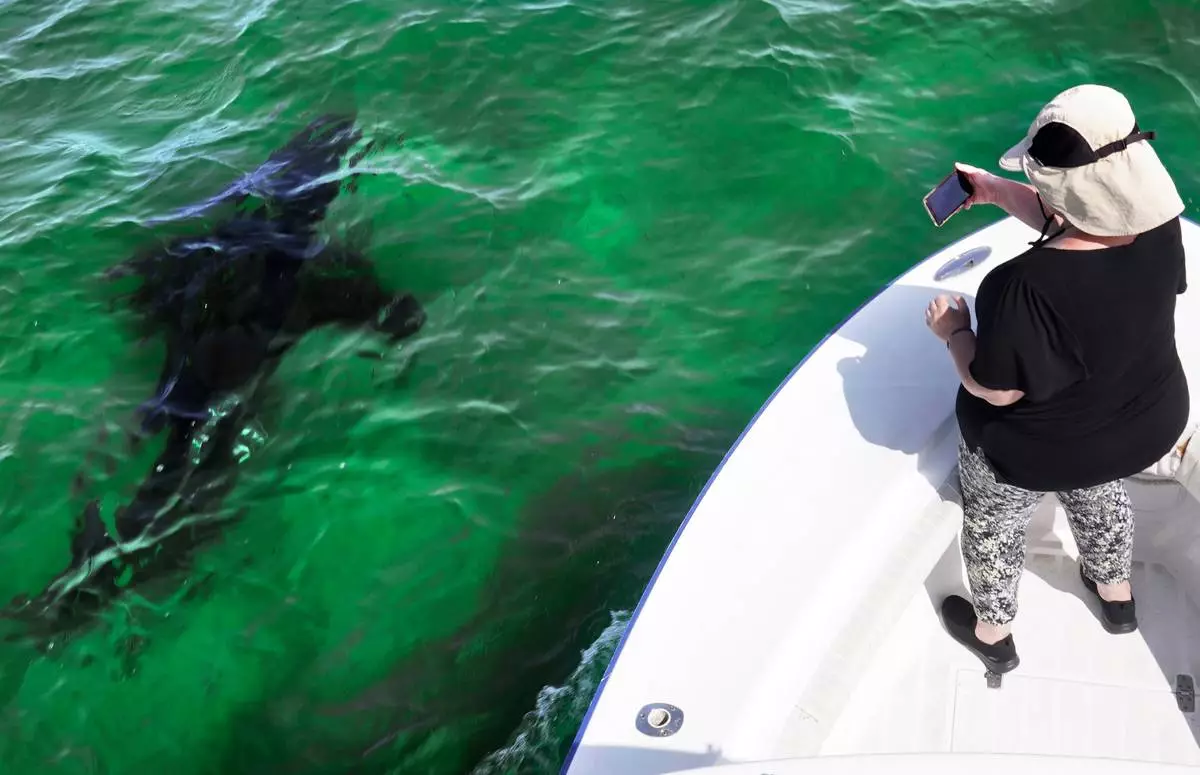
FILE - Mindi Moran, of Portland, Maine, watches a great white shark swims past while on shark watch with Dragonfly Sportfishing charters off the Massachusetts' coast of Cape Cod, Aug. 17, 2021. (AP Photo/Charles Krupa, File)
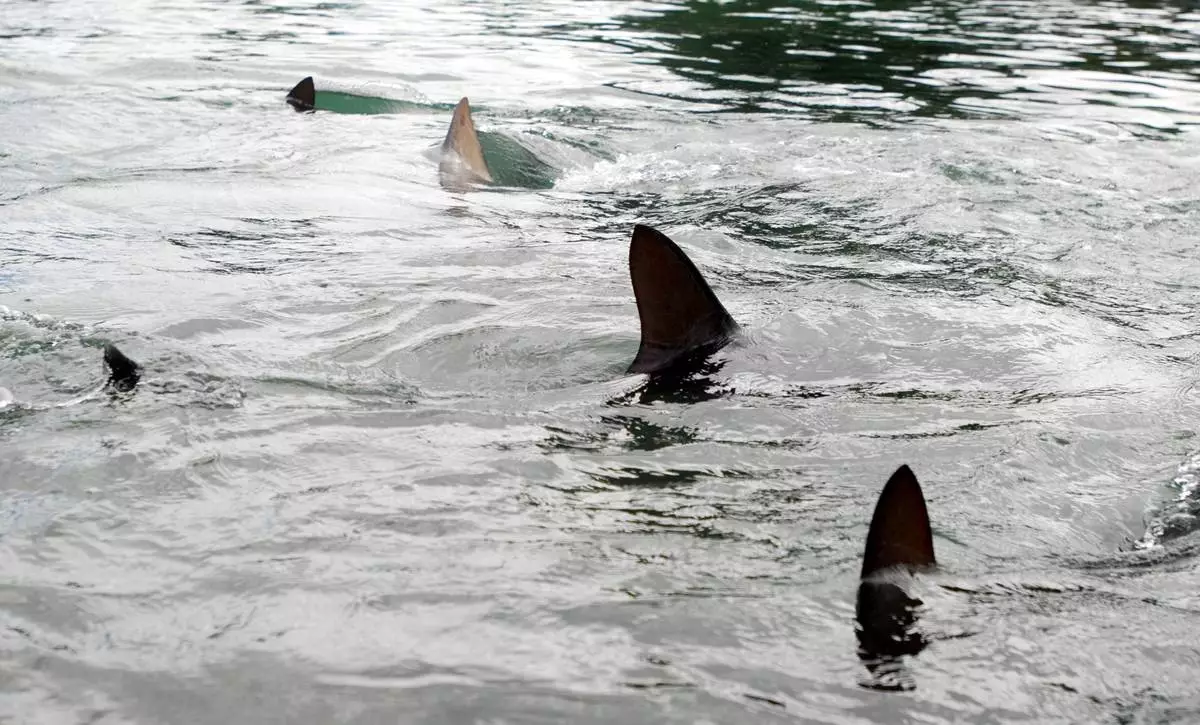
FILE - Sand and hammerhead sharks swim in a holding tank at the University of Hawaii's Institute of Marine Biology on Oahu's Coconut Island on Jan. 21, 2016. (AP Photo/Caleb Jones, File)
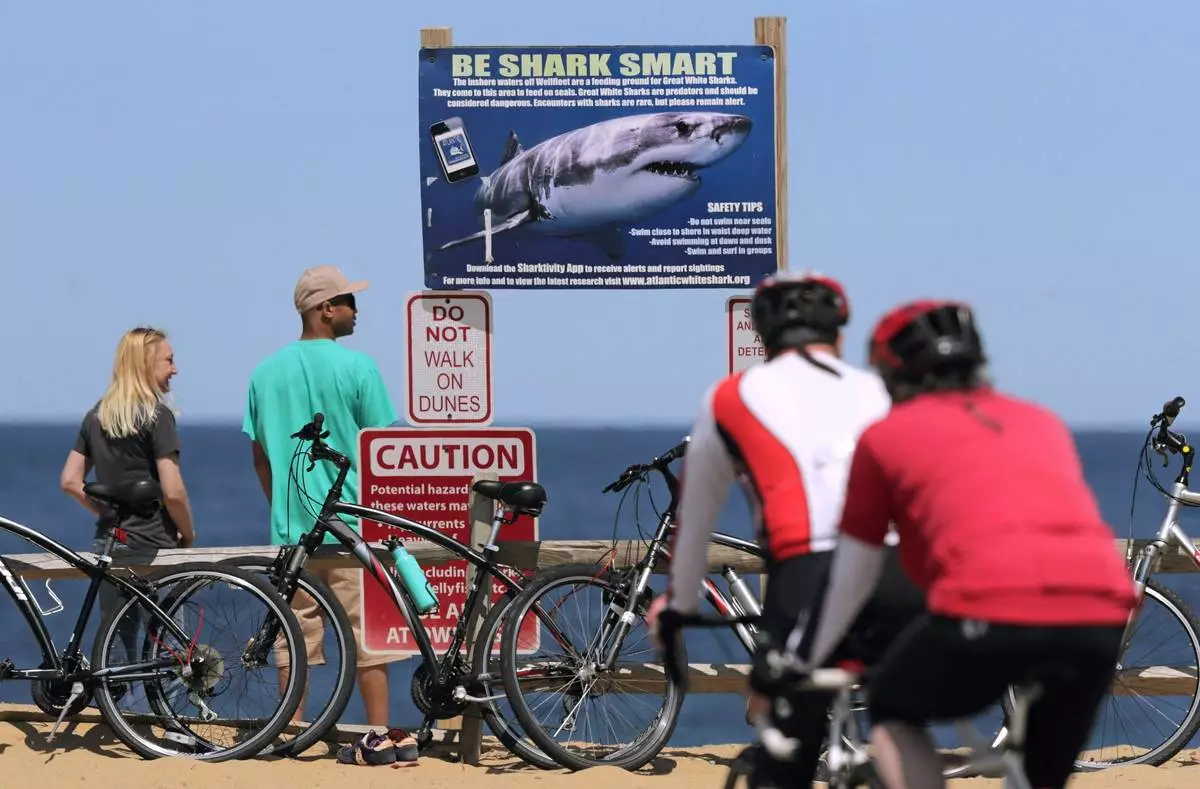
FILE - A sign warns beachgoers about sharks at Lecount Hollow Beach May 22, 2019 in Wellfleet, Mass. (AP Photo/Charles Krupa, File)