The 2026 World Cup is bringing crowds back to stadiums across North America, but in the Gaza Strip, a stadium-turned shelter witnesses local people's shattered football and World Cup dream.
In the southern city of Khan Younis, a stadium that once hosted matches with the memories of hundreds of players has become a shelter for displaced families. Its facilities lie in ruins, its pitch has lost its green turf, and rows of worn tents now cover much of the ground where football games were once played.
For Hassan Abu Habib, a former footballer in Gaza, returning to Khan Younis Municipal Stadium was both familiar and painful.
"This football pitch used to be 100 meters long and 70 meters wide, covered with green artificial turf. Today, sadly, it is just sand and sewage. The situation is deeply depressing," Abu Habib said.
The goalposts are gone. Families now live in former locker rooms and office areas. Between the tents, a small open patch of just over 20 square meters is one of the few places left where children can still kick a ball.
The stadium began to change more than two years ago. In late 2023, as Israeli military operations intensified in southern Gaza, Khan Younis Municipal Stadium was badly damaged.
The club where Abu Habib had played for years was also reduced to rubble, forcing many of those who once trained and competed there to leave. His football career of more than a decade came to an abrupt end.
"My medals, my individual honors and the team trophies are all buried under the rubble. Because when one is forced to flee, one can only think about carrying the most essential things. We could not take any of those things, so they were left under the rubble," Abu Habib said.
According to the Palestinian Olympic Committee, 265 sports facilities in Gaza had been damaged as of February during the latest large-scale Palestinian-Israeli conflict, of which 184 were completely destroyed. More than 1,000 Palestinian athletes, coaches and other sports workers had also been killed in the conflict, the committee said.
For many displaced residents, football has not disappeared from daily life, but the joy once associated with the game has been overshadowed by the struggle to find food and water.
"The Khan Younis stadium used to be enthusiastic. The stands would be packed with fans cheering for the players, and the players would come over to salute the crowd. Of course, we are still following the World Cup, but in a very different way. Today, we watch the World Cup while thinking about the next day — how to get food from the charity kitchen, and how to find drinking water and water for daily use. Compared with 2022, the atmosphere of the 2026 World Cup is very different," said Bilal Hamdan, displaced resident in Gaza.
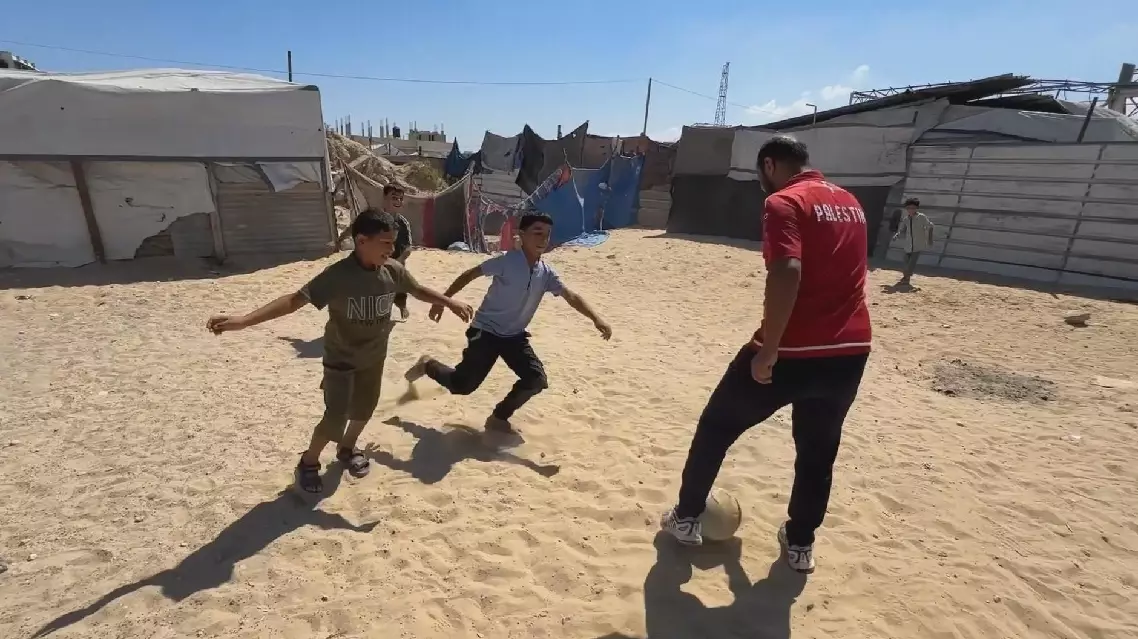
Stadium-turned shelter witnesses Gazans' shattered World Cup dream