Japanese shares closed mixed on Monday, as a result of the impact of weak performance in technology companies and falling oil prices, said Timothy Pope, a market analyst for China Global Television Network (CGTN).
Tokyo stocks ended mixed Monday as investors took profits in recently outperforming heavyweight technology shares, while falling crude oil prices eased inflation concerns.
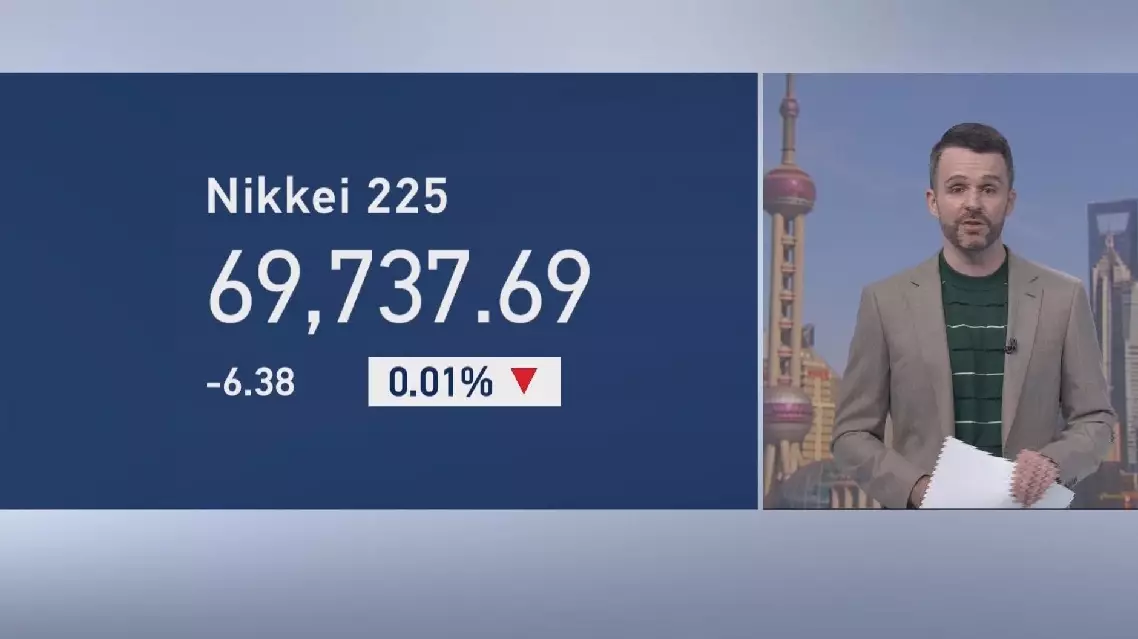
The benchmark 225-issue Nikkei Stock Average edged down 6.38 points, or 0.01 percent, from Friday to 69,737.69.
The broader Topix index, meanwhile, extended its gains to a sixth straight session, finishing up 37.36 points, or 0.92 percent, at a record close of 4,101.96.
The Nikkei spent most of the day in negative territory as investors locked in gains on heavyweight chip- and artificial intelligence-related stocks, although dip-buying briefly lifted the index into positive territory.
At the same time, the retreat in crude oil prices to levels seen before the Middle East conflict helped ease inflation concerns and support market sentiment, analysts said.
"In Tokyo today we saw a bit of similar trend to the Greater China markets -- the broader Topix Index rose a little under 1 percent as cyclical and energy stocks took over from the Nikkei's tech heavyweights. The Nikkei 225 closed flat with the tech weakness leaving it struggling to make headway. The U.S. markets closed on Friday, too, ahead of the July 4 holiday, and that left Tokyo traders lacking a little bit of direction. Helping to counter that there was the OPEC+ decision at the weekend to increase oil production, and that should help to stabilize sentiment over Japan's energy security," Pope said.
Tokyo stocks end mixed on weak tech performances
The Chinese stock market closed lower on Monday, mainly due to shift in trade and the rolling out of new trading rules, said a market analyst Timothy Pope.
Chinese stocks closed lower on Monday, with the benchmark Shanghai Composite Index down 0.06 percent to 4,041.24 points.
The Shenzhen Component Index closed 1.16 percent lower at 15,416.80 points.
The ChiNext Index, tracking China's Nasdaq-style board of growth enterprises, fell 1.77 percent to close at 3,948.86 points.
The ChiNext Index, together with the Shenzhen Component Index and other indices, reflects the performance of stocks listed on the Shenzhen Stock Exchange.
Pope said regardless of the general downturn, some of the traders' shift from tech names towards cyclical stocks brought positive signs to the market.
"We did see a bit of a shift in trade on the Chinese mainland markets today, away from tech names and towards cyclical stocks. That shift had helped the Shanghai Composite Index stay positive for most of the session but it did slip into the negative just ahead of closing time. The cooler attitude to tech today had the Shenzhen Component down 1.2 percent and the ChiNext board down 1.8 percent. Instead of tech we saw gains for energy and financial stocks in the main, with the big banks and coal and oil majors contributing the most to the Shanghai index," he said.
China's stock exchanges began to follow revised A-share trading rules on Monday, which include extending after-hours fixed-price trading and unifying daily price limits for risk-alert stocks with other stocks across the main board. Pope said the changes of rules could also lead to market volatility to some extent.
"Mainland exchanges have also been rolling out those new set of trading rule changes today. In addition to some that we talked about, we have also the daily price limit for the so-called Special Treatment or 'risk-warning' stocks - companies flagged for financial trouble - has been doubled from 5 to 10 percent. That's going to affect a fairly small section of the market, around 150 stocks, but that is nearly 7 million investors. Brokerages are cautioning retail investors not to mistake the wider trading band for any sort of assessment of reduced risk, because many of these companies still face a real chance of being de-listed. Another change which took affect today was widened after-hours trading, which is now going to cover all A-shares and ETFs (exchange-traded funds), not just tech-board names," Pope said.

China stocks fall amid shift in trade, revised trading rules: analyst