People in northern Venezuela's Puerto Cabello City have started to rebuild their daily life after two deadly earthquakes jolted the country on June 24.
The twin earthquakes have already killed 3,342 people and injured 16,740 others, according to official figures released on Sunday.
Several communities in Puerto Cabello saw homes collapse and the power system cut off as the strong quakes hit. Even some hospitals in the city crumbled, prompting an emergency evacuation of patients.
After days of rescue and response efforts, the city's power system stabilized and repairs on damaged homes have begun.
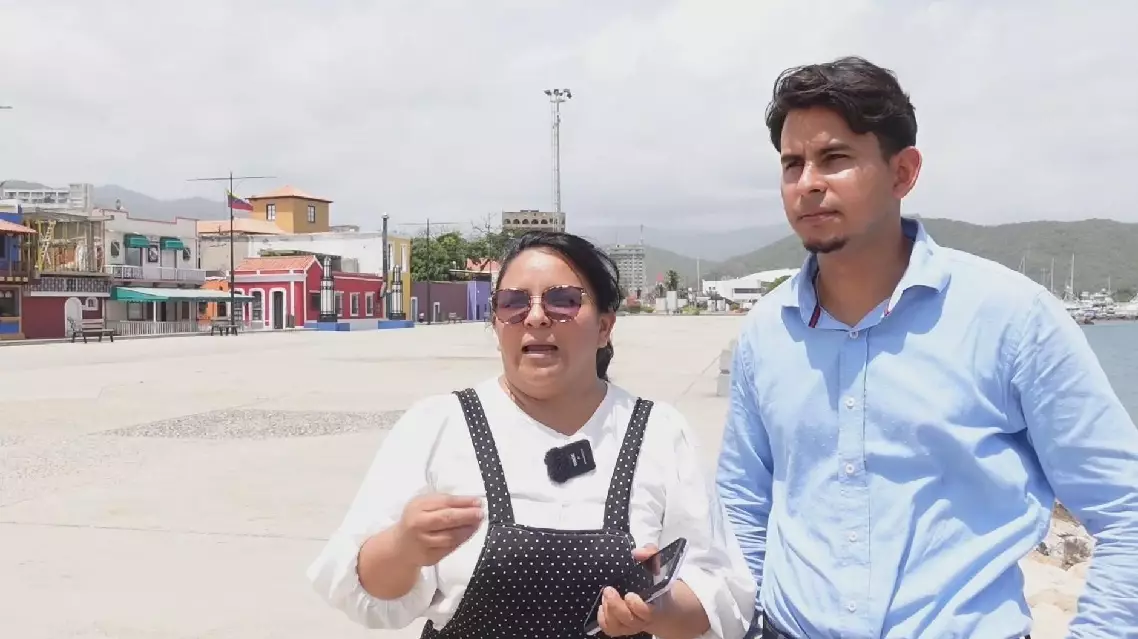
"Thank God the disaster here was relatively mild. Puerto Cabello took less of the impact. But after the disaster, local people spontaneously offered help to the victims. Now everyone is working together to help rebuild the city," said Julio Gonzalez, a local resident.
"Tourism in Puerto Cabello has taken a hit, and people go out and gather much less now. But it's okay. We'll adjust slowly, and we'll adapt. The earthquakes let us feel the spirit of solidarity, like in a one big family," said Kaila Silva, another resident.
Daily life has largely returned to normal, but as Venezuela's largest port, Puerto Cabello still faces two major challenges.
The first is port logistics. As port operations at the worst-hit city of La Guaira are being redirected to Puerto Cabello, pressure on its ports has increased.
The second is the oil production of the city's El Palito refinery. The plant, with a capacity of over 140,000 barrels per day, halted production after a quake-triggered power outage. It is still unknown if its oil output has returned to pre-quake levels.
Northern Venezuela residents start to rebuild life after earthquakes
The Beijing Space Computing Innovation Center, unveiled on June 29 in the capital city's satellite town in the northwestern district of Haidian, is expected to gather talent across sectors and drive growth in the space computing industry, according to industry insiders.
Jointly led by the Beijing University of Posts and Telecommunications and leading enterprises in the space computing sector, the center will work on tackling common technological challenges such as large-scale space models, while advancing the construction of public platforms, the formulation of industry standards, and the commercialization of application scenarios.
The Beijing Space Computing Innovation Alliance was also launched at the same time, expected to bring together 108 diverse innovation entities ranging from universities and research institutes to state-owned enterprises and private companies to pool resources and strengthen industry collaboration.
"Space computing power in effect is a field with a very long industrial chain, covering commercial aerospace -- which has developed rapidly in recent years -- as well as chips, artificial intelligence, cloud-related technologies, and specific application scenarios -- integrating all of these together for organized research and development," said Fu Yunhao, CEO of Beijing Tiansuan Xinglian Technology Company.
"As satellite networks become increasingly advanced, they will inevitably host a variety of value-added services and applications. And these value-added services and applications will certainly require computing," said Wang Shangguang, dean of the School of Computer Science at the Beijing University of Posts and Telecommunications.
Space computing power technologies refer to deploying computing facilities within an orbital satellite system so that massive volumes of data can be processed, stored and transmitted in orbit. Compared with traditional space information processing method, where data collected by satellites need to be sent back to the Earth for processing, space computing power technologies can break through latency bottlenecks and be applied to numerous scenarios such as remote sensing and monitoring.

Beijing's new space computing innovation center to attract talent, drive growth: insiders