Millions of Iranians paid their last respects to late Supreme Leader Ali Khamenei at his funeral procession in Tehran on Monday, following a two-day farewell ceremony.
The mourners, including local Tehran residents and those from across the country, started to rally at the Azadi Square, one of Iran's most iconic landmarks, at around 04:00 in the morning.
The funeral procession was originally scheduled to begin at 6:00 and last around 10 to 12 hours, with the hearse carrying the coffins of Ali Khamenei and his deceased family members driving 10 kilometers across Tehran's main districts. However, the authorities later altered the plan due to the growing number of mourners.
As the funeral procession began, Ali Khamenei's hearse was parked near the Azadi Square, the terminal point of the procession. Authorities announced that a helicopter would later carry Ali Khamenei's coffin over the entire route.
Despite the scorching weather, many mourners swarmed to the streets holding the late supreme leader's portraits while waving Iran's national flags, chanting slogans against the United States and Israel throughout the procession.
"Khamenei was a man who dedicated his life to the struggle against oppression. Therefore, at this moment, it is our responsibility to attend his funeral. We still cannot believe he has perished, and this will be the pain we have to endure for the rest of our lives," said Ali, a Tehran resident.
According to Iran's official plan, another funeral procession for the late supreme leader will be held in the central city of Qom, and on Wednesday, Khamenei's body will be transferred to the Shiite holy cities of Najaf and Karbala in Iraq for further rites.
The late supreme leader will be laid to rest on Thursday in his birthplace -- the northeastern Iranian city of Mashhad.
Ali Khamenei was killed in a U.S. and Israeli strike in Tehran on Feb. 28. His son, Mojtaba Khamenei, was selected as Iran's new supreme leader in March.
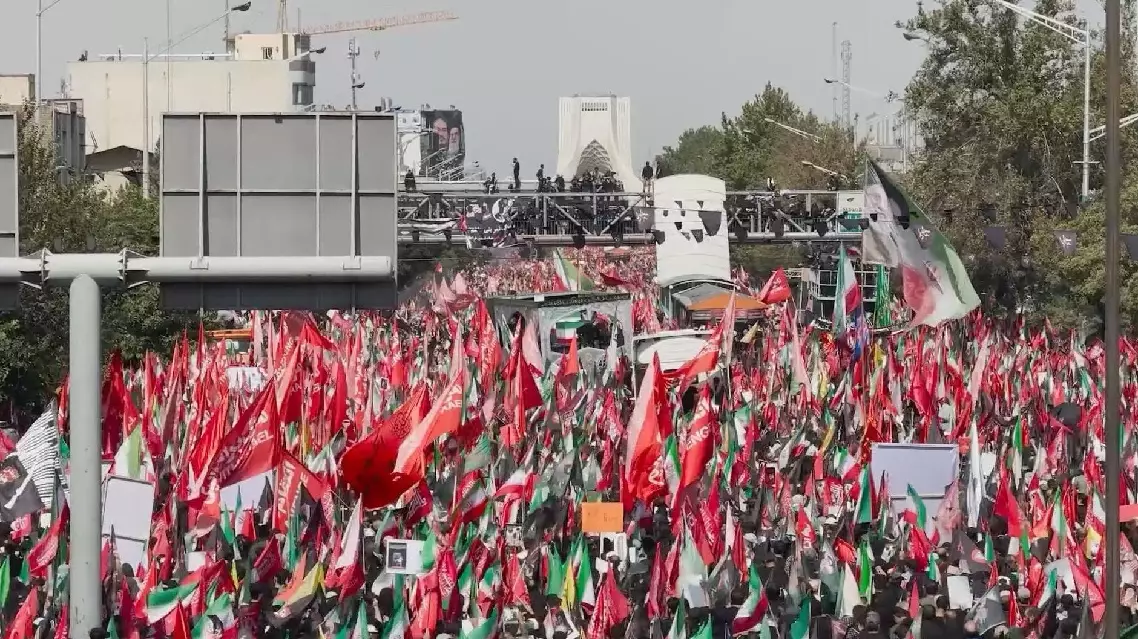
Iranians mourn for late supreme leader Ali Khamenei in Tehran
The Chinese stock market closed lower on Monday, mainly due to shift in trade and the rolling out of new trading rules, said a market analyst Timothy Pope.
Chinese stocks closed lower on Monday, with the benchmark Shanghai Composite Index down 0.06 percent to 4,041.24 points.
The Shenzhen Component Index closed 1.16 percent lower at 15,416.80 points.
The ChiNext Index, tracking China's Nasdaq-style board of growth enterprises, fell 1.77 percent to close at 3,948.86 points.
The ChiNext Index, together with the Shenzhen Component Index and other indices, reflects the performance of stocks listed on the Shenzhen Stock Exchange.
Pope said regardless of the general downturn, some of the traders' shift from tech names towards cyclical stocks brought positive signs to the market.
"We did see a bit of a shift in trade on the Chinese mainland markets today, away from tech names and towards cyclical stocks. That shift had helped the Shanghai Composite Index stay positive for most of the session but it did slip into the negative just ahead of closing time. The cooler attitude to tech today had the Shenzhen Component down 1.2 percent and the ChiNext board down 1.8 percent. Instead of tech we saw gains for energy and financial stocks in the main, with the big banks and coal and oil majors contributing the most to the Shanghai index," he said.
China's stock exchanges began to follow revised A-share trading rules on Monday, which include extending after-hours fixed-price trading and unifying daily price limits for risk-alert stocks with other stocks across the main board. Pope said the changes of rules could also lead to market volatility to some extent.
"Mainland exchanges have also been rolling out those new set of trading rule changes today. In addition to some that we talked about, we have also the daily price limit for the so-called Special Treatment or 'risk-warning' stocks - companies flagged for financial trouble - has been doubled from 5 to 10 percent. That's going to affect a fairly small section of the market, around 150 stocks, but that is nearly 7 million investors. Brokerages are cautioning retail investors not to mistake the wider trading band for any sort of assessment of reduced risk, because many of these companies still face a real chance of being de-listed. Another change which took affect today was widened after-hours trading, which is now going to cover all A-shares and ETFs (exchange-traded funds), not just tech-board names," Pope said.

China stocks fall amid shift in trade, revised trading rules: analyst