The Potala Palace Fire and Rescue Brigade patrols the 1,300‑year‑old landmark in Lhasa daily, combining modern firefighting technology with round‑the‑clock vigilance to guard the UNESCO World Heritage site against fire risks that threaten its cultural legacy.
The palace rises above Lhasa, capital of Tibet Autonomous Region in southwest China, and is considered the world's highest‑altitude and best‑preserved palace complex.
Norbu Tsering has led the Potala Palace Fire and Rescue Brigade for nine years. He said the palace, built mainly of wood, earth, and stone, is highly vulnerable to fire. Its interconnected design means a blaze could spread quickly from one building to another, while flammable relics such as thangkas and tapestries add to the risk.
Working with the management office, the brigade combines technology with on‑the‑ground patrols, running 24‑hour shifts and carrying out daily checks before opening and after closing to eliminate hazards from ignition sources to electrical systems.
Fu Mei Tianci, a firefighter, said the team has introduced smart monitors, alarms, sensors, fiber‑optic cables, and emergency call systems that now cover every corner of the palace.
Despite these advances, the brigade has remained on duty without a break since 1984, taking on more rescue and service duties as tourist numbers grow. Its efforts ensure that the morning bells and evening drums of the Potala Palace still echo across the land, while preserving the sacred dignity of this ancient monument.
The Potala Palace stands as a historical testament to China's governance of its frontier regions and a lasting witness to exchanges, interactions, and integration among the Chinese nation's diverse ethnic groups. Across its long history, politics, religion, culture, and art have intertwined to create countless remarkable stories.

Potala Palace fire brigade patrols ancient landmark in Lhasa
A rare rock carving of a four-horse chariot was recently discovered in the Helan Mountains of northwest China's Ningxia Hui Autonomous Region, marking the first finding of its kind in the area and filling a long-standing archaeological gap.
The carving was found on a boulder partially buried in an alluvial fan area. Surrounded by thick grass, only about 15 centimeters of the rock was exposed above ground, making it extremely difficult to spot.
"At first, we didn't notice it's a four-horse chariot pattern because there was a color difference between the grooves and the outer surface of the rock. Then I outlined the pattern with chalk and that's when we realized it features four horses. Unfortunately, part of the carving was broken," said Xu Xiaolong, a member of the Helan Mountains rock art survey team.
The carving measures 24 by 20 centimeters with groove marks about 1.5 millimeters deep.
The discovery fills a gap in similar themes, while enhancing the richness, diversity and uniqueness of the Helan Mountains rock carvings.
"The most common rock carvings we've found depict two-horse chariots, and this is the first time we've discovered a four-horse chariot here. In fact, four-horse chariot rock carvings are quite rare even across the country. They are usually associated with tribal communities, like those linked to grassland cultures, where a tribal chief or someone of high status might travel in a four-horse chariot," said Zhang Xu, deputy head of the cultural relics management department of the Helan Mountains Rock Art Management Office.
The Helan Mountains rock carvings are generally believed to date from between 3,000 and 10,000 years ago. Although the four-horse chariot rock carving cannot be precisely dated at present, an assessment based on the chisel marks, subject matter, carving techniques and general patterns excludes the Neolithic period.
"We think it might date to the late Bronze Age, possibly during the Spring and Autumn and Warring States periods (770 BC-221 BC) or possibly the Han Dynasty (202 BC-AD 220). It was likely created by nomadic people living in this area," said Zhang.
Stretching 250 km, Helan Mountains are home to over 20,000 ancient rock carvings created by early inhabitants with stones, metal tools or mineral pigments. The carvings depict diverse subjects ranging from natural images like human faces, animals and handprints, to ancient life scenes such as herding, hunting and rituals.
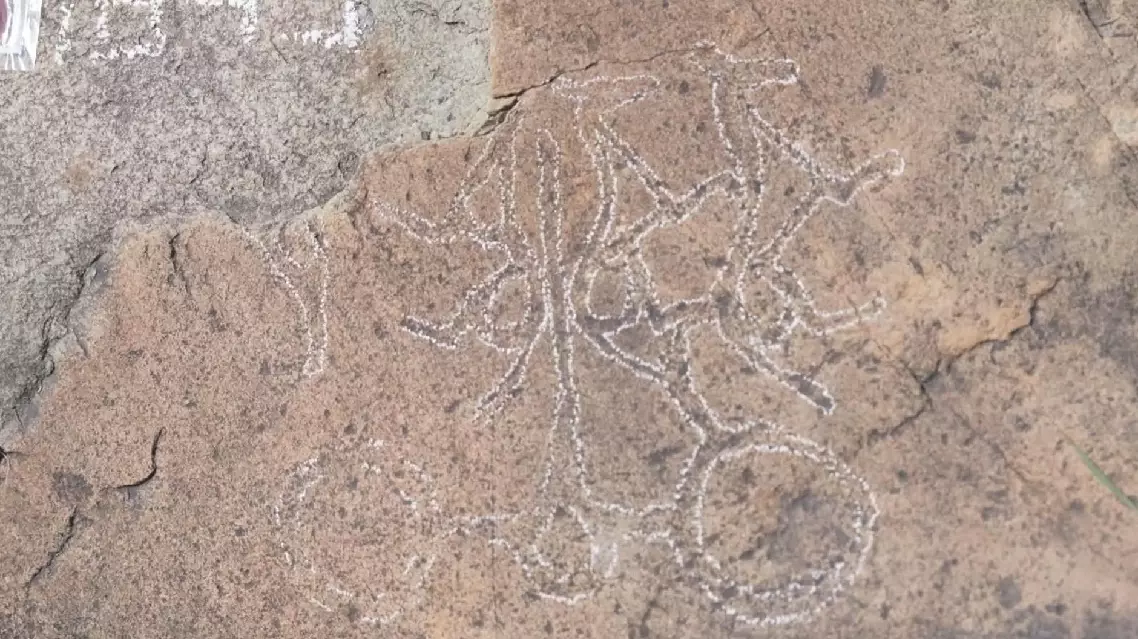
Rare four-horse chariot rock carving discovered in northwest China