With Typhoon Bavi forecast to land on Saturday night and bring heavy rain and strong winds to eastern China, railway authorities have suspended high-risk train services and rolled out comprehensive safety and passenger assistance measures across the affected regions.
The National Meteorological Center renewed an orange alert for the strong typhoon on Friday, with maximum sustained winds of 42 meters per second near its center. Heavy to torrential rain is expected to hit parts of Zhejiang, Fujian and Taiwan, with some areas of Taiwan facing up to 800 mm of precipitation.
In response, railway authorities have adjusted train operations on the Quzhou–Ningde, Ningbo-Jinhua, Shanghai–Kunming, and other lines, with suspensions scheduled from July 11 to 14 based on the typhoon's projected path. Additional suspensions have also been announced for several Beijing suburban lines on Friday.
At Beijing Railway Station, free raincoats are distributed to passengers.
To ensure the safety of operating trains, the Chengde track maintenance section has implemented full-cycle inspection procedures, with dynamic risk control measures in place.
Further service adjustments will be made flexibly based on wind speed, rainfall, and actual conditions.
Passengers holding tickets for suspended trains may claim full refunds with no service charge through the 12306 website or mobile app within 30 days after the scheduled travel date, or at station ticket offices with valid ID.
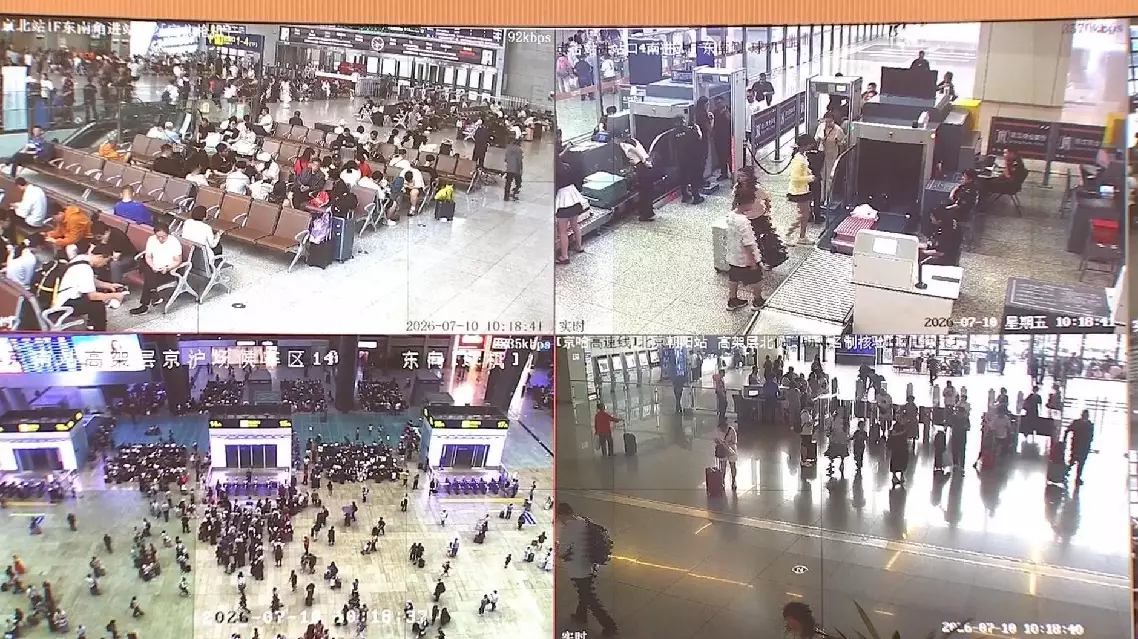
Railway system responds to Typhoon Bavi in emergency

Officials and community representatives have expressed strong confidence that Macao's new five-year plan (2026-2030) for economic and social development will effectively leverage the special administrative region's advantages to advance the cause of "one country, two systems" and better integrate into and serve China's overall development.
The plan, released by the Macao Special Administrative Region (SAR) government on Tuesday, sets out eight development goals. It serves as a comprehensive roadmap for Macao's next phase of growth, aligning closely with the national 15th Five-Year Plan (2026-2030) adopted by the National People's Congress in March.
"The Third Five-Year Plan is based on in-depth study and research into the new arrangements, new policies, new directions, key projects, and major initiatives of the national 15th Five-Year Plan and also considers the actual conditions and development needs of Macao and the Hengqin Cooperation Zone to identify Macao's strategic focus areas that leverage Macao's unique strengths and capabilities to meet national requirements and fully align with the national 15th Five-Year Plan," said Cheong Chok Man, director of the Policy Research and Regional Development Bureau of the Macao SAR.
Community leaders from various sectors have praised the plan's participatory drafting process and its ambitious yet pragmatic vision for the city's future. "The government has fully absorbed public opinion during the planning stage. This plan is not only the government's agenda but truly belongs to all sectors of society. It is designed to better harness the synergy between an effective market and a capable government. I believe the entire society would work together to advance the high-quality development of the 'one country, two systems' practice with Macao characteristics and better integrate into the nation's overall development," said Tong Kai Chung, dean of the Macao Institute of Management and a member of the SAR's sixth-term Executive Council. "The Third Five-Year Plan has drawn a new blueprint for Macao's future and provided clearer direction for our youth. The plan specifically emphasizes 'supporting youth growth and development.' What young people need most are opportunities and platforms. We believe that in the coming years, Macao's youth will find greater prospects in emerging fields such as technological innovation, the digital economy, cultural tourism, and convention and exhibitions," said Wong Chi Choi, chairman of the Macao New Youth Association.
The plan underscores the SAR government's commitment to promoting moderate economic diversification and strengthening Macao's role as a bridge connecting China with Portuguese-speaking countries and the broader global community.
Macao's sectors vow concerted efforts to usher in new era of high-quality development