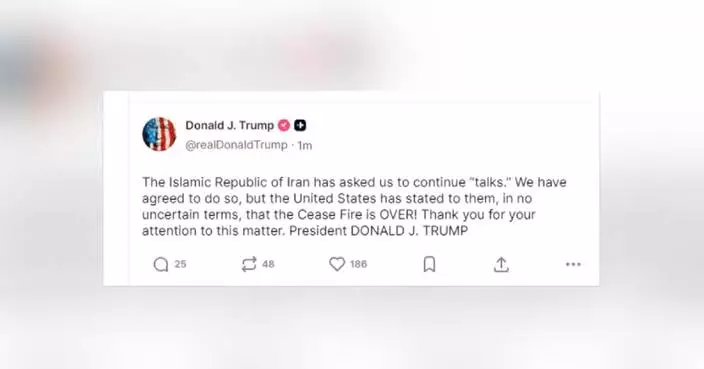
As oil flows through the Strait of Hormuz resumed in June, global oil prices fell and demand began to recover, but renewed exchanges of fire between the United States and Iran are clouding the market outlook, the International Energy Agency (IEA) said on Friday.
In its latest monthly oil market report, the agency noted that global oil consumption is rebounding from the lows recorded in May.
The report said that oil production in parts of the Gulf region had begun to recover as oil shipments through the Strait of Hormuz gradually resumed.
Global daily oil supply rose by 4.1 million barrels in June to 98.8 million barrels, yet that level remains roughly 9.4 million barrels below the pre-war figure.
Gulf region daily oil exports climbed by 6.5 million barrels to 16.1 million barrels in June, still well below the approximately 24 million barrels per day registered before the war.
Despite a sharp drop in international oil prices in June, the IEA cautioned that renewed exchanges of fire between the United States and Iran this week had clouded the outlook, saying that reaching "a lasting peace agreement" was "a must for the normalization in oil markets."
The IEA said global oil supply could improve further if renewed hostilities are swiftly de-escalated. If transit volumes through the Strait of Hormuz increase, global oil supply is expected to expand by 7.5 million barrels per day in 2027, the agency said.

IEA sees oil demand recovery, warns renewed US-Iran clashes threaten outlook
A documentary has revealed how generations of fishermen in south China's Hainan Province navigated the South China Sea for centuries with no GPS, no weather forecasts, relying only on a handwritten manual known as the Genglubu.
The documentary, Genglubu: Charting the South China Sea, premiered Thursday on China Global Television Network (CGTN).
Unintelligible to outsiders, the Genglubu was an invaluable navigational guide for fishermen and one of the most important items they carried on board.
"What Tanmen fisherman do is dive into the sea and catch fish ourselves. Finding better reefs means catching more fish. And that's why we keep going back to the South China Sea. My grandfather and father would study it like homework before setting out," said Wang Zhendong, curator of the Genglubu Museum in Hainan's Qionghai City.
Wang cannot personally interpret the old manuscript, but he understands its importance: his father studied it before every voyage, and his grandfather trusted it with his life.
"When electronic equipment fails, if you don't understand navigation, how are you going to bring everyone home safely? A captain needs to understand experience. So where does that experience come from? It comes from the Genglubu. It's the ancient knowledge recorded generation after generation," said Wang Shubao, Wang Zhendong's father.
Over generations, that knowledge was written down in the Genglubu.
"Geng" referred to both time and distance traveled at sea. One "geng" was about two hours of sailing, or roughly 10 nautical miles.
"Lu" referred to compass bearings and direction, while "bu" meant "book."
Without modern instruments, fishermen learned to read the sea -- its currents, its depths, its changing moods.
Knowledge shaped their navigation. The Genglubu recorded that knowledge.
One line in it says: From Tanmen port to the Xisha Islands' Zhaoshu (Paracel's Tree Island), follow the direction of the Qian, Sun, which is northwestward. It covers a distance of some 150 nautical miles.
Just a few lines, enough to guide a boat across open water.
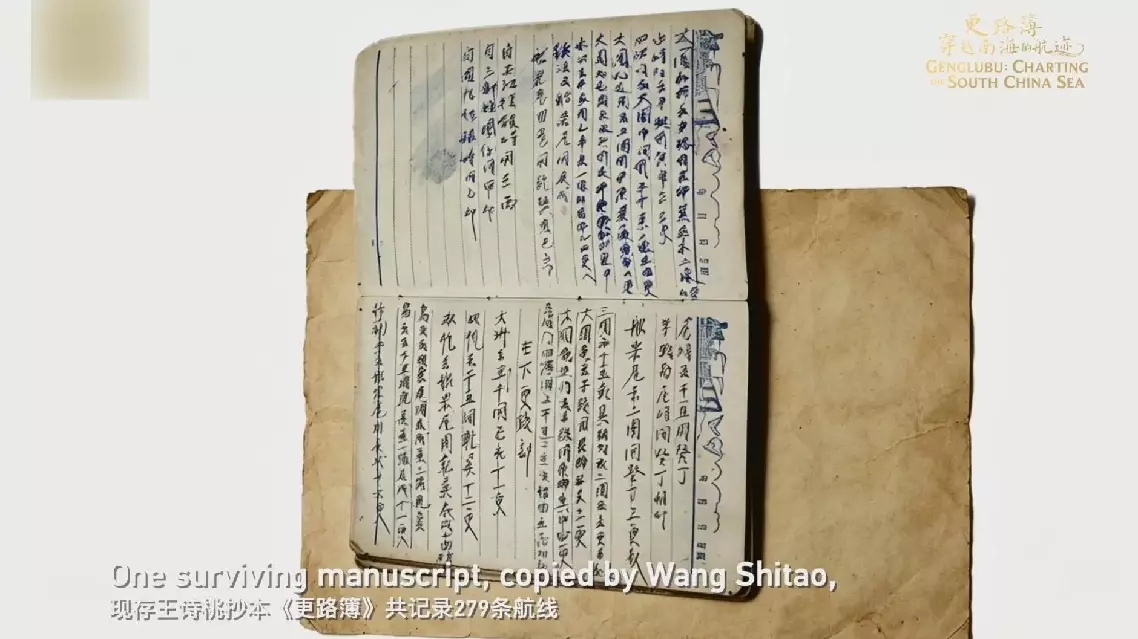
One surviving manuscript, copied by Wang Shitao, records 279 routes, making it one of the most detailed versions of the Genglubu known today. Its routes link Hainan with island groups across the South China Sea, with some extending even farther.
"Before Zheng He's voyages (1405-1433) to the Western Seas, the fishermen had already been working these waters of the South China Sea," said Zhou Weimin, a professor at Hainan University.
Experts say the Genglubu is more than a practical guide to navigation; it is also a record of China’s maritime history, cultural heritage and the accumulated wisdom of a people shaped by the sea.
"The Genglubu is a navigation handbook born of experience accumulated through long-term practice. It forms an integral part of China's maritime system. It is a cultural legacy created by our ancestors and a crystallization of the wisdom of a people with a long maritime tradition," said Liu Yijie, a professor at the Center for Studies of Fujian and Taiwan at Fujian Normal University.
Documentary decodes Genglubu - South China Sea's ancient GPS