Skip to Content Facebook Feature Image

Israel's parliament approves laws to enshrine exemption of ultra-Orthodox men from military service

News

Israel's parliament approves laws to enshrine exemption of ultra-Orthodox men from military service
News

News

Israel's parliament approves laws to enshrine exemption of ultra-Orthodox men from military service

2026-07-15 02:52 Last Updated At:03:01

TEL AVIV, Israel (AP) — Israel's parliament has approved laws that effectively halt the enlistment of ultra-Orthodox men in the country's military in a last-ditch effort by Prime Minister Benjamin Netanyahu's ruling coalition to woo religious political parties ahead of elections in the fall.

Lawmakers voted in a marathon session on Monday and Tuesday to both freeze the arrests of ultra-Orthodox draft evaders and to enshrine Jewish religious studies as a “foundational value” of the state.

Both laws represent significant concessions by Netanyahu's Likud party to ultra-Orthodox politicians seeking to formalize their community's de facto exemption from serving in the military, which is compulsory for most Jewish men and women in Israel.

The military is already grappling with troop shortages and many Israelis have grown tired of the longstanding system that allowed ultra-Orthodox men to avoid service. Each year, roughly 13,000 ultra-Orthodox men reach the conscription age of 18, but less than 10% enlist, according to a parliamentary committee.

The laws come in the wake of nearly three years of wars — from Gaza to Lebanon and Iran — and ahead of the Knesset's break for the summer recess. It will return just days before the next parliament elections on Oct. 27, a vote that will also be a referendum on Netanyahu's wartime leadership.

The prime minister, who has served more terms than any other premier in Israel's history, is courting the support of the ultra-Orthodox, also known as Haredim, in the upcoming polls.

“Netanyahu is trying to ensure that Haredim are going to negotiate only with him after the next elections,” said Shlomit Ravitsky Tur-Paz, head of the religious and state program at the Israel Democracy Institute think tank.

But Netanyahu faces stiff opposition, including from within his own party and even the military chief of staff, Ravitsky Tur-Paz said.

In a letter to Netanyahu and Defense Minister Israel Katz, military chief Eyal Zamir criticized the bills, describing them as “clearly and unequivocally inconsistent” with the military's needs, according to local media reports.

“It is inconceivable that the military system under my command, which demands unprecedented sacrifice from its personnel, would be party to granting mass exemptions from prosecution,” he wrote.

The exemptions for the ultra-Orthodox date back to the 1948 founding of Israel, when a small number of students sought to revive the Jewish scholarship system after it was decimated during the Holocaust.

Israel's Supreme Court later ruled that the exemptions are illegal. Experts say the law formalizing the study of the Torah, Judaism's foundational text, grants the state a legal basis from which to oppose the court's opinions.

The law is “an utter desecration of God’s name” that is “spitting in the face" of Israeli soldiers, said opposition leader Yair Lapid.

For Moshe Gafni, an ultra-Orthodox lawmaker who sponsored the bill, its passage is historic.

Melzer reported from Nahariya, Israel.
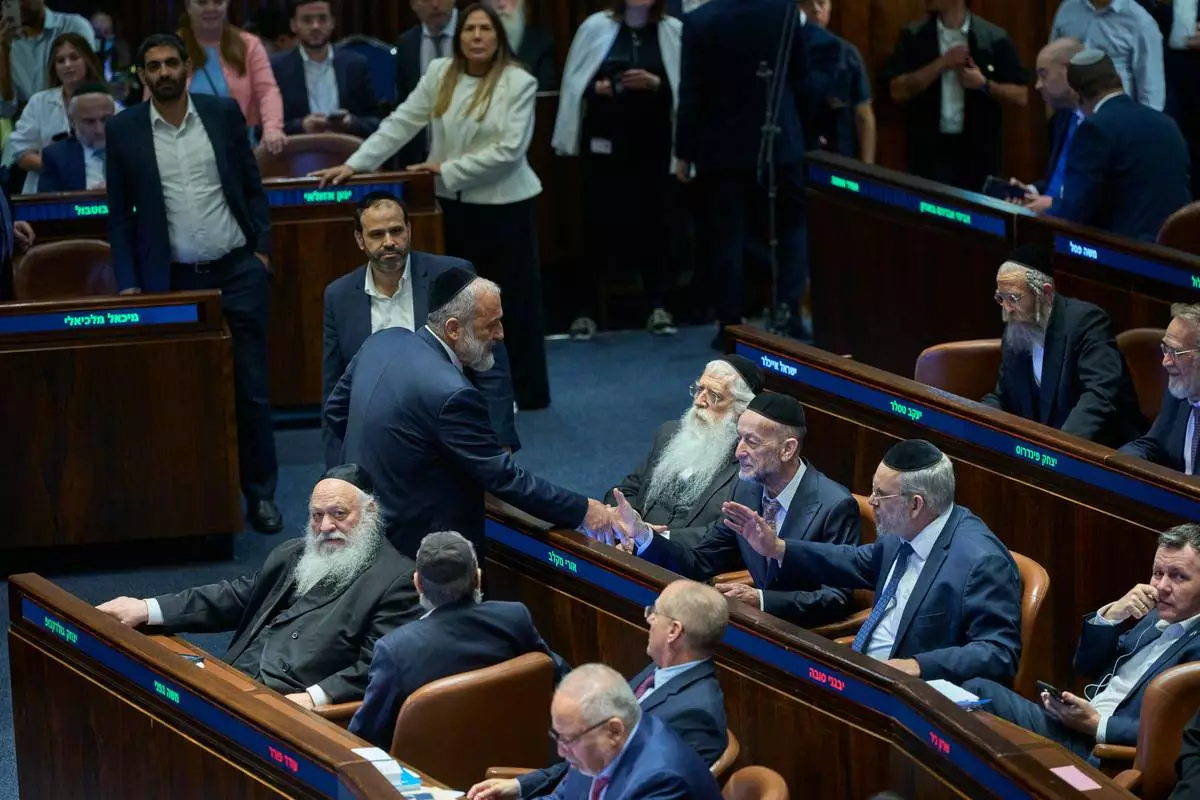
Israeli lawmakers attend a parliament session after the vote on a bill that seeks to equate the study of Jewish texts with military service, in Jerusalem, Monday, July 13, 2026. (AP Photo/Ohad Zwigenberg)
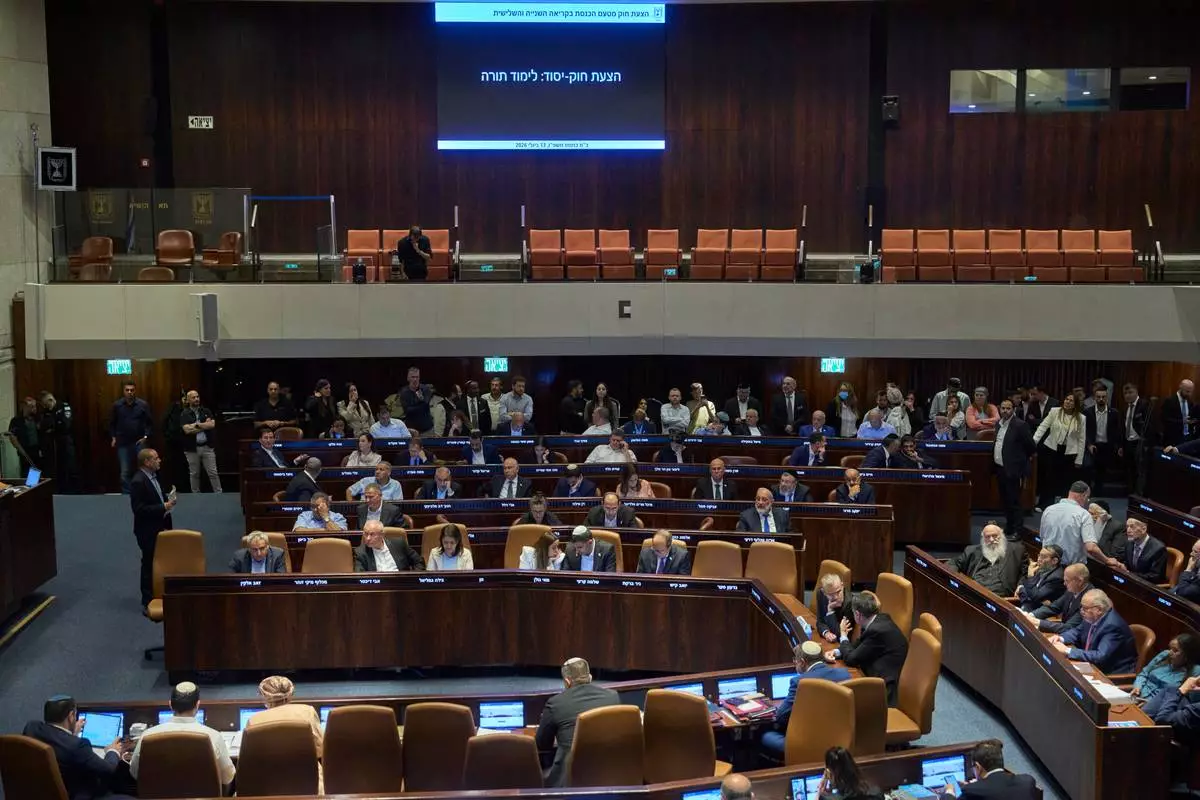
Israeli lawmakers attend a parliament session after the vote on a bill that seeks to equate the study of Jewish texts with military service, in Jerusalem, Monday, July 13, 2026. (AP Photo/Ohad Zwigenberg)
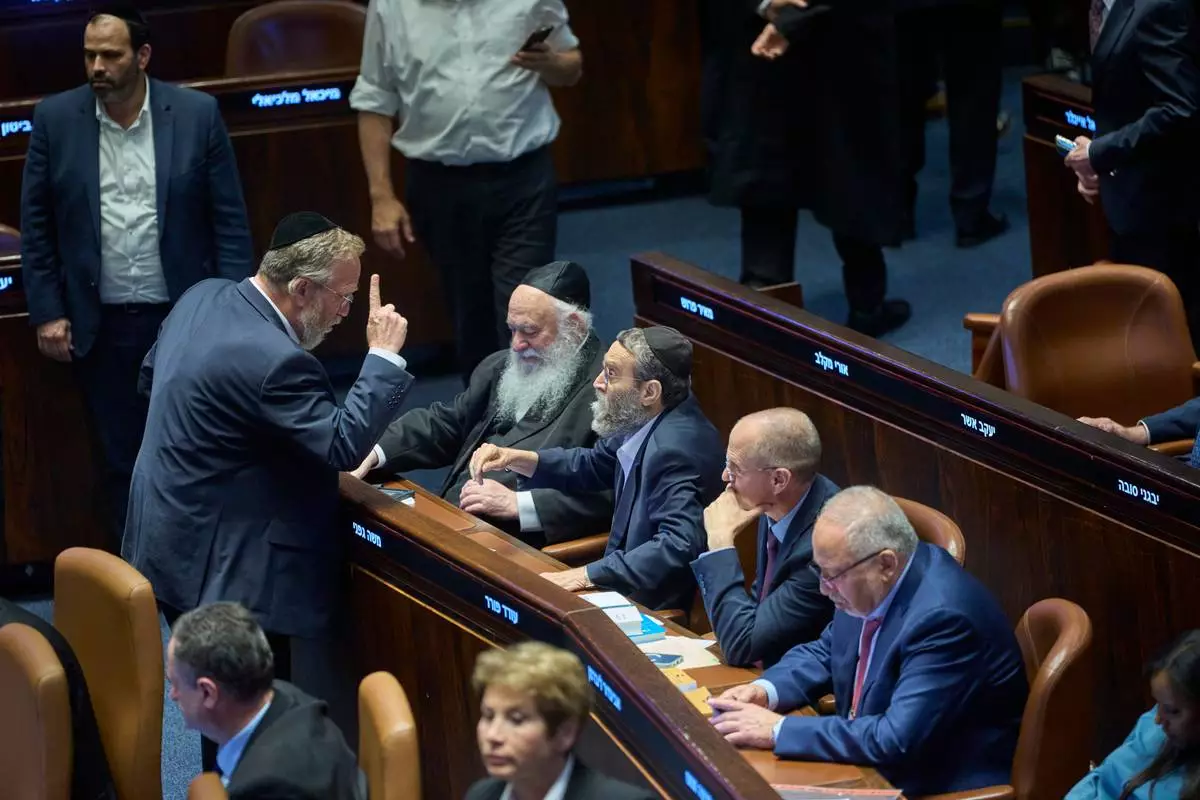
Israeli lawmakers attend a parliamental hearing for a bill that wants to equate study of Jewish texts with military service, in Jerusalem, Monday, July 13, 2026. (AP Photo/Ohad Zwigenberg)


Israeli lawmakers attend a parliamental hearing for a bill that wants to equate study of Jewish texts with military service, in Jerusalem, Monday, July 13, 2026. (AP Photo/Ohad Zwigenberg)
Israeli lawmakers in the Israeli parliament discuss after the vote on a bill that seeks to equate the study of Jewish texts with military service, in Jerusalem, Monday, July 13, 2026. (AP Photo/Ohad Zwigenberg)

Israeli lawmakers in the Israeli parliament discuss after the vote on a bill that seeks to equate the study of Jewish texts with military service, in Jerusalem, Monday, July 13, 2026. (AP Photo/Ohad Zwigenberg)

The term weaponized vehicle has become commonplace at news conferences and in statements released by federal officials during the Trump administration's immigration crackdown.

Federal authorities initially used that language Monday when talking to state officials about the actions of a Maine driver who was fatally shot by immigration officers. In public statements, Department of Homeland Security officials shifted their description to say officers fired into the vehicle “fearing for public safety.”

It was the second time in a week that federal immigration authorities shot and killed someone behind the wheel of a car, initially accusing the driver of attempting to ram into immigration officers.

But while the weaponization of a car is often used to justify the use of deadly force against a driver, the legal definition is a lot less clear cut.

In numerous state and federal courts, judges have agreed that vehicles can be considered weapons when they are used to inflict harm. But many of those cases have been considerations of whether enhanced charges such as aggravated assault with a deadly weapon can be levied against a person after an injury or death was already caused by a vehicle.

Many state laws that address assault with a vehicle are designed to enhance manslaughter or other charges against people violating traffic laws or driving requirements. Judicial opinions have largely focused on crimes of negligence, road rage or driving while intoxicated, and in rare instances, cases where someone purposefully drove their car into a crowd of people.

They rarely deal with the question faced by police or federal law enforcement officials of when a moving vehicle should be considered a dangerous weapon, and when that allows for the use of deadly force.

Many law enforcement departments and agencies weigh the potential for unintended harm heavily when instructing officers or agents on when it's acceptable to fire a weapon at a moving vehicle.

Many department policies tell officers to move out of the way of a vehicle rather than shoot because of the potential harm to bystanders who could be struck by unintended gunfire or by a careening vehicle if the driver is incapacitated.

Policies often say a suspect fleeing is not enough justification for using deadly force. Some require another weapon such as a firearm being used as a threat from the person in the vehicle to establish a clear threat to public or officer safety.

Exceptions exist in many use-of-force policies for what became a familiar scene abroad and at times in the U.S. — a person driving a vehicle into crowded public streets to inflict as much damage as possible.

But, experts say those exceptions have been used as a defense in situations where a person was not posing the same level of threat.

They say officers and juries should consider factors such as the speed of the vehicle, whether there are large gatherings of people on the sidewalks or nearby, and the reason for the initial police interaction. For example, a person fleeing an armed robbery at a bank might pose a higher danger than someone fleeing a traffic stop.

FILE - A woman walks by posters of Renee Good and Alex Pretti during a solidarity bike ride for Pretti, Jan. 31, 2026, in Minneapolis. (AP Photo/Julia Demaree Nikhinson, File)

FILE - A woman walks by posters of Renee Good and Alex Pretti during a solidarity bike ride for Pretti, Jan. 31, 2026, in Minneapolis. (AP Photo/Julia Demaree Nikhinson, File)

Recommended Articles