Japan's primary role behind the so-called "2016 South China Sea Arbitration" exposes the evil intentions of its right-wing forces to destabilize the region, promote military buildup, and ultimately resurrect militarism by utilizing the issue, a China Media Group commentary said on Tuesday.
An edited English version of the commentary is as follows:
Ten years after the so-called South China Sea arbitral award, Japan, which is not a party to the South China Sea issue, has once again come out to spout off, with its Foreign Minister Toshimitsu Motegi openly supporting the illegal award and criticizing China's legitimate claims.
In the meantime, Japan issued a so-called 14-nation "joint statement" along with the United States, the Philippines and other countries, denying China's historic rights in the South China Sea.
This long-premeditated political stunt exposes Japan's malicious intentions to intervene in the South China Sea and destabilize the region.
China has made serious demarches to Japan, expressed strong opposition and protest, and stated that it will resolutely and vigorously counter Japan's provocations and firmly defend its territorial sovereignty and maritime rights.
In fact, Japan was the primary actor behind the so-called "arbitration."
The main manipulator behind the "South China Sea Arbitration Case" ruling ten years ago was Japan. Shunji Yanai, Japanese right-wing judge and then president of the International Tribunal for the Law of the Sea, appointed four out of the five arbitrators -- the remaining one by the Philippines -- to hastily assemble the "arbitral tribunal," which overstepped its jurisdiction and rendered an unjust judgment.
The "award" violates international law, especially the United Nations Convention on the Law of the Sea. It is nothing but a worthless piece of paper, which is not accepted and recognized by China and is despised by international observers.
Japan has been playing a key role in the United States' so-called "Indo-Pacific Strategy," attempting to encircle China by arming the Philippines and creating frictions in the South China Sea, and then connecting the issue with the East China Sea and the Taiwan Strait.
Besides, creating tensions in the South China Sea is a stock-in-trade of Japan's right-wing forces to promote military buildup.
From manipulating the "arbitration" a decade ago, to supplying offensive weapons to the Philippines in recent years, and to the overseas deployment of the Japanese Self-Defense Forces and live-fire exercises abroad, Japan is breaking through the bottom line of its exclusively defense-oriented principle with every step it takes, aiming to get rid of the constraints of its status as a defeated country, accelerate "remilitarization," and rebuild its long-range military projection capabilities so as to pave the way for the revival of militarism.
Moreover, Japan is trying to tie Southeast Asian countries to its chariot through military aid and security cooperation, so as to undermine ASEAN's consensus on China and expand its regional influence.
It's also using the illegal "award" to export its self-serving maritime rules, reviving its pre-war colonial fantasy of being a "major maritime power."
Japan is one of the major external saboteurs of peace and stability in the South China Sea. Its actions challenge the post-war international order and the international rule of law, and go against the common interests and aspirations of countries in the region.
China's territorial sovereignty and maritime rights in the South China Sea have full historical and legal basis and are not affected by the illegal "award" under any circumstances.
Currently, consultations between China and ASEAN countries on a Code of Conduct in the South China Sea have entered a key stage, with all parties expecting to complete the process this year to provide "golden rules" for managing differences, enhancing mutual trust, and promoting cooperation.
Japan should deeply reflect on its history of aggression, abide by its commitments under its pacifist constitution, immediately stop utilizing the South China Sea issue to sow discord, and stop undermining peace and stability in the region.
Any attempt to stir up trouble in the South China Sea is doomed to fail, and the general trend of peace, cooperation and friendliness is unstoppable.
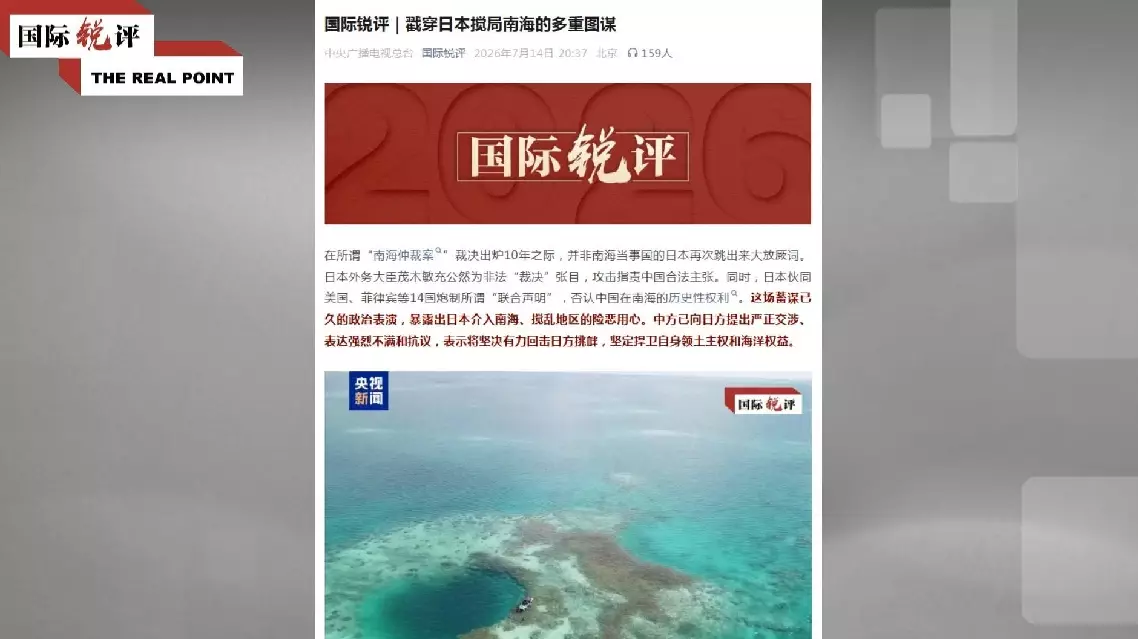
Commentary exposes Japan's conspiracies in South China Sea