Strategic partnership integrates design optimisation and artificial intelligence to improve engineering efficiency, project outcomes and decarbonisation
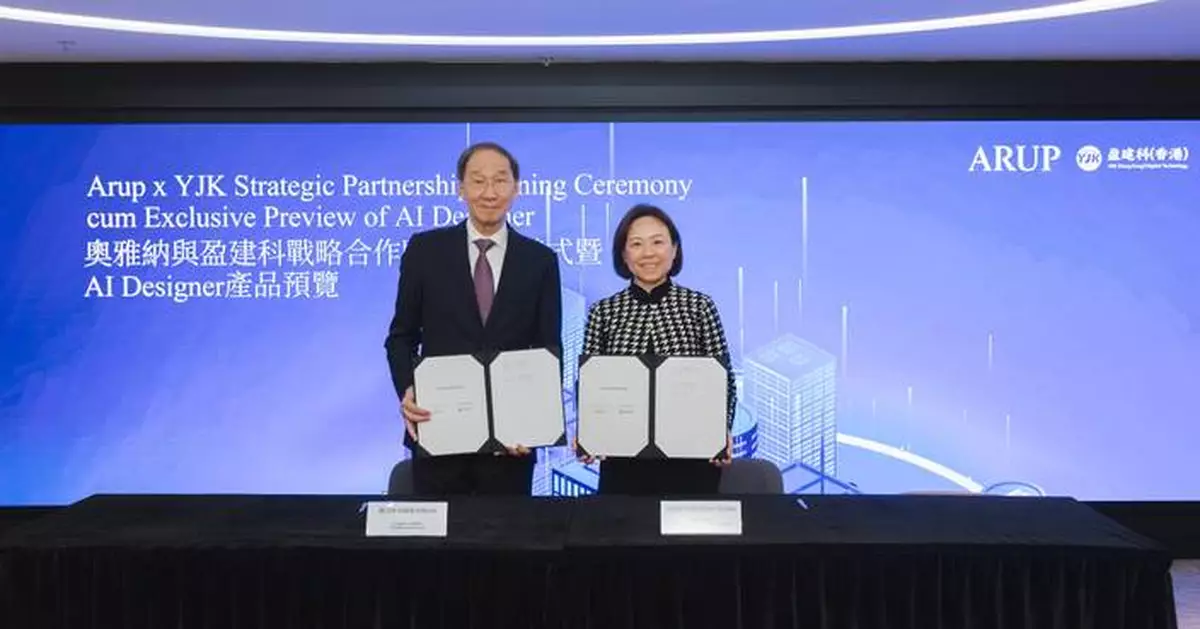
HONG KONG SAR - Media OutReach Newswire - 15 July 2026 - Arup and YJK, a leading engineering software solutions company in Chinese Mainland, announced the launch of AI Designer in Hong Kong, an innovative digital platform that integrates artificial intelligence ('AI') with design optimisation, enhancing the efficiency, quality and productivity of engineering workflows.
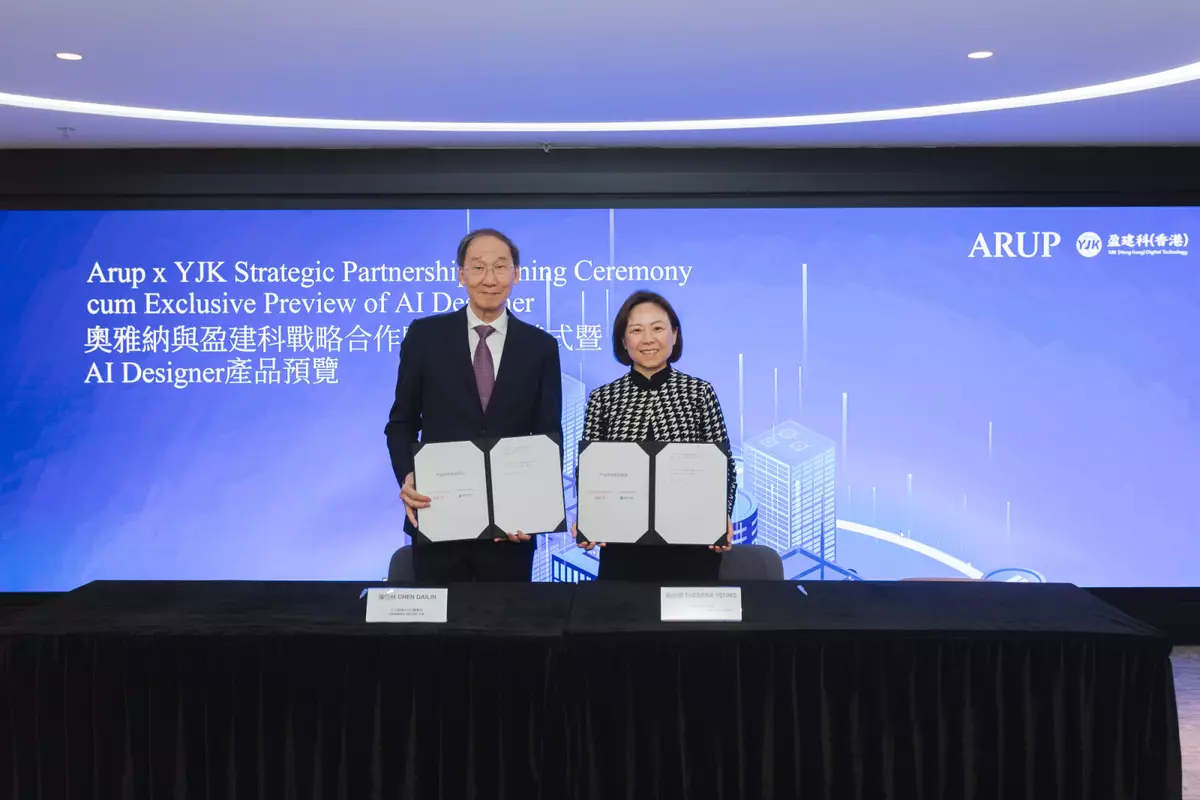
Chen Dailin, Chairman of Beijing YJK Building Software Co., Ltd (left), and Theresa Yeung, Managing Principal, East Asia at Arup (right), officially sign the strategic partnership agreement.
Jointly developed by Arup and YJK, the initial AI Designer modules combine Arup's global structural engineering experience and advanced computational design expertise with YJK's integrated software capabilities in analysis, code-compliant design and drawing production. The first phase of the platform focuses on two core applications: Structural design optimisation, including reinforced concrete and steel structures, and Piled foundation layout and design optimisation.
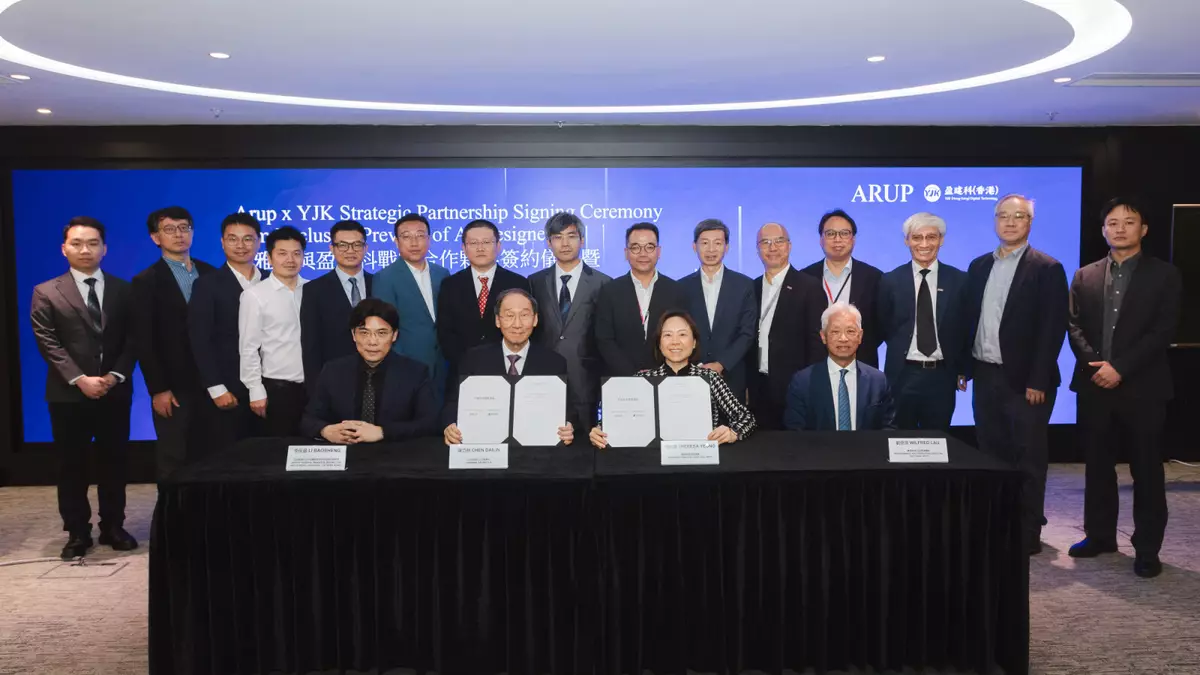
Chen Dailin, Chairman of Beijing YJK Building Software Co., Ltd (middle left), and Theresa Yeung, Managing Principal, East Asia at Arup (middle right), with teams from YJK and Arup at the Arup x YJK Strategic Partnership Signing Ceremony in Hong Kong.
The platform helps engineers evaluate design options more effectively, enabling faster decision-making, improved project outcomes and smarter project delivery, while representing a transformational step forward in modernising engineering workflows.
Key features of AI Designer
- YJK's structural design software (Hong Kong Code Edition) has been officially recognised by the Hong Kong Buildings Department, while its structural, BIM and construction software suite has been certified under Hong Kong's Construction Innovation and Technology Fund (CITF).
- In controlled benchmarking using the same model, loads and code — and with engineer review retained — AI Designer's algorithmic optimisation reduced design iteration time by approximately 82% (from 2.5 days to 0.5 days) and decreased over-limit components by around 88% (from 64 to 6).
- Through AI Designer's optimisation, material usage could be reduced by around 10–20%, contributing to lower embodied carbon.
The partnership underscores Hong Kong's ambitions to accelerate the adoption of digital technologies across the construction sector. By enhancing productivity and streamlining engineering processes, AI Designer will bring more efficient project delivery while supporting the city's innovation agenda and driving AI adoption across the built environment industry.
Theresa Yeung, Managing Principal, East Asia of Arup, said: "We are delighted to collaborate with YJK on the launch of the first AI Designer module. By combining Arup's deep structural engineering and computational design expertise with YJK's advanced software capabilities, we are empowering engineers with powerful tools that improve workflows, accelerate design exploration and unlock new opportunities for innovation.
As projects become increasingly complex, AI Designer will enable us to assess a broader range of solutions more efficiently while maintaining the highest standards of technical excellence. This reflects our commitment to applying emerging technologies to deliver better outcomes for our clients, communities and the built environment."
Chen Dailin, Chairman of Beijing YJK, said: "We are thrilled to partner with Arup, an industry heavyweight with deep expertise in computational design. By combining YJK's software capabilities with Arup's optimisation algorithms, AI Designer will deliver real impact by enhancing design quality, broadening the application of artificial intelligence in engineering, and supporting the development of a smarter, more efficient and resilient built environment."
The launch ceremony was attended by representatives from both the public and private sectors, reflecting the growing importance of advanced technologies in driving innovation across Hong Kong's construction and infrastructure industries. Attendees were introduced to AI Designer's capabilities and its vision for the future of AI-enabled engineering and design.
Hashtag: #Arup #YJK
The issuer is solely responsible for the content of this announcement.
About Arup
Arup is a global built environment consultancy providing advisory and technical expertise for our clients across more than 150 disciplines. We create safe, resilient, and regenerative places.
www.arup.com
About YJK
YJK (Hong Kong) Digital Technology Limited is a wholly-owned overseas subsidiary of YJK. Leveraging Hong Kong's geographical advantages, it has established a two-pronged strategy of "deepening local adaptation in Hong Kong while simultaneously expanding overseas markets", and oversees the overall planning of YJK's operations in Hong Kong, China as well as its overseas business layout.
The parent company has long been deeply engaged in the engineering software sector covering construction, bridges, municipal infrastructure, power and other fields. It provides standardized BIM products and digital solutions for the full project lifecycle, backed by profound in-house R&D capabilities and solid technical accumulation.
Leveraging the parent company's in-house software R&D strengths and AI technology expertise, YJK (Hong Kong) has achieved in-depth alignment with Hong Kong's engineering codes and business workflows, further consolidating its local service capabilities. Meanwhile, with Hong Kong as its strategic pivot for internationalization, it aligns with mainstream international engineering standards and delivers digital products and services tailored for overseas markets. Driven by technological innovation as its core driving force, the company provides high-quality engineering digital services to clients across the globe.
** This press release is distributed by Media OutReach Newswire through automated distribution system, for which the client assumes full responsibility. **
Scenario-based analysis shows AI will expand demand across office, industrial and retail
HONG KONG SAR - Media OutReach Newswire - 15 July 2026 - Artificial intelligence (AI) is set to fuel economic expansion and increase demand for commercial real estate across Asia Pacific (APAC), rather than displace it, according to a study by Cushman & Wakefield. The analysis, AI Impact: Regional Insights – Asia Pacific, noted that AI will act as a net positive force for both economic growth and real estate demand as the region strengthens its position as a global hub for production, services and innovation.
"There is a misconception that AI will reduce the need for physical space," said Dr. Dominic Brown, Head of International Research, APAC & EMEA, Cushman & Wakefield. "Our analysis shows the opposite – AI expands economic activity and that ultimately drives greater demand for real estate across sectors."
The APAC analysis is part of Cushman & Wakefield's global, multi-sector, scenario-based assessment of how AI adoption could reshape real estate fundamentals over the next decade. Rather than attempting to predict how AI itself evolves, the framework focuses on how firms respond to AI under different adoption, productivity and monetization scenarios and how those responses translate into macroeconomic outcomes, space demand and capital markets dynamics. These scenarios are also fully integrated into Cushman & Wakefield's "House View" forecasting process, incorporating broader macroeconomic factors such as monetary policy, trade dynamics and geopolitical risks.
Four Scenarios, Wide Range of Outcomes
Cushman & Wakefield's study models four distinct scenarios reflecting different paths for AI adoption, productivity and labor market outcomes:
- C&W Baseline — Gradual Adoption (50%): Moderate productivity gains support steady economic expansion. Demand holds up, with near-term softness in select sectors, as AI becomes additive over time.
- Productivity-Led Expansion (15% probability): Rapid AI adoption drives strong economic growth and job creation. Broad demand growth across sectors supports rent growth and rising values.
- AI Bust — Moderate Recession (25%): AI adoption falls short of expectations, contributing to a cyclical downturn. Demand weakens in the near term, with higher vacancies and rent pressure, followed by recovery.
- Dystopic/Displacement (5%): AI adoption proves more labor-substituting than expected, leading to higher unemployment. Demand remains weak for a more sustained period, with downside pressure on rents and values.
Under the baseline scenario, the APAC economy is projected to grow at around 3-4% annually through 2030, supported by AI-driven productivity gains and continued investment in infrastructure such as data centers and power.
"AI will be a critical force in sustaining APAC's long-term growth story," said Dr. Brown. "It will help offset demographic headwinds in some developed markets while accelerating productivity across emerging economies."
While AI will automate certain routine functions, the study indicates overall employment in APAC is expected to rise, with a projected net increase of 58.5 million jobs between 2026 and 2030 under the baseline scenario. However, this growth is likely to moderate over time as economies mature, alongside a shift toward higher-value, knowledge-based work.
AI Impact on Real Estate
From a commercial real estate perspective, AI is expected to be additive to demand, rather than a substitute for space as stronger economic output and business formation drive higher occupancy needs over time. This expansion will be accompanied by structural changes in how space is used as well as evolving investment strategies. Emerging asset classes, particularly data centers are expected to become increasingly central to portfolios.
Under the baseline scenario, core real estate returns are projected to stabilise at around 10%, supported by strong regional growth and evolving demand drivers.
- Office Market to be Transformed, Not Disrupted
Prime net absorption of office space is projected to reach 1.035 billion sq ft over the next decade under the baseline scenario. Demand will increasingly favour high-quality, flexible spaces in prime locations, particularly in talent-rich cities and environments designed for collaboration and innovation. This sustained flight to quality, already evident in recent years, is expected to accelerate further, widening gap between premium and lower-grade buildings.
- Logistics and Data Centers Lead AI-Driven Demand
The logistics and industrial sector is set to be one of the primary beneficiaries of AI adoption, with demand driven by automation, e-commerce growth and rising supply chain complexity. Prime net absorption is forecast to reach 2.542 billion sq ft by 2030 under the baseline scenario. Within this growth, data centers are emerging as critical infrastructure, with power availability becoming a key constraint in shaping both supply and investment decisions.
- Retail to Become More Polarised
Stronger income growth will support spending but the retail market is expected to split into clear winners and losers. High and low-end retail segments are likely to outperform, while mid-tier retail will face structural challenges, reflecting a more polarised consumer landscape.
While the overall outlook is positive, there are potential downside risks such as slower-than-expected AI productivity boost or labour market disruption, which could result in higher vacancy rates and downward pressure on rents.
"While the base case is constructive, the range of outcomes remains wide. Understanding the different scenarios is critical for both occupiers and investors as they plan for the next decade," said Dr. Brown.
About the Study
AI Impact on Commercial Real Estate: The Next 10 Years uses econometric models and a scenario-based framework integrated into Cushman & Wakefield's House View forecasts. The analysis traces AI's impact through a chain of transmission – from foundational drivers (regulation, power infrastructure, data center development) through AI adoption and productivity, macroeconomic outcomes, occupier demand, and real estate market response. Regional reports covering the U.S., EMEA, and Asia Pacific are available at cushmanwakefield.com.
Hashtag: #Cushman&Wakefield
The issuer is solely responsible for the content of this announcement.
About Cushman & Wakefield
Cushman & Wakefield (NYSE: CWK) is a leading global commercial real estate services firm for property owners and occupiers with approximately 53,000 employees in nearly 350 offices and 60 countries. In Greater China, a network of 23 offices serves local markets across the region. In 2025, the firm reported revenue of $10.3 billion across its core services of Valuation, Consulting, Project & Development Services, Capital Markets, Project & Occupier Services, Industrial & Logistics, Retail, and others. Built around the belief that Better never settles, the firm receives numerous industry and business accolades for its award-winning culture. For additional information, visit www.cushmanwakefield.com.hk or follow us on LinkedIn (https://www.linkedin.com/company/cushman-&-wakefield-greater-china).
** This press release is distributed by Media OutReach Newswire through automated distribution system, for which the client assumes full responsibility. **