A research team at the University of California, San Diego (UC San Diego) has published a groundbreaking study in the leading international journal Nature. The study details the first-ever use of two Chinese-made Unitree G1 humanoid robots to perform two live-animal gallbladder removal surgeries via remote control. It marks the world's first experiment of this kind.
The report's first author and corresponding author is UCSD PhD student Zekai Liang. The findings have drawn attention from the international tech and medical communities.
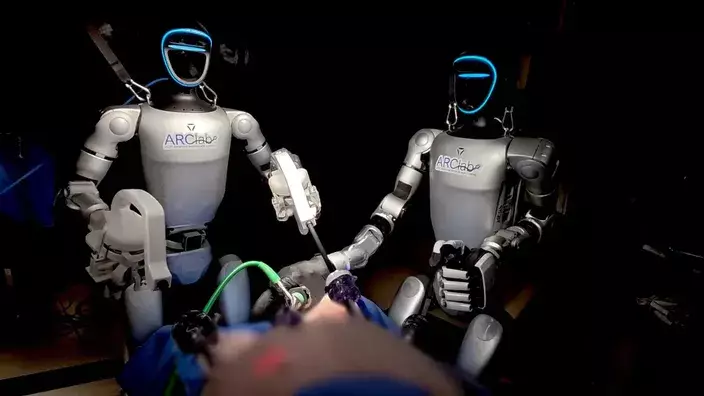
The research team noted that the G1 used in this study is a general-purpose humanoid robot. It stands about 1.5 meters tall and weighs roughly 27 kilograms. Unlike traditional dedicated surgical robots, its design is closer to human form, and it can work with off-the-shelf medical instruments.
The team fitted the robot with a surgical adapter. This adapter allows the robot's hands directly grip laparoscopic surgical tools. A remote-control system then translated the surgeon's movements into precise robotic actions.
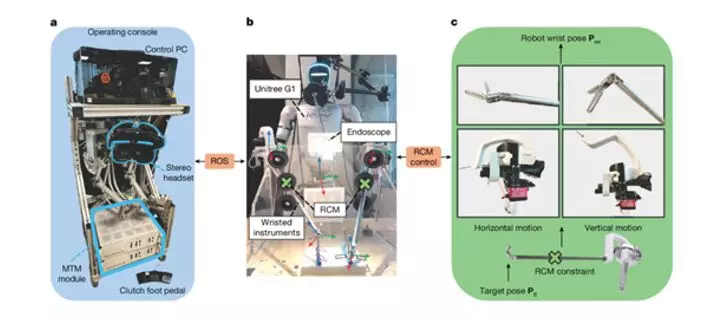
According to the report, the surgery was not carried out by a single robot working alone. Instead, two G1 units divided the labor between them. One handled the main surgical operations, while the other assisted by controlling the endoscope and retracting tissue, mimicking the division of roles in a real surgical team. The researchers performed two laparoscopic cholecystectomies on test pigs. Both procedures were completed successfully without needing to convert to open surgery.
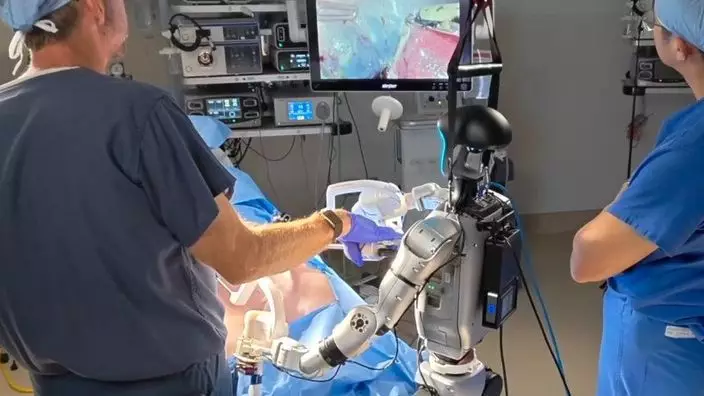
That said, the researchers acknowledged that humanoid robots still face considerable limitations at this stage. These include the need for frequent recalibration and movement fluidity that falls short of human hands. Overall surgical times also ran longer than those of existing dedicated surgical robots.
During the second procedure, there was minor bile leakage and bleeding from the liver bed. Both issues were addressed immediately without causing serious complications.
The research team believes this achievement primarily demonstrates the feasibility of humanoid robots entering surgical settings. Because the G1 can use standard medical instruments and offers more flexible deployment options, it could eventually serve remote areas and regions with limited medical resources. It might even support surgery in unconventional environments.
UCSD Professor Michael Yip said that remotely controlled and autonomously operating humanoid robots have the potential to expand patients' access to critical surgeries. This, he added, could help ease global healthcare pressures.
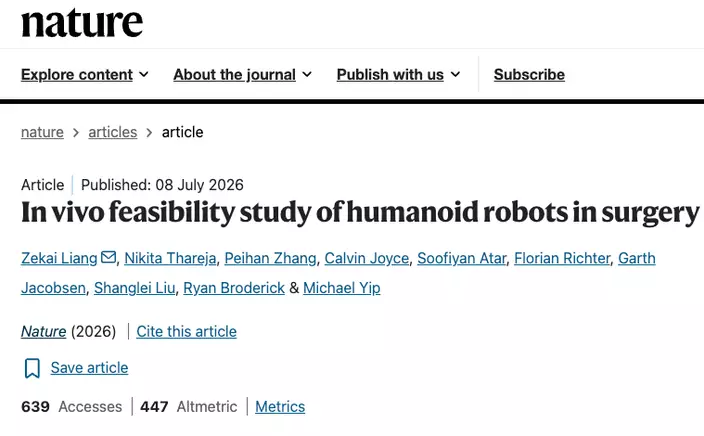
Another key focus of this research is first author and corresponding author Zekai Liang. Multiple Chinese and English-language media outlets have pointed out that this reflects the important role Chinese scholars are playing in cutting-edge robotic medical research. It also signals that Chinese-made humanoid robots are gradually moving from demonstration products toward experimental medical applications.
This study represents pre-clinical validation. It is not intended to replace existing surgical robot systems. Rather, its core aim is to prove that general-purpose humanoid robots can function in remote surgical settings.
Mao Paishou
** 博客文章文責自負,不代表本公司立場 **
Bloomberg reported on October 14 local time that the EU is negotiating with China. Brussels hopes Beijing will lift sanctions on the small German company Sindlhauser Materials GmbH. That small firm supplies the Dutch ASML, the world's most important chip equipment manufacturer. The sanctions now threaten its survival.
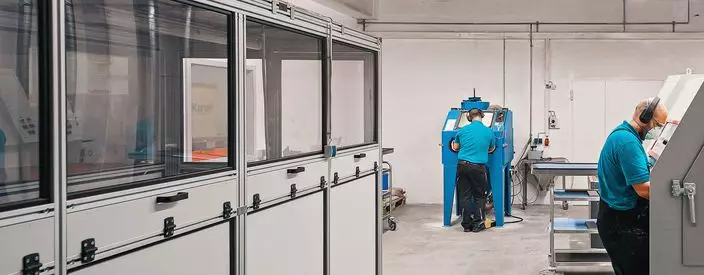
EU seeks China deal to free ASML supplier Sindlhauser.
The Deal on the Table
Bloomberg cited people in the know as saying the EU will remove trade restrictions on an unnamed Chinese company in exchange. That company is accused of assisting Russia in launching war against Ukraine.
In July this year, China imposed sanctions on Sindlhauser and 13 other European companies. The move retaliated for the EU's 21st round of sanctions against Russia. Sindlhauser is a small German company specializing in precision manufacturing and advanced coating technology for semiconductors and other industries.
In that round of sanctions, the EU listed several Chinese entities as sanctions targets. The EU said they were suspected of providing Russia with key components that could be used to manufacture weapons. Companies placed on the relevant EU and Chinese lists are subject to export controls.
People familiar with the matter said Sindlhauser relies on Chinese supplies of rare earths and critical minerals. If China's sanctions continue, the company will face the risk of bankruptcy within the coming months. It was also said this German company is part of ASML's supply chain.

ASML, Dutch semiconductor equipment giant.
Berlin and Brussels Race to Rescue Sindlhauser
Bloomberg sees a message in China's choice of target. Imposing controls on such an obscure company, the report argues, shows China knows exactly where Europe's economic bottlenecks sit.
An EU official says the European Union has begun discussions with China on whether each side would remove the entities from its own list. That means China's export control framework on one side, and the entities the EU has listed under its own regulations on the other.
The official added that any removal decision on the EU side would require unanimous support from all member states.
The trouble began in July when China's Ministry of Commerce put Sindlhauser on its export control list, and the company's first reaction was panic.
For weeks after the announcement, Sindlhauser had no clear view of whether, or how, it could keep operating.
Help came quickly. According to the people who knows what’s happening, the German government and the Bavarian state government, where Sindlhauser is headquartered, stepped in immediately to help the company find alternative suppliers wherever possible.
The two governments also explored other workarounds, such as recycling existing materials and seeking whatever financial support was available.
Brussels was watching too. Some officials there understood the company's plight and raised the matter with the Chinese side for several weeks.

Sindlhauser's rare earth supply nearly all Chinese.
A Policy Dilemma, an Intelligence Blind Spot
Sindlhauser sits squarely inside China's rare earth grip. According to the report, the company relies almost entirely on Chinese rare earths, and its placement on the export control list dealt a direct blow to its supply chain.
The company had previously taken almost no measures to diversify its supply sources or reduce its dependence on Chinese raw materials.
Some officials see a problem with the rescue. Removing companies such as Sindlhauser from the sanctions list, they worry, could once again weaken the urgency for these European companies to build supply chain networks outside China.
That leaves the German government and EU officials in a bind. Deciding through negotiations which companies go onto or come off trade restriction lists could set a bad precedent for other companies also hoping for sanctions exemptions. It would also mean the EU must make concessions on the question of certain Chinese entities.
But officials involved in handling the matter see a deeper problem. The situation behind the case, they argue, is more concerning, though not surprising.
The explanation: over the past year and a half, China has been collecting information on global supply chains as much as it possibly can. That is how China identified a small company in Bavaria as a supplier to the world's most important chip equipment manufacturer.
Beijing's map of global supply chains runs remarkably deep. The report credits that insight to the licensing system China has built for exports of critical minerals and rare earths.
The system requires foreign companies to submit detailed information, including their customers, how and where Chinese raw materials are used, and photos of the final products.
Germany shows the cost. Some companies have been leaking business secrets to China, while the German government remained completely unaware and unable to obtain the same or even similar information.
More important, the German government still has not formulated any strategy to address its shortcomings in economic intelligence.
A Possible Template, and China's Stated Position
The talks went straight to the top. According to the report, EU Trade Commissioner Maroš Šefčovič visited Beijing last week and met with Chinese Commerce Minister Wang Wentao. The two sides discussed lifting restrictions on Sindlhauser in exchange for relief for a Chinese company.
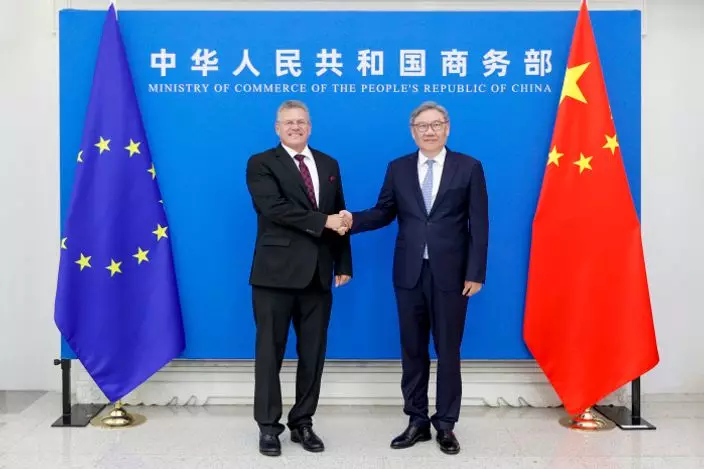
EU trade chief Šefčovič met Wang Wentao in Beijing.
The backdrop is stark. The EU is hunting for a fix to a massive trade deficit that exceeds $1 billion every single day.
People familiar with the matter say the two sides agreed in Beijing to strengthen information sharing and to give each other advance notice of export restriction measures.
The "one-for-one" arrangement around Sindlhauser, in which each side takes the other's company off its restriction list, could become a template for similar moves in the future. The EU is expected to act first. Only then would China lift its restrictions on the German company.
China's message has stayed consistent. The Chinese side has repeatedly stressed that China holds an objective and impartial position on the Ukraine crisis, stays committed to promoting peace talks, and plays a constructive role in advancing a political resolution of the crisis.
The opposition is just as firm. China firmly rejects the EU's blame-shifting, smears and denigration over the Ukraine crisis. It equally and firmly opposes the EU's unjustified listing and sanctions against Chinese companies and citizens.