PORTLAND, Maine--(BUSINESS WIRE)--Jul 15, 2026--
The Avangrid Foundation, the philanthropic arm of leading energy company Avangrid Inc., a member of the Iberdrola Group, today joined Northeastern University's Roux Institute and nonprofit leaders from across Maine to kick off the 2026 Intrapreneurship for Nonprofits Program. Made possible through a $125,000 grant from the Avangrid Foundation, the program provides participating nonprofits with hands-on workshops, expert mentorship, and strategic guidance to help build, test, and scale innovative ideas that strengthen their long-term impact and financial resilience.
This press release features multimedia. View the full release here: https://www.businesswire.com/news/home/20260715365326/en/
"Strong communities are built through collaboration, innovation, and investment in local organizations,” said Avangrid CEO Jose Antonio Miranda. “The Intrapreneurship for Nonprofits Program reflects those values by helping nonprofits develop new approaches to achieving their missions and maintaining long-term success. The Avangrid Foundation’s support of this important initiative empowers organizations that make a meaningful difference across Maine every day."
“Nonprofit organizations are at the heart of thriving communities, and we're proud to support leaders who are finding innovative ways to advance their missions and expand their impact,” said Pablo Colón, Executive Director of the Avangrid Foundation and Director of Corporate Citizenship at Avangrid. “Through our partnership with Northeastern University's Roux Institute, the Intrapreneurship for Nonprofits Program provides participating organizations with the tools, mentorship, and resources they need to sustainable growth while continuing to serve communities across Maine."
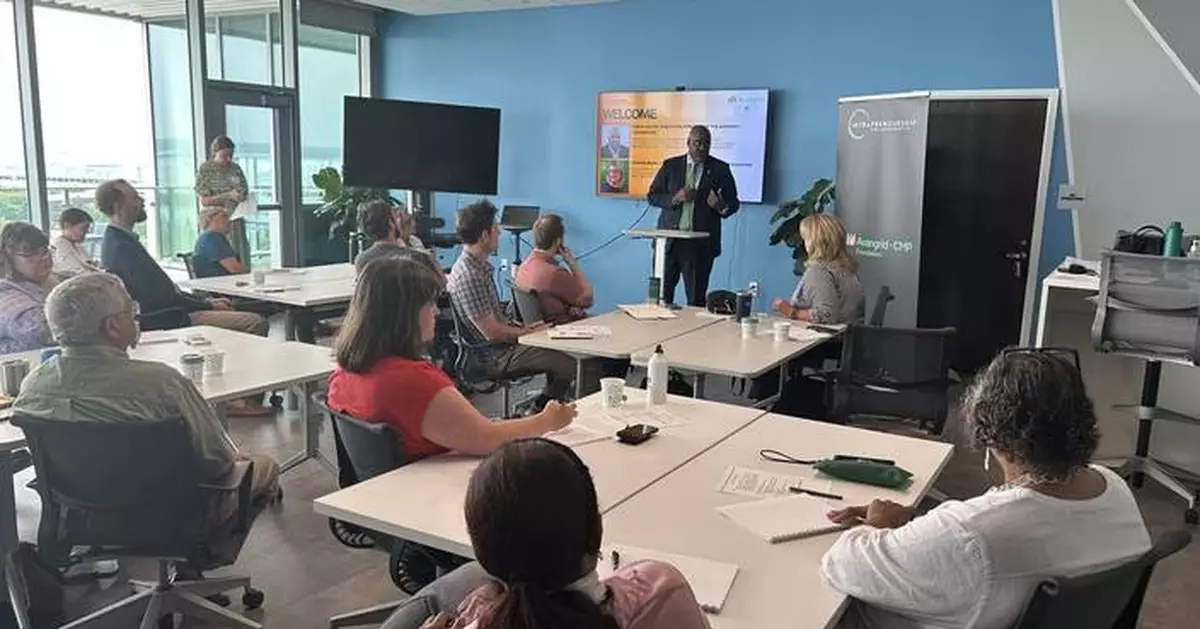
The event featured remarks from Pablo Colón, Executive Director of the Avangrid Foundation and Director of Corporate Citizenship at Avangrid, and Joanne Bean, President and Chief Executive Officer of Camp Sunshine and a participant in the program's 2025 cohort. They were joined by representatives from Northeastern University's Roux Institute and leaders from nonprofit organizations across Maine participating in the 2026 program.
"We're thrilled to continue our partnership with the Avangrid Foundation for a second year of the Intrapreneurship for Nonprofits program. The response from last year's inaugural cohort and the community demonstrated just how much demand exists for innovation within Maine's nonprofit sector. By combining entrepreneurial thinking with mission-driven leadership, together we are helping nonprofit organizations develop new solutions, build capacity, and create lasting impact in the communities they serve. Avangrid's continued investment is not only helping individual organizations grow, it's strengthening Maine's entire nonprofit ecosystem,” said Chris Torina, Director of Entrepreneurship, Northeastern University's Roux Institute.
Anna Ackerman, Entrepreneurship Program Manager at the Roux Institute, created and has spearheaded this program since its inception in 2023. This cohort marks the program's fourth iteration. The 10 new participating nonprofits will join a growing network of 26 alumni nonprofits. This six-month program will include seven workshops running from July through September, including "Leveraging AI for Intrapreneurship," run by the Custom Learning team at the Roux Institute, as well as "Customer Discovery" and "Business Model and Pricing," and more, run by mentors from Northeastern's Venture Mentor Network. The showcase will be held on December 8th at the Roux Institute.
About Avangrid Foundation: The Avangrid Foundation is an independent, nonprofit organization that funds philanthropic investments that primarily impact communities where Avangrid, Inc. and its subsidiaries operate. Since 2001, the Avangrid Foundation and its predecessors have invested more than $45 million in partnerships that focus on building sustainable, vital and healthy communities; preserving cultural and artistic heritage; advancing education; and improving people’s lives. The Avangrid Foundation is committed to advancing the United Nations Sustainable Development Goals in the United States. For more information, please visit https://www.avangrid.com/avangrid-foundation.
About Avangrid: Avangrid, Inc. is a leading energy company in the United States working to meet the growing demand for energy for homes and businesses across the nation through service, innovation, and continued investments by expanding grid infrastructure and energy generation projects. Avangrid has offices in Connecticut, New York, Massachusetts, Maine, and Oregon, including operations in 25 states with approximately $50 billion in assets. Avangrid owns and operates seven electric and natural gas utilities, serving more than 3.4 million customers in New York and New England. It also owns and operates nearly 100 energy generation facilities across the United States producing more than 11 GW of power for over 3 million customers. Avangrid employs approximately 8,500 people and was named among the World’s Most Ethical Companies in 2026 for the eighth consecutive year by the Ethisphere Institute. Avangrid is a member of the group of companies controlled by Iberdrola, S.A. For more information, visit http://www.avangrid.com.

Pablo Colón, Executive Director of the Avangrid Foundation and Director of Corporate Citizenship at Avangrid speaks to 2026 program cohort.
PARIS (AP) — France’s National Assembly gave final approval Wednesday to a bill allowing adults with incurable illnesses to receive lethal medication, the culmination of years of debate over end-of-life care.
The lower house of parliament approved the measure in a 291-241 vote, after backing it in three previous readings, completing parliament’s work on the legislation announced by French President Emmanuel Macron more than three years ago.
According to various estimates, assisted dying is available to around 300 million people worldwide, with euthanasia legal under certain conditions in some countries and assisted suicide allowed in others and in several U.S. states. France has an increasingly aging population, with growing numbers of patients in the country who require care for chronic illnesses.
France, a traditionally Catholic nation, has grappled with legal, medical, moral and religious questions about end-of-life options, including existing legislation that allows doctors to keep terminally ill patients sedated before death, but stops short of allowing assisted suicide and euthanasia.
Many French people have traveled to neighboring countries where medically assisted suicide or euthanasia are legal. Medically assisted suicide generally involves a patient voluntarily taking lethal medication prescribed by a doctor. Euthanasia involves a doctor or other health care professional administering a lethal injection at the patient’s request.
End-of-life options are also being debated in the United Kingdom. A bill to legalize assisted dying in England and Wales will formally return to Parliament on Sept. 11, five months after it ran out of time in Parliament’s last session.
The proposed measure in France primarily provides for medically assisted suicide, by allowing patients to receive and self-administer lethal medication under strict conditions. Only people whose physical condition prevents them from doing so would be allowed to receive assistance from a doctor or a nurse.
Patients seeking to end their lives would have to be at least 18 years old and either French citizens or legal residents of France.
A doctor would first have to consult a team of health care professionals and then confirm that the patient has a serious and incurable illness that is life-threatening. The patient must be in an advanced or terminal stage, experiencing pain that can't be relieved or is unbearable, and seeking lethal medication of their own free will.
Lawmakers specified that psychological suffering alone wouldn't qualify a person for medically assisted dying.
People with severe psychiatric disorders or neurodegenerative diseases such as Alzheimer’s wouldn't be eligible.
Patients would initiate the request, to be reviewed by health professionals within 15 days, and then confirm it after a period of reflection lasting at least two days.
If approved, they could take the lethal medication at the time and in the place of their choice, including at home or in a health care facility, in the presence of their loved ones if they wish.
On the chosen date, the doctor or nurse would have to verify that the person still wishes to proceed and remain nearby to intervene if complications arise.
France’s national health insurance system would cover all associated costs.
A 2023 report found that most French people are in favor of legalizing end-of-life options, and opinion polls have shown support increasing over the past two decades.
The Association for the Right to Die With Dignity said that the law would allow people “to choose to end unbearable suffering, freely and with full awareness.” Its president, Jonathan Denis, said in a statement that “a law that creates a new right never forces anyone to exercise it. It does, however, ensure that every person … can remain at the heart of medical decisions that concern them and have their wishes respected.”
Opponents argue the measure could put pressure on older people and those living with illness or disabilities.
In an open letter to Macron, the anti-euthanasia group Alliance Vita said that “every effort must be made to ensure that people who are suffering have immediate access to palliative care and support. Presenting death as a desirable solution can never be an acceptable response to suffering and is contrary to human dignity.”
The Senate, the upper house where conservatives hold a majority, rejected the bill. But under France’s legislative process, the National Assembly has the final say when the two houses of parliament disagree.
Senate President Gérard Larcher and Prime Minister Sebastien Lecornu said that they would refer the bill to the Constitutional Council, which will have up to a month to determine whether it complies with the Constitution. The law would only take effect once that review has been completed.
“Extensive debates have taken place in the National Assembly on this bill. However, discussions in the Senate did not allow for such an in-depth examination, in order to produce legislation that addresses both the aspirations of its supporters and the concerns of those who are worried about how it will be implemented,” Lecornu said.
In the U.K., opponents of the bill to legalize assisted dying prevented it from passing in the House of Lords, the upper house, by filing more than 1,200 amendments on a range of concerns, including potential coercion of vulnerable people and a lack of safeguards for those with disabilities.
That was in April, after elected representatives in the House of Commons passed it.
The bill that is expected to be presented again proposes allowing adults in England and Wales, with fewer than six months to live, to apply for an assisted death subject to the approval of two doctors and an expert panel. One aim is so people no longer go to other countries, such as Switzerland, for an assisted death.
In Germany, parliament’s lower house, the Bundestag, in 2023 considered two proposals to regulate assisted dying and rejected both of them.
John Leicester in Paris, Pan Pylas in London and Geir Moulson in Berlin contributed to this report.

The French National Assembly is draped with the artwork "Marianne rêve" ("Marianne Dreams") by French street artist Seth, depicting Marianne the symbol of the French Republic, before lawmakers vote later on final approval of a bill allowing adults with incurable illnesses to receive lethal medication, in Paris, Wednesday, July 15, 2026. (AP Photo/Michel Euler)

FILE - French President Emmanuel Macron delivers his speech on the end-of-life options, April 3, 2023, at the Elysee Palace in Paris. (AP Photo/Aurelien Morissard, Pool, File)

FILE - The National Assembly is seen, Jan. 13, 2026, in Paris. (AP Photo/Emma Da Silva, File)