Rescue teams were working through the night on Saturday in southwest China's Chongqing Municipality, racing against time to find survivors of the mountain collapse, with operations still within the critical 72-hour golden window.
The geological disaster occurred at 09:08 on Friday in the Hanjia sub-district of Pengshui Miao and Tujia Autonomous County in Chongqing, burying more than 10 residential buildings.
In an immediate response, the Ministry of Natural Resources activated its geological disaster emergency response mechanism and mobilized more than 120 experts, including academicians, to the scene to assist with rescue efforts, emergency mapping, and disaster monitoring.
Preliminary investigations indicate that the total collapsed volume is approximately 18,000 cubic meters, with the largest single rock block among the debris estimated at 3,000 cubic meters. Dangerous rock masses remain perched at the top and along the flanks of the collapse zone, posing a high risk of further instability under heavy rainfall conditions.
To stabilize the slope and prevent secondary disasters, rescue teams have brought in long-arm excavators to buttress the mountain and create a safe working platform. Millimeter-precision slope radar systems have also been deployed at the site to monitor ground displacement in real time, providing early warnings to safeguard rescue personnel.
Since the disaster struck, a joint force of emergency engineering crews, fire and rescue teams, and geological disaster specialists has been working continuously at the scene. With rescue efforts still within the critical 72-hour golden window, the search and relief operations are pressing forward.
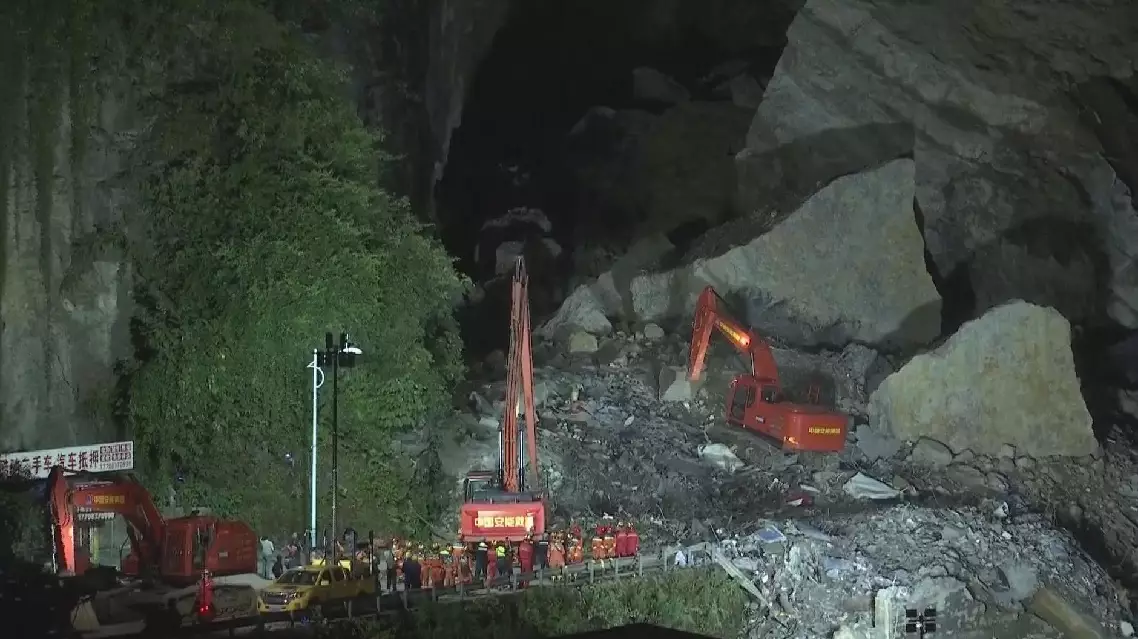
Overnight rescue continues after mountain collapse in Chongqing