China’s emphasis on open‑source sharing and inclusive artificial intelligence (AI) development is becoming a critical factor in shaping the global AI landscape, according to Joe Weinman, head of the U.S. International Institute for Future Industries.
In an exclusive interview with China Media Group in Shanghai on Sunday, Weinman said countries must balance competition with cooperation while preparing for embodied AI as the next leap, adding that China’s blend of advanced manufacturing and intelligent technology provides a strategic edge in the global market.
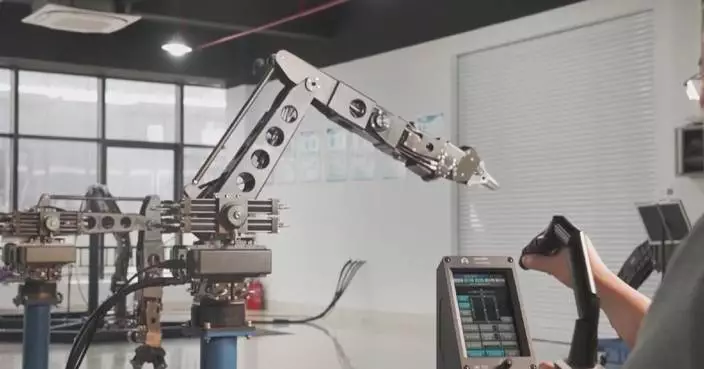
"That's critical, because it's an interesting game of co-optation now between countries. Because countries benefit from being competitive in this space. They also benefit from being cooperative in this space. And so, seeing how all that is going to play out is really fascinating. Embodied AI is the critical next leap. So, you can see here at WAIC, the number of robotics companies that are doing everything from personal companion robots to flexible robots that can dance to industrial robots. And when we think about embodied AI, that includes full self-driving automobiles, it includes drones and low-altitude vehicles, includes satellites. And I think China's traditional manufacturing capabilities being able to produce highest quality products at globally competitive prices, when you combine that with intelligence, really leads to strategic advantages in the global market," he explained.
Weinman, who coined the concept of "AI economics," acknowledged current shortcomings in AI but stressed that the technology will steadily improve and that operating costs are falling at an exponential pace.
"People sometimes look at AI right now and they say oh well, look, it's hallucinating, or look, it can't count the number of Rs in strawberry and it's kind of entertaining, I've laughed and chuckled at it. But the point is that technology always gets better. It's going to continue to improve, sometimes linearly and sometimes in leaps and bounds and exponentially. The cost of technology to accomplish anything because the underlying technology gets better, it means that the costs improve, and so the cost of AI continues to drop. We're already seeing that with exponential declines in the cost of inference. In other words, answering a query like you just asked, like what are the important things of AI economics for a model to have answered that two years ago, it's a thousand times lower cost now for a model to answer that same question," he said.
Weinman’s comments came against the backdrop of the 2026 World AI Conference and High‑Level Meeting on Global AI Governance, which ran from Friday to Monday in Shanghai. The event drew representatives from more than 100 countries and international organizations, featured 140 forum sessions, and saw over 1,100 enterprises present more than 3,000 products.

China’s open‑source AI push offers global edge: expert