MADISON, Wis. (AP) — A chaotic Democratic primary for Wisconsin governor that has seen numerous candidates drop out and re-enter the race has threatened to leave thousands of voters who have already returned their ballots with worthless votes for the state's top office.
That possibility prompted the state Democratic Party on Tuesday to make a plea to the state elections commission, urging it to allow voters who already cast an absentee ballot to vote again. More than 80,000 ballots have already been returned.
The request is all-but certain to result in a lawsuit with the primary just three weeks away.
Democrats want to allow voters to cast new ballots after Lt. Gov. Sara Rodriguez, a Democrat, ended her campaign for governor on Friday and another candidate, Milwaukee County Executive David Crowley, rejoined the race with the endorsement of current Gov. Tony Evers. There are now five Democratic candidates actively campaigning for governor ahead of the Aug. 11 primary.
Any voter who already returned an absentee ballot cast for Rodriguez would not be able to get a new ballot, based on guidance approved by the bipartisan Wisconsin Elections Commission earlier this month. The guidance was adopted after another Democratic candidate for governor, Missy Hughes, dropped out in June. Both Rodriguez and Hughes remain on the ballot even though they have ended their campaigns.
The winner of the Democratic primary for governor is likely to face Republican U.S. Rep. Tom Tiffany, who has only token opposition. The seat is open after Evers decided against seeking a third term. Democrats hope to retain the office and flip both chambers of the Legislature to gain full control of state government for the first time since 2010.
The Democratic Party argues that the commission’s guidance must be rescinded because it reversed its own rule that was in place four years ago and is inconsistent with a 2006 U.S. Supreme Court ruling. That ruling said voting rules should not be changed close to an election.
If the elections commission does not reverse itself and allow for new absentee ballots to be cast, “some voters will not be able to truly participate in our Democratic primary process,” Democratic Party Chairman Devin Remiker said in a statement.
He said the party asked for the reversal after checking with all five of the candidates actively campaigning for the Democratic nomination for governor.
Rodriguez ended her campaign after discovering that she had far less money on hand than she thought. She blamed her campaign manager for double counting donations and underreporting expenses. A day after she dropped out, Crowley rejoined the race. He had gotten out on July 8 and endorsed Rodriguez.
Both Crowley and Hughes were at the bottom of the field in public opinion polls before they dropped out. Hughes ended her campaign June 22 and said Democrats needed to coalesce around a candidate who could win in November. She endorsed Rodriguez, who then dropped out less than a month later.
Absentee voting by mail has been going on since late June and early in-person voting begins on July 28. Wisconsin Republican Party Chairman Brian Schimming criticized the push by Democrats to allow early absentee voters to cast a fresh ballot.
“Their primary is already chaotic enough," he said. “Election laws should not be changed to rescue one party from the consequences of its own actions.”
The rarely used practice known as ballot spoiling was the subject of a lawsuit in 2022. A Waukesha County judge sided with a Republican group that brought the lawsuit, ruling in October 2022 that the elections commission must rescind its guidance allowing for spoiling of ballots. But a state appeals court put that on hold just weeks before the midterm election that year.
And then in February, a state appeals court repealed the ruling, saying the lawsuit was not properly served. The appeals court did not address the merits of the case.
Despite that ruling, the elections commission voted 4-2 to prohibit voters who have already turned in their absentee ballot from getting a new one. One Democratic commissioner joined with three Republicans in voting in favor of the prohibition. Two Democrats voted against it.
There’s no way to know how many of the spoiled ballots were from Democrats or Republicans because voters in Wisconsin do not register by party. Voters who obtained an absentee ballot, but have not yet voted and want to obtain a new one, can still do that.
Previously in Wisconsin, voters who had submitted an absentee ballot could spoil it and cast a new ballot up to three times for any reason. But it very rarely happened.
From the 2018 midterms through the 2022 primary, less than 1% of all votes cast were cast by people who cast a new absentee ballot after spoiling an earlier one, data from the Wisconsin Elections Commission showed.
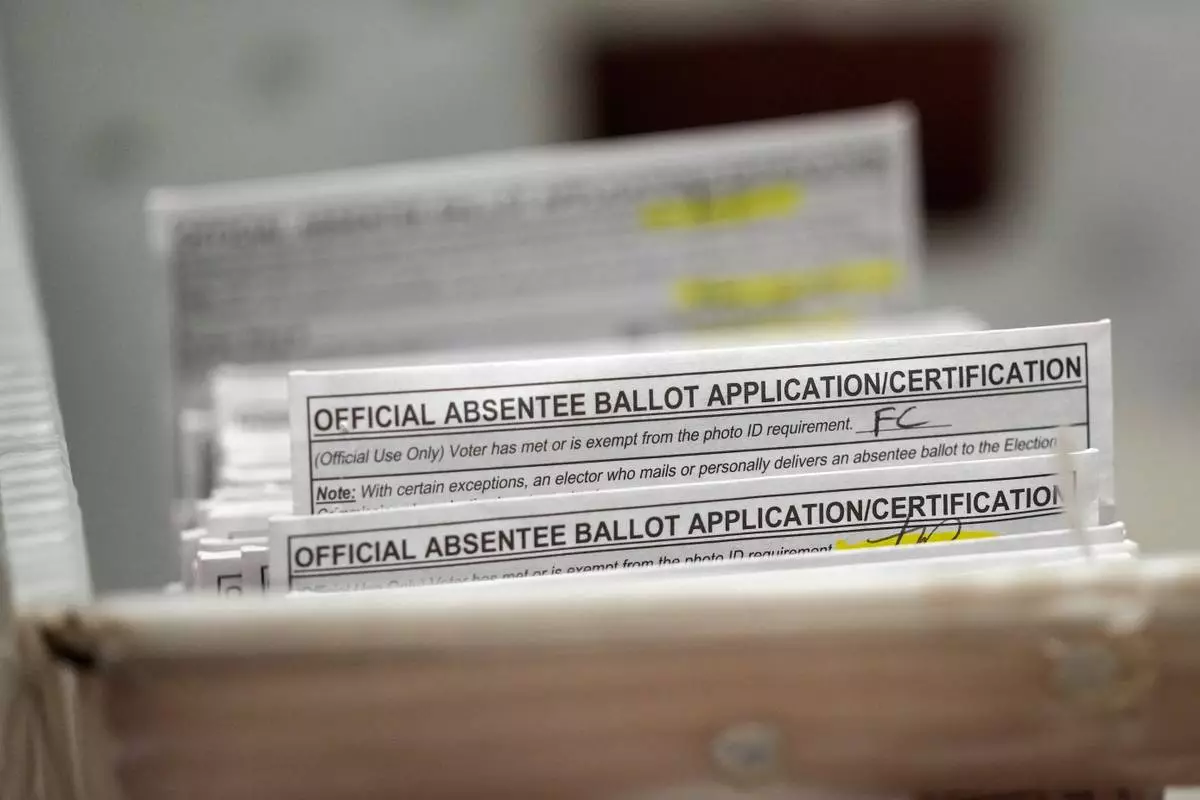
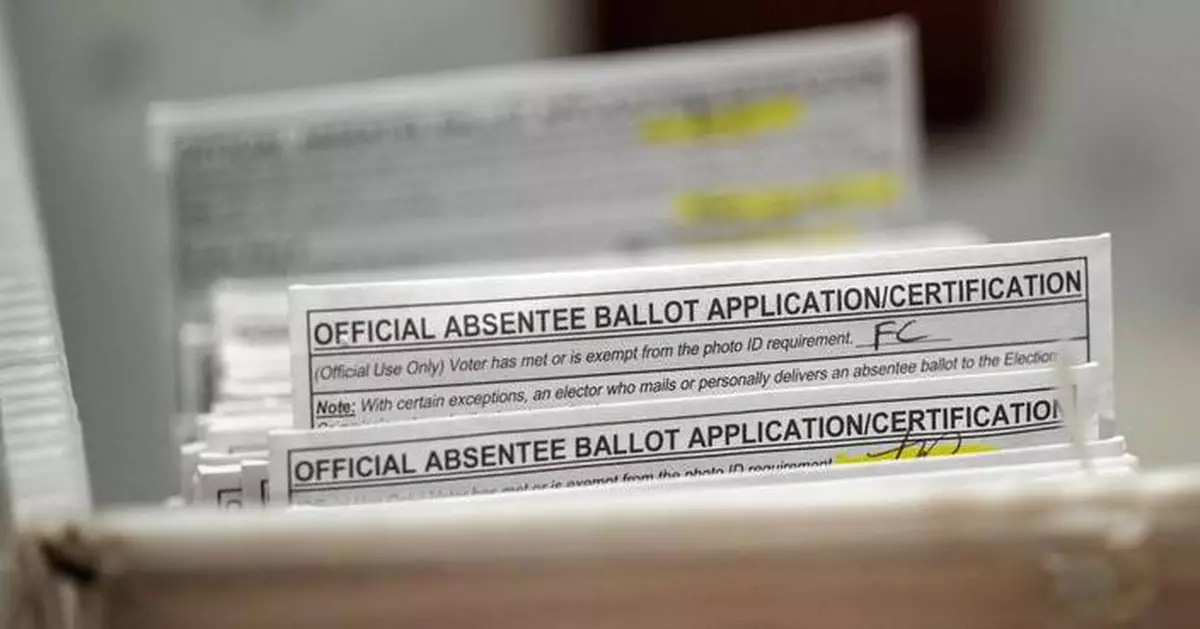
FILE - Absentee ballots during a count at the Wisconsin Center, Nov. 8, 2022, in Milwaukee. (AP Photo/Morry Gash, File)
KYIV, Ukraine (AP) — The new commander-in-chief of the Ukrainian military forged his reputation as a daring and determined fighter in the early days of the country's battle against Russia, then spent a decade in combat assignments while steadily rising through the ranks.
Maj. Gen. Mykhailo Drapatyi was named to the post Tuesday after President Volodymyr Zelenskyy fired Gen. Oleksandr Syrskyi following days of mass protests in Kyiv and other cities. Demonstrators demanded his removal and the reinstatement of former Defense Minister Mykhailo Fedorov, who was seen as a driver of military modernization. Protesters said Syrskyi embodied the army’s old, Soviet-style command culture.
In a Facebook post, Drapatyi thanked Syrskyi for his work strengthening the military.
“I grew up in it,” he said, referring to the army. “I will work responsibly, with focus and with respect for the people defending our state today.”
Drapatyi, 43, represents a new generation of Ukrainian generals forged in the crucible of the country’s fight against Russia. He has spent nearly his entire career in combat postings, including leading Ukraine’s Joint Forces, which direct day-to-day combat operations across branches of the army.
He is known as intensely disciplined and highly effective in combat, and he is often sent to stabilize the most critical sectors of the front. He has rarely appeared in public but has nonetheless gained wide respect and popularity within the military and beyond for his past victories.
His reputation was forged in 2014, early in Russia’s war in eastern Ukraine. That May, as a major commanding a battalion of the 72nd Brigade, he led an armored column into central Mariupol to rescue police officers and territorial defense officials besieged by pro-Russian militants who had threatened to burn them alive.
When the column’s path was blocked by a barricade more than a meter (yard) high, Drapatyi, riding in the lead vehicle, ordered the driver to accelerate, and the vehicle bounced over the barrier as if off a ramp. The moment, which was captured on video that circulated widely, is considered one of the most remarkable episodes in the early resistance.
It was a bold move for the Ukrainian army at the time, when decisive and independent moves by field officers were rare. The army was still poorly equipped, largely untested and wary of any action that might escalate tensions with Russia.
Months later, Drapatyi's battalion spent weeks encircled by Russian-backed forces near the Russian border. Rather than disarm and walk out, Drapatyi chose to fight his way free, leading 260 soldiers and more than 30 vehicles out of the pocket at night.
He rose through field commands over the following decade, leading brigades in eastern Ukraine, then serving as deputy Joint Forces commander when Russia’s full-scale invasion began in February 2022.
In 2024, he took command of forces that halted Russia’s advance on Zelenskyy’s hometown of Kryvyi Rih and helped push Russian troops back from parts of the Kherson region, then organized the defense that blunted a renewed Russian offensive in the Kharkiv region in 2024.
Zelenskyy named him ground forces commander later that year.
But he soon resigned from that post after a Russian strike killed numerous Ukrainian soldiers at a ground forces training center, the second such attack on the facility in months. He took personal responsibility, saying he had been unable to ensure his orders were carried out. He wrote in his resignation report that he had been blocked from reforming the branch by officials protecting one another from accountability.
Shortly after that, Zelenskyy named him commander of the Joint Forces.
Drapatyi’s uncompromising streak became public on Thursday, when Fedorov, the former defense minister, said Ukraine’s military leadership had resisted reform and pressured commanders who pushed for it, including Drapatyi, who he said had received three reprimands from Syrskyi.
Drapatyi responded with a social media post backing the Defense Ministry’s leadership that was eventually dismissed. He agreed that many changes had been pushed through “despite the system, rather than thanks to how it worked.” A commander’s silence, he wrote, “has never been a form of responsibility.”
He was born in 1982 in Kamianets-Podilskyi, in western Ukraine’s Khmelnytskyi region, to a family of teachers. He trained as a tank officer at the Kharkiv Institute of Tank Troops, graduated in 2004 and was assigned to the 72nd Separate Mechanized Brigade in Bila Tserkva, which was then commanded by Syrskyi.
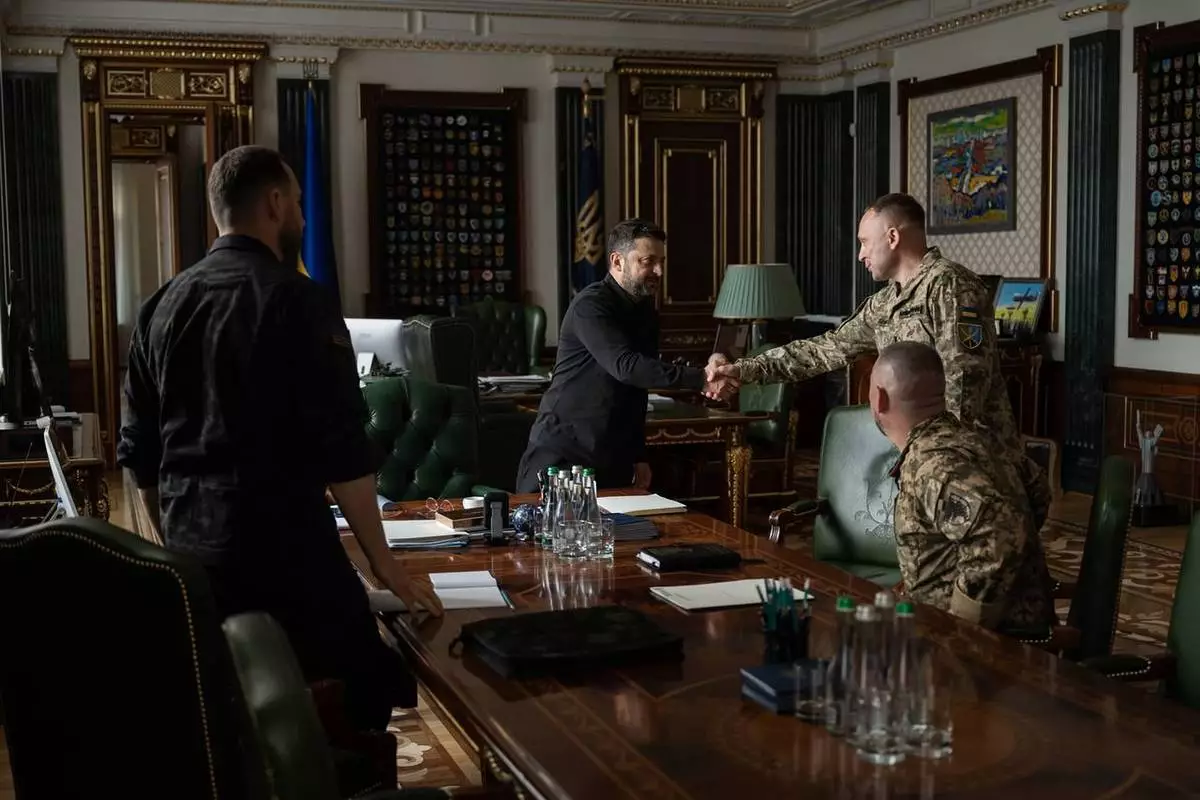
In this photo provided by the Ukrainian Presidential Press Office, Ukrainian President Volodymyr Zelenskyy, center, shakes hands with new commander-in-chief of Ukraine's Armed Forces Mykhailo Drapatyi during their meeting in Kyiv, Ukraine, Monday, July 20, 2026. (Ukrainian Presidential Press Office via AP)
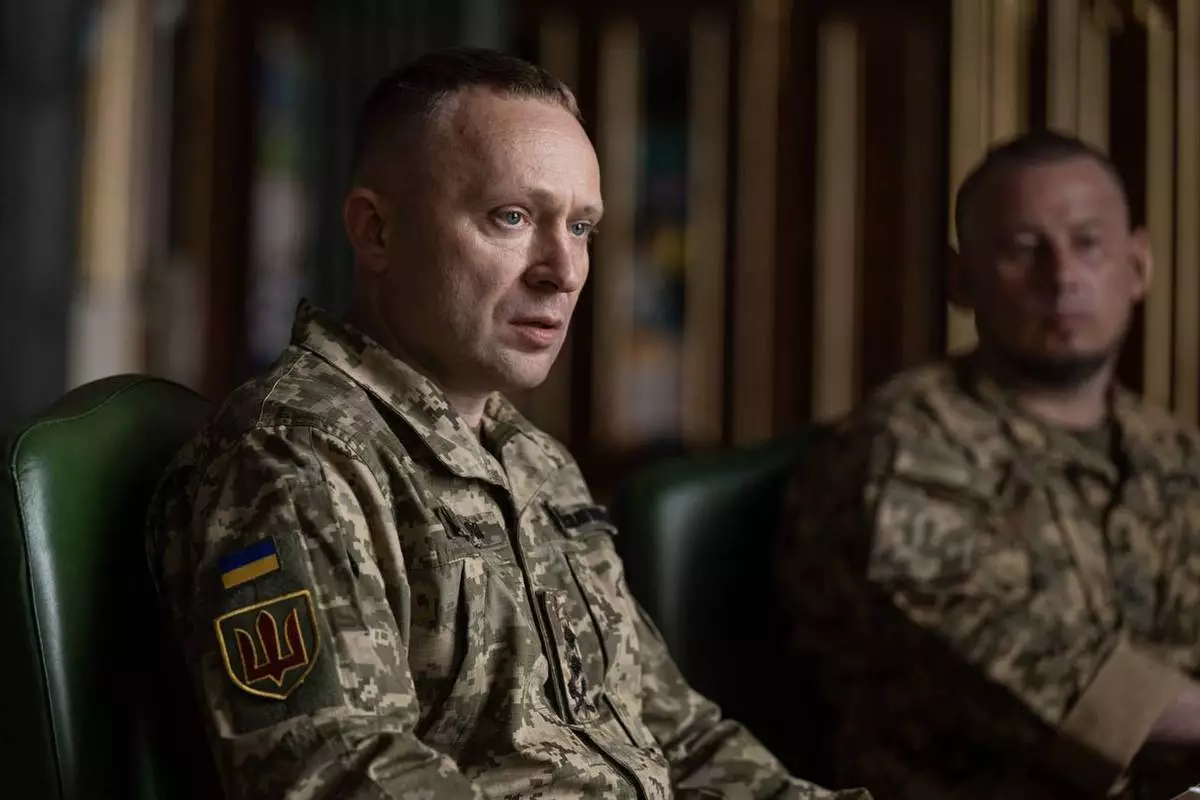
In this photo provided by the Ukrainian Presidential Press Office, new commander-in-chief of Ukraine's Armed Forces Mykhailo Drapatyi looks on during his meeting with Ukrainian President Volodymyr Zelenskyy in Kyiv, Ukraine, Monday, July 20, 2026. (Ukrainian Presidential Press Office via AP)