Skip to Content Facebook Feature Image

N-Zyme Biomedical Closes US$4.6 Million Series A Financing to Advance Clinical Development

Business

N-Zyme Biomedical Closes US$4.6 Million Series A Financing to Advance Clinical Development
Business

Business

N-Zyme Biomedical Closes US$4.6 Million Series A Financing to Advance Clinical Development

2026-07-22 20:27 Last Updated At:20:40

NEWARK, Del. & WAUWATOSA, Wis.--(BUSINESS WIRE)--Jul 22, 2026--

N-Zyme Biomedical today announced the successful closing of its Series A financing, raising approximately US$4.6 million to accelerate the advancement of its Phase 2 clinical programs and further the development of its novel pepsin inhibitor platform for reflux disease.

This press release features multimedia. View the full release here: https://www.businesswire.com/news/home/20260722028346/en/

The financing marks a significant milestone for the company and provides the capital to advance the clinical development of its lead therapeutic candidate across Phase 2 clinical programs for laryngopharyngeal reflux (LPR) and proton pump inhibitor (PPI)-refractory gastroesophageal reflux disease (GERD), positioning N-Zyme to further evaluate its novel pepsin inhibitor platform across multiple high-need reflux indications.

The financing was backed by a diverse group of investors, including healthcare professionals, entrepreneurs, a venture capital group, and strategic investors who recognize the significant unmet medical need in reflux disease and the potential of N-Zyme’s differentiated scientific approach.

“We are incredibly grateful for the confidence and support our investors have placed in N-Zyme,” said Franco Vigile, Co-Founder and Chief Executive Officer of N-Zyme Biomedical.

“Closing our Series A financing is more than a funding milestone—it’s an important validation of our science, our strategy, and our team’s commitment to transforming the treatment of reflux disease. We are deeply grateful to our shareholders for believing in our vision and supporting our mission.

Their investment enables us to accelerate our Phase 2 clinical programs and brings us one step closer to delivering a first-in-class therapy for the millions of patients worldwide who continue to live with significant unmet medical needs. We believe this financing marks the beginning of an exciting new chapter for N-Zyme as we continue building a leading biotechnology company dedicated to improving the lives of patients with reflux disease.”

Dr. Nikki Johnston, Co-Founder and Chief Scientific Officer of N-Zyme Biomedical, added, “This financing provides the resources necessary to continue rigorously evaluating our novel therapeutic approach through well-designed clinical studies. We remain committed to advancing the science and generating high-quality clinical evidence that we believe has the potential to meaningfully improve the lives of patients living with reflux disease. We are excited to build on the strong momentum we’ve established and continue advancing a therapeutic platform that has the potential to redefine the treatment paradigm for reflux disease.”

Unlike conventional therapies that primarily reduce gastric acid production, N-Zyme’s investigational therapy is designed to inhibit pepsin—the digestive enzyme increasingly recognized as a key driver of tissue damage and persistent symptoms in reflux disease. By targeting this underlying mechanism, the company believes its approach has the potential to redefine the treatment paradigm for reflux disease.

Proceeds from the financing will support the continued advancement of the company’s Phase 2 clinical programs, including the ongoing Phase 2 evaluation of its lead therapeutic candidate for LPR and planned Phase 2 development in patients with PPI-refractory GERD, as well as regulatory and manufacturing activities, expansion of scientific and business development initiatives, and general corporate purposes.

The successful financing follows a period of significant momentum for N-Zyme, including the launch of its Phase 2 clinical program for LPR, continued expansion of its global intellectual property portfolio, and growing recognition from investors, clinicians, and strategic partners.

With this financing complete, N-Zyme is well positioned to execute its next phase of growth, including advancing its Phase 2 clinical program, expanding strategic partnerships, and continuing to build a leading biotechnology company focused on improving outcomes for patients living with reflux disease.

About N-Zyme Biomedical

N-Zyme Biomedical is a clinical-stage biotechnology company developing first-in-class therapies targeting pepsin, a key driver of tissue damage in reflux disease. The company’s lead program is currently being evaluated in Phase 2 clinical trials for laryngopharyngeal reflux (LPR), with additional development planned for patients with proton pump inhibitor (PPI)-refractory gastroesophageal reflux disease (GERD). Through its differentiated mechanism of action, N-Zyme aims to transform the treatment paradigm for reflux disease by addressing one of its underlying causes rather than simply reducing gastric acid.
N-Zyme Biomedical Closes US$4.6 Million Series A Financing to Advance Clinical Development


N-Zyme Biomedical Closes US$4.6 Million Series A Financing to Advance Clinical Development
TOKYO (AP) — Global shares were trading mixed Wednesday following a rally on Wall Street, despite concerns about higher oil prices and inflation.

France's CAC 40 edged up 0.6% in early trading to 8,410.68, while the German DAX rose 0.4% to 25,106.51. Britain's FTSE 100 gained 0.8% to 10,666.51. U.S. shares were set to drift lower with Dow futures down 0.2% at 52,366.00. S&P 500 futures lost 0.4% to 7,518.75.

Japan's benchmark Nikkei 225 fell 0.2% to finish at 66,115.60, after the government reported that both imports and exports rose last month from a year earlier, as the weakening yen raised the value of both when converted from dollars to yen.

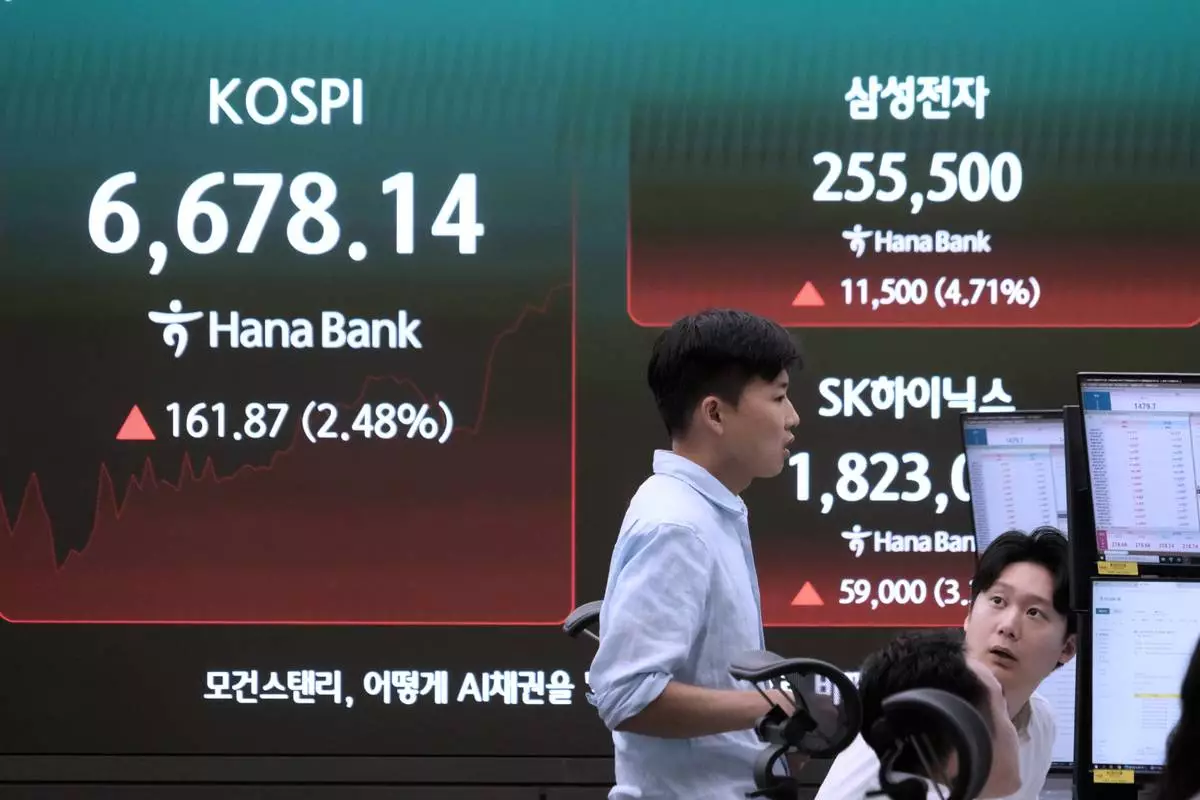
Australia's S&P/ASX 200 added 0.3% to 8,823.00. South Korea's Kospi rose 0.7% to 6,797.70. The Hang Seng dipped nearly 1.0% to 24,892.66, while the Shanghai Composite was little changed, adding less than 0.1% to 3,867.03.

More climbs for oil prices have come after the continued attacks between the United States and Iran. Benchmark U.S. crude added $2.90 to $87.24 a barrel. Brent crude, the international standard, rose $2.91 to $93.92 a barrel.

“Oil makes the situation more difficult because Japan imports most of its energy. A weaker yen and higher crude prices arrive together like two waves hitting the same sea wall,” said analyst Stephen Innes, a former trader.

In currency trading, the U.S. dollar inched down to 163.11 Japanese yen from 163.14 yen. The euro cost $1.1409, up from $1.1404.

Rising oil prices are again pushing inflation higher, just as increases for prices were slowing more than economists expected. That in turn could push the Federal Reserve and other central banks to raise interest rates, which would slow economies and undercut prices for stocks and other investments.

AP Business Writer Stan Choe contributed to this report.

Two men wade in the waters of the Strait of Hormuz with vessels anchored in the background, off Bandar Abbas, Iran, Sunday, July 12, 2026. (Razieh Poudat/ISNA via AP)

Two men wade in the waters of the Strait of Hormuz with vessels anchored in the background, off Bandar Abbas, Iran, Sunday, July 12, 2026. (Razieh Poudat/ISNA via AP)

Currency traders work near a screen showing the Korea Composite Stock Price Index (KOSPI), SK Hynix and Samsung Electronics Co. stock price at the foreign exchange dealing room of the Hana Bank headquarters in Seoul, South Korea, Tuesday, July 21, 2026. (AP Photo/Ahn Young-joon)

Currency traders work near a screen showing the Korea Composite Stock Price Index (KOSPI), SK Hynix and Samsung Electronics Co. stock price at the foreign exchange dealing room of the Hana Bank headquarters in Seoul, South Korea, Tuesday, July 21, 2026. (AP Photo/Ahn Young-joon)

Currency traders work near a screen showing the Korea Composite Stock Price Index (KOSPI) and the foreign exchange rate between U.S. dollar and South Korean won at the foreign exchange dealing room of the Hana Bank headquarters in Seoul, South Korea, Wednesday, July 22, 2026. (AP Photo/Ahn Young-joon)

Currency traders work near a screen showing the Korea Composite Stock Price Index (KOSPI) and the foreign exchange rate between U.S. dollar and South Korean won at the foreign exchange dealing room of the Hana Bank headquarters in Seoul, South Korea, Wednesday, July 22, 2026. (AP Photo/Ahn Young-joon)

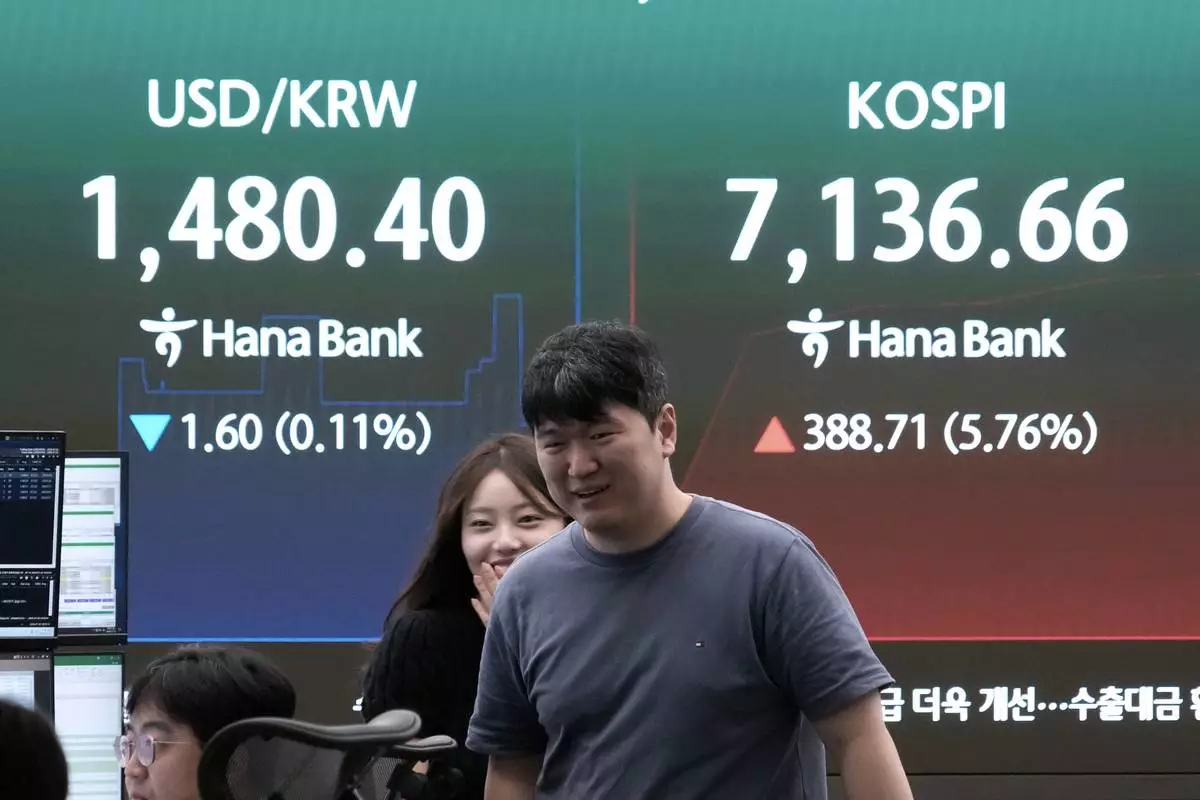
Currency traders walk by a screen showing the Korea Composite Stock Price Index (KOSPI) and the foreign exchange rate between U.S. dollar and South Korean won at the foreign exchange dealing room of the Hana Bank headquarters in Seoul, South Korea, Wednesday, July 22, 2026. (AP Photo/Ahn Young-joon)

Currency traders walk by a screen showing the Korea Composite Stock Price Index (KOSPI) and the foreign exchange rate between U.S. dollar and South Korean won at the foreign exchange dealing room of the Hana Bank headquarters in Seoul, South Korea, Wednesday, July 22, 2026. (AP Photo/Ahn Young-joon)

Currency traders walk by a screen showing the Korea Composite Stock Price Index (KOSPI), SK Hynix and Samsung Electronics Co. stock price at the foreign exchange dealing room of the Hana Bank headquarters in Seoul, South Korea, Wednesday, July 22, 2026. (AP Photo/Ahn Young-joon)

Currency traders walk by a screen showing the Korea Composite Stock Price Index (KOSPI), SK Hynix and Samsung Electronics Co. stock price at the foreign exchange dealing room of the Hana Bank headquarters in Seoul, South Korea, Wednesday, July 22, 2026. (AP Photo/Ahn Young-joon)

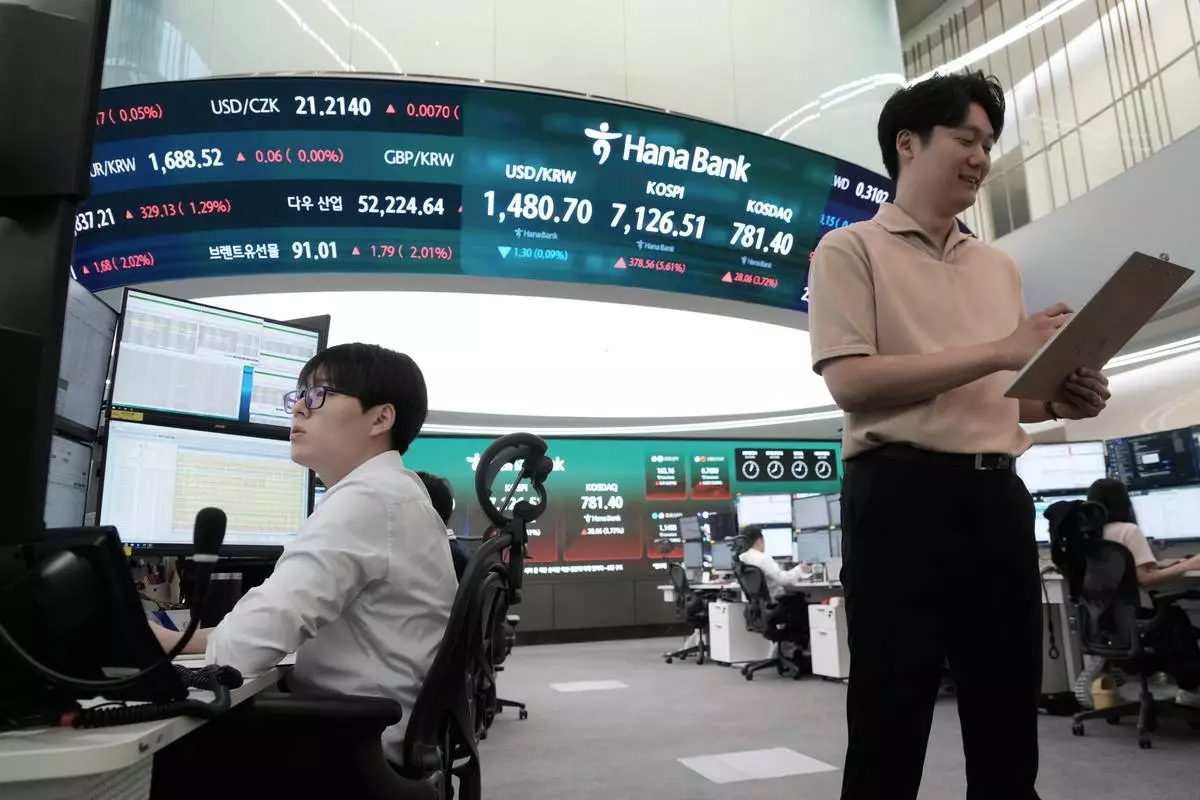
Currency traders work at the foreign exchange dealing room of the Hana Bank headquarters in Seoul, South Korea, Wednesday, July 22, 2026. (AP Photo/Ahn Young-joon)

Currency traders work at the foreign exchange dealing room of the Hana Bank headquarters in Seoul, South Korea, Wednesday, July 22, 2026. (AP Photo/Ahn Young-joon)

Recommended Articles