China reported 34.17 billion cross-regional passenger trips in the first half (H1) of 2026, an increase of 1.2 percent year on year, the Ministry of Transport said on Wednesday.
Road passenger traffic rose 0.9 percent year on year to 31.32 billion trips, while waterway passenger trips increased 4.3 percent to 130 million, according to the data released by the ministry.
During this period, China handled 28.07 billion tonnes of commercial freight, up 3.2 percent year on year. Of the total, road and waterway freight volumes reached 21.22 billion tonnes and 4.23 billion tonnes, respectively.
Total port cargo throughput rose 2 percent year on year to 9.07 billion tonnes, while container throughput climbed 5.9 percent to 180 million twenty-foot equivalent units.
During the January-June period, fixed-asset investment in the transport sector remained at a high level, totaling 1.5 trillion yuan (about 220.81 billion U.S. dollars). Of the total, highway and waterway investment stood at 1 trillion yuan and 109.9 billion yuan, respectively, the data revealed.
Since the beginning of this year, China has seen the commencement of multiple major transportation infrastructure projects. Notably, several large-scale initiatives with investments exceeding 20 billion yuan have officially broken ground. These include the Sutong Second River-Crossing Channel in Jiangsu Province, the Nanjiang to Santai Expressway in Sichuan Province, and the S35 Jingtai to Lixian Expressway in Gansu Province.
In addition to these new developments, construction is accelerating on several other key transport networks. Major projects such as the new Three Gorges Waterway Channel, the Duku Expressway in Xinjiang, and the comprehensive transportation hub at Dalian Jinzhouwan International Airport are currently being fast-tracked to further enhance the nation's logistics and travel infrastructure.
"In the first half of the year, the transportation economy remained generally stable. The scale of major physical volume indicators continued to expand, achieving growth across the board. Notably, in June, all indicators showed a rebound to varying degrees, demonstrating the strong resilience and vitality of China's economic development," said Zhou Jian, deputy director of the Information Center at the Transport Planning and Research Institute of the Ministry of Transport.

China's cross-regional passenger trips up 1.2 pct in H1
Emergency measures are being put in place to help urban areas across China cope with sweltering daytime temperatures as a severe heatwave grips multiple regions of the country, with local community rest stations being set up to shield residents and provide much-needed respite to outdoor workers amid the scorching weather.
Large swathes of the country are baking as the summer heat takes hold. According to the Central Meteorological Observatory of China, eight of the top ten hottest areas nationwide on Wednesday were in northwest China's Xinjiang Uygur Autonomous Region, where Turpan and Toksun both recorded temperatures above 44.5 degrees Celsius.
The intense heat is unlikely to let up anytime soon, as Hami Meteorological Station has issued a red alert and is forecasting that temperatures in Hami City will exceed 40 degrees Celsius from Wednesday to Sunday.
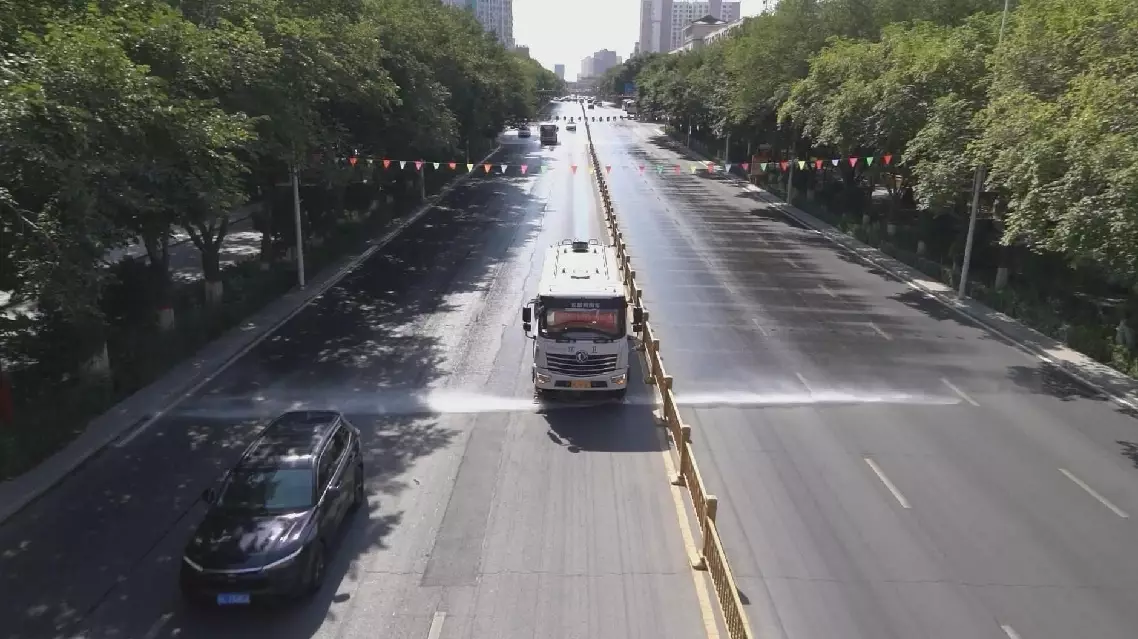
In an effort to combat the heatwave, the local sanitation department has deployed multiple sprinkler and spray trucks to cover major roads in downtown Hami to help with dust suppression and road surface cooling, while upping the frequency of operations.
Persistent high temperatures have also affected many areas in the southwestern Sichuan Province, with some weather stations recording maximum highs exceeding 42 degrees Celsius and weather alerts being issued in numerous cities.
In Guang'an City, the mercury had already soared to 38 degrees Celsius by 10:00 Wednesday morning, pointing to a long, hot day ahead.
However, the county has opened nearly 350 'rest stations' to help local people escape the heat. These air-conditioned cooling points, equipped with fans, drinking water, emergency medicines, and seating, provide much-needed rest areas for outdoor workers such as delivery drivers and couriers, as well as to the elderly and other passersby.
"This round of high temperatures is characterized by its long duration, high temperatures, and the oppressive, muggy conditions, impacting outdoor workers and the elderly the most," said Yu Jilin, Secretary of the Party Leadership Group at the Wusheng County Federation of Trade Unions.
In the neighboring Chongqing Municipality, a red alert for high temperatures was issued on the same day.
At the exit of a busy highway in Wuxi County, heat waves shimmered on the road surface amid heavy traffic. Police officers on duty were busy checking vehicles under the scorching sun, focusing on any potential safety hazards in passenger and freight vehicles, while enduring the sizzling weather themselves.
"The main issue is the high temperature -- surface temperatures can reach over 50 degrees Celsius. Whenever we are on duty, the exhaust from passing fuel-powered vehicles feels scorching hot against our bodies," said Lin Xianyong, an auxiliary police officer.
Air-conditioned "rest stations" set up to provide respite as scorching heatwave grips China