A four-hour documentary about Elon Musk, Martin McDonagh's dark CIA comedy “Wild Horse Nine” and films featuring Robert Pattinson, Penélope Cruz and Javier Bardem are among the movies premiering at the Venice Film Festival in September.
Alberto Barbera, the festival's artistic director, unveiled the lineup Thursday for the 83rd edition of the festival, the first of many in a busy fall film season that culminates in the Hollywood awards showdown. Like the Cannes Film Festival earlier this year, the selection is lighter on Hollywood studio films than in years past.
“Wild Horse Nine,” starring John Malkovich and Sam Rockwell as CIA agents in Chile before the 1973 coup, is among the higher-profile titles playing in competition. It will play alongside “Primetime,” in which Pattinson stars as “To Catch a Predator” host Chris Hansen. The broader slate has anticipated documentaries like Alex Gibney's “Musk,” a sweeping portrait of the billionaire, and Julia Loktev’s “My Undesirable Friends: Part II — Exile,” which follows Russian independent journalists after they leave the country. Similar to the first part, it runs 355 minutes.
The festival's main competition includes a diverse array of international and American films, like Werner Herzog’s “Bucking Fastard,” in which sisters Rooney and Kate Mara play identical twins.
Also on the program are Florian Zeller’s thriller “Bunker,” with Bardem and Cruz playing a married couple, Lee Chang-dong’s “Possible Love,” Stéphane Brizé’s “A Good Little Soldier” and Hirokazu Kore-eda’s “Look Back,” a coming of age story about two girls who dream of being manga artists. Casey Affleck will be in competition for the first time with “Company,” starring Nick Nolte and Ben Mendelsohn. Nanni Moretti also returns for the first time since 1989.
Notable documentary premieres out of competition include “Oasis: Don't Look Back in Anger,” Barbara Kopple’s “Union Town,” Elizabeth Chai Vasarhelyi and Jimmy Chin's “Everest: The Other Side,” Luca Guadagnino’s seven-hour Bernardo Bertolucci film “Joie de Vivre,” Wim Wenders' look at architect Peter Zumthor, Russell Crowe’s autobiographical musical concert movie, “What Love Builds,” and Laura Poitras’s short about U.S. Immigration and Customs Enforcement in Minneapolis, “They're Here.”
Barbera said he expects Noel and Liam Gallagher to attend on behalf of the film, which was directed by Steven Knight and will be in theaters soon after, on Sept. 11.
The festival is set to open on Sept. 2 with Danny Boyle’s “Ink,” an adaptation of James Graham’s stage play which dramatizes the rise of media tycoon Rupert Murdoch. “Ink” is also playing in the main competition and in the running for awards such as the Golden Lion, a prize that is decided upon by a jury led this year by filmmaker and actor Maggie Gyllenhaal. Other jurors include filmmakers like Kaouther Ben Hania, Johnnie To and Shahrbanoo Sadat and composer Daniel Blumberg.
Gyllenhaal has a film playing as well: A Marilyn Monroe-inspired short, “Flesh Impact,” in which Dakota Johnson and Ellen Burstyn “give body and voice to the myth of Marilyn,” Barbera said. The 93-year-old Burstyn will also get a lifetime achievement award from the festival.
Venice has in the last 15 years proved a desirable launching pad for Oscar hopefuls, even if not everything breaks through. Last year’s edition had plenty of star power in the lineup, with Julia Roberts, George Clooney and Dwayne Johnson movies among the splashy premieres. But the glow of the festival moment was short-lived: The films, “After the Hunt,” “Jay Kelly” and “The Smashing Machine,” were neither triumphant with audiences in theaters (“Jay Kelly” was a Netflix release) nor with awards voters.
Still, there’s usually a best picture nominee in the slate: Last year there were two in “Frankenstein” and “Bugonia.”
This year won’t be bereft of a Clooney moment either: The Venice regular is getting a lifetime achievement award.

FILE - Festival goers pass the red carpet of the 81st edition of the Venice Film Festival in Venice, Italy, Aug. 27, 2024. (Photo by Vianney Le Caer/Invision/AP, File)
RAMALLAH, West Bank (AP) — The world’s leading authority on food insecurity said Thursday that the situation in Gaza had improved since famine was declared in parts of the Palestinian territory last year, but warned that conditions remained at crisis levels and could slip back into catastrophe.
The Integrated Food Security Phase Classification, or IPC, said a reduction in fighting and the fact that Israel was allowing more aid into Gaza had a “significant impact, albeit unevenly across areas.” But it noted that most families living in the war-battered enclave still weren't getting nearly enough to eat.
“Even small disruptions to humanitarian access could rapidly reverse recent gains,” the report warned.
The report shows how conditions have markedly improved since last year, yet there’s no immediate prospect of pulling Gaza's 2.1 million Palestinians out of this crisis.
More than 1,185 people have been killed by Israeli strikes and shelling since last October’s agreement, according to the territory’s health ministry. Israel controls more than half the territory, leaving Palestinians confined to squalid tent camps and heavily damaged urban neighborhoods. Failing sewage systems have contributed to routine disease outbreaks and left residents with inconsistent access to basic services.
“Many children are still going hungry, and some children may never fully recover from prolonged lack of proper nutrition,” UNICEF Executive Director Catherine Russell said in a statement.
Living for such a long time without enough food has contributed to a rise in reported cases of “stunting,” a condition in which children’s growth is permanently impaired by not being able to eat. IPC said the rise reflected “the cumulative impact of inadequate conditions” and, for kids, would have “lasting consequences for growth and cognitive development.”
The IPC assesses hunger crises by measuring indicators of acute malnutrition and famine, including how many households are experiencing extreme food shortages, how many young children show bodily signs of malnutrition and how many people are dying from starvation.
It uses five phases to classify food insecurity. Last August, IPC confirmed famine, its most severe classification, in Gaza Governorate, which covers Gaza City. Thursday’s report classified all five governorates in the territory as being in Phase 3 “crisis” conditions while estimating that more than 200,000 residents were experiencing Phase 4 “emergency” conditions.
Although acute food insecurity — whether households can get enough food to survive — remains at crisis levels, the authority said acute malnutrition — the physical effects of not eating enough — had declined to levels classified as acceptable, despite last year’s warnings.
It has declared famines in other places, including parts of Sudan and Somalia. But the authority's declaration last August of famine in parts of Gaza was its first in the Middle East.
Israel strenuously denied allegations of widespread hunger and manmade famine in Gaza, calling them lies. But after imposing an almost total blockade on humanitarian aid from early March to mid-May last year, it began allowing more aid into the territory.
This week's assessment was IPC’s first since December 2025, when it said famine in Gaza City had not spread as feared, downgrading the governorate's classification to Phase 4.
COGAT, the Israeli military body overseeing humanitarian affairs in Gaza, said it “strongly rejects the claims and conclusions” in Thursday's report because it lacked objectivity and did not take into account Israel's data about the amount of aid entering.
As the world’s attention has shifted to Iran, efforts to advance reconstruction, demilitarize Gaza or transition governance to a U.S.-led Board of Peace have mostly stalled. “Measurable improvements in humanitarian access and overall conditions” have taken hold since Israel and Hamas signed on to an agreement that decreased the intensity of fighting, IPC said.
It warned such gains were fragile and partial.
Even with improvements, Gaza’s widespread destruction has left it almost wholly dependent on aid, the report warns. Palestinians have lost their livelihoods and access to most of the territory’s agricultural land, which lies in the more than half of Gaza that remains under Israel’s control.
The IPC cautioned about some indicators pointing to renewed deterioration. It said household food consumption has improved and acute malnutrition — not eating to the extent that it's life-threatening — has “declined significantly.” Still, roughly 1.4 million people are expected to face acute food insecurity through the end of the year, about 200,000 more than the IPC projected in its previous assessment covering mid-April through June of this year.
Almost 75,000 children under five will require treatment for acute malnutrition between now and April 2027. Almost 25,000 pregnant and breastfeeding women are expected to experience acute malnutrition over the same period, though the number benefiting from supplementary feeding programs has declined “due to funding constraints and uncertainty” over whether Israel will continue allowing international aid groups to operate, the report said.
Israel introduced new registration rules for international NGOs last year that require organizations to disclose extensive information that aid workers say could endanger staff and compromise humanitarian operations. Aid organizations say the rules could force some groups to halt operations in Gaza.
Associated Press journalists Najib Joubain in Cairo and Sam Mednick in Tamariu, Spain, contributed.
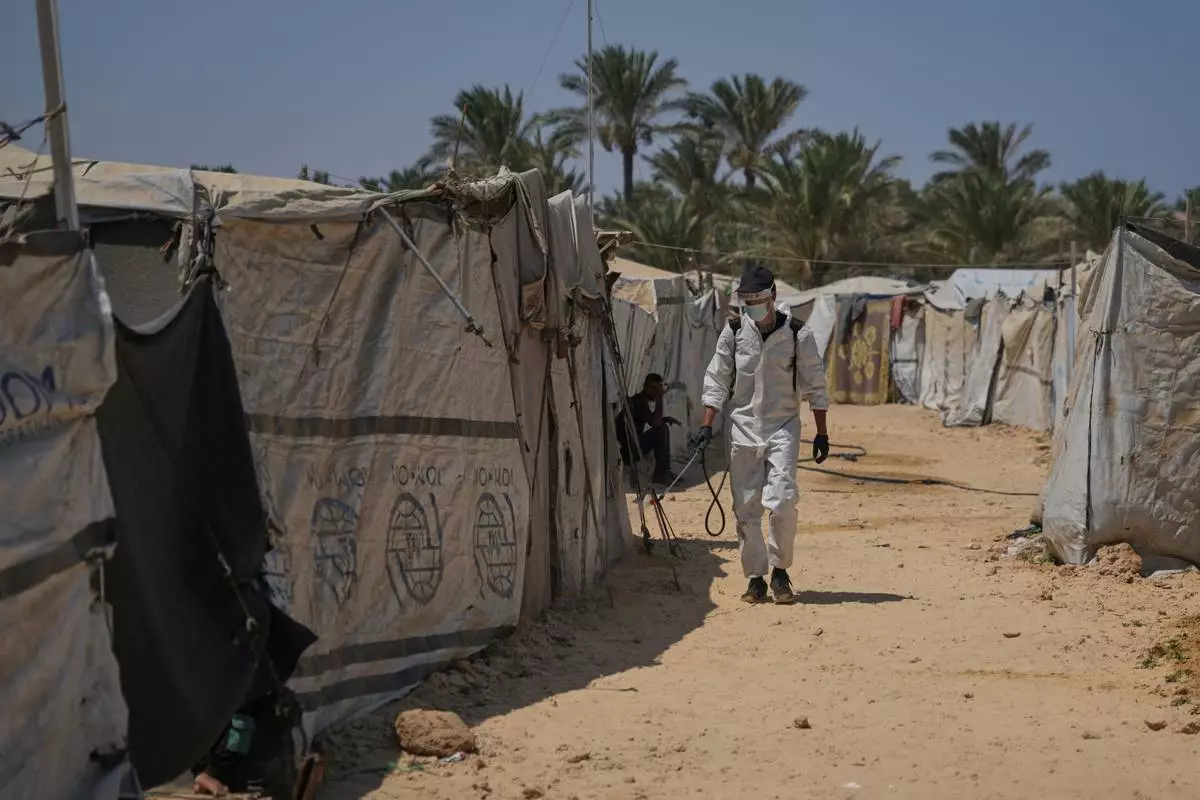
A municipal worker sprays pesticide as part of an initiative to combat rodents and insects at a tent camp for displaced Palestinians in Deir al-Balah, central Gaza Strip, Wednesday, July 22, 2026. (AP Photo/Abdel Kareem Hana)
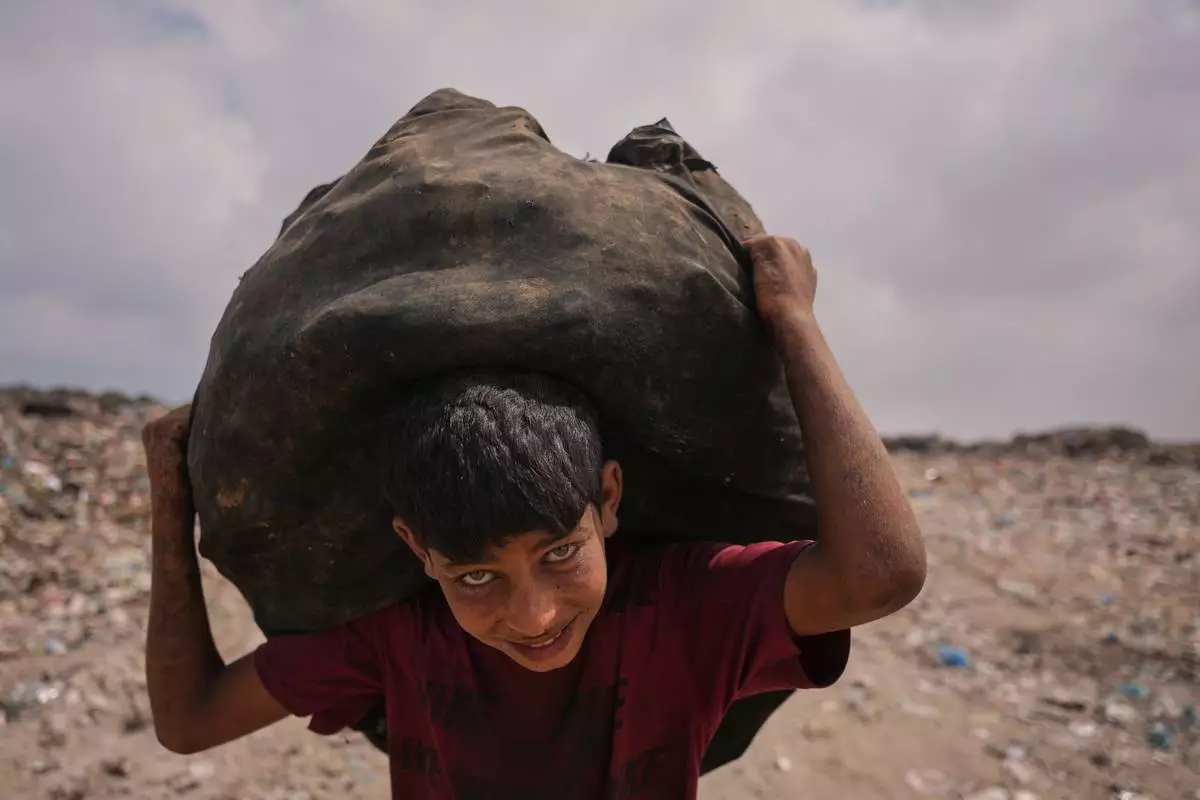
Omar Ghabin, 14, looks at the camera as he carries a bag after sorting through trash at a landfill in Deir al-Balah, central Gaza Strip, Thursday, July 23, 2026. (AP Photo/Abdel Kareem Hana)