MANHASSET, N.Y.--(BUSINESS WIRE)--Jul 23, 2026--
Responsible for millions of deaths worldwide, sepsis, a life-threatening condition where the body’s immune system spirals out of control, demands relentless and innovative research to advance understanding and deliver life-saving therapies. For their dedication to sepsis research, investigators from Northwell Health’sFeinstein Institutes for Medical Research were the recipients of seven prestigious awards at the 2026 Shock Society Annual Conference last month.
This press release features multimedia. View the full release here: https://www.businesswire.com/news/home/20260723367396/en/
The impressive sweep of awards came from the labs of Ping Wang, MD, chief scientific officer and professor at the Center for Immunology and Inflammation, the Feinstein Institutes. These awards not only underscore the labs’ commitment to research, but also highlights their pivotal role in advancing critical insights and new therapeutic strategies.
“I am immensely proud of my team’s well-deserved accolades at the Shock Society Annual Conference,” said Dr. Wang. “This recognition is a powerful testament to their relentless dedication to pioneering research that will ultimately transform how we understand and treat critical illnesses like sepsis.”
The awards span a range of recognition, highlighting both established and emerging talent within Dr. Wang’s team:
“Dr. Wang’s labs, with their success at the Shock Society conference, isn’t just receiving recognition; it’s a testament to the powerful discoveries that will directly transform care for patients facing life-threatening conditions,” said Kevin J. Tracey, MD, president and CEO of the Feinstein Institutes, Karches Family Distinguished Chair in Medical Research. “This is the kind of accelerated science we need to find useful treatments to cure this disease.”
The Shock Society was founded in 1978 by a group of dedicated clinicians and researchers whose mission is to improve the care of victims of trauma, shock, and sepsis by promoting clinically relevant research, providing a multidisciplinary forum to integrate and disseminate new knowledge, and promoting the education and mentoring of the next generation of investigators in the field.
Last year, Clifford S. Deutschman, MD, was recognized with Shock Society’s Scientific Achievement Award, joining Dr. Kevin J. Tracey in 2016 and Dr. Ping Wang in 2019.
About the Feinstein Institutes
The Feinstein Institutes for Medical Researchis the home of the research institutes of Northwell Health, the largest health care provider and private employer in New York State. Encompassing 50+ research labs, 3,000 clinical research studies and 5,000 researchers and staff, the Feinstein Institutes raises the standard of medical innovation through its six institutes of behavioral science, bioelectronic medicine, cancer, health system science, molecular medicine, and translational research. We are the global scientific leader in bioelectronic medicine – an innovative field of science that has the potential to revolutionize medicine. The Feinstein Institutes publishes two open-access, international peer-reviewed journalsMolecular MedicineandBioelectronic Medicine. Through theElmezzi Graduate School of Molecular Medicine, we offer an accelerated PhD program. For more information about how we produce knowledge to cure disease, visithttp://feinstein.northwell.eduand follow us onLinkedIn.

From left to right: Drs. Kohei Ishikawa, Yuichi Akama, Tomoki Abe, Russell Hollis, Ping Wang, Noah Robey, Monowar Aziz, Hui Jin, Jeremy Kaplitt, and Rafael Fernandez. (Credit: Feinstein Institutes)
NEW YORK (AP) — Oil prices are leaping further Thursday as increased fighting in the Middle East threatens to slow the global flow of crude. Sharp drops for two of Wall Street's most influential companies, Alphabet and Tesla, are meanwhile dragging the U.S. stock market lower.
The S&P 500 dropped 1.2% and may be heading for its first back-to-back weekly loss since March. The Dow Jones Industrial Average was down 477 points, or 0.9%, as of 11 a.m. Eastern time, and the Nasdaq composite was 2.4% lower.
Stocks sank under the pressure of rising oil prices, which raise costs for businesses and erode their customers’ ability to spend. The price for a barrel of Brent crude oil, the international standard, jumped 7.2% to $100.88.
It earlier touched the highest price in two months for the most actively traded Brent contract in the market. The cause: attacks on two Saudi oil tankers in the Red Sea. They threaten another avenue that oil companies use to transport their crude from the Middle East to customers worldwide, along with the Strait of Hormuz.
Underscoring the importance of the sea route for the economy, President Donald Trump threatened “major military punishment” against the Houthi rebels in Yemen, who are backed by Iran, if they keep attacking ships.
It was just a few weeks ago that Brent had dropped below $72 per barrel, roughly back to where it was before the United States and Israel attacked Iran to begin their war, on hopes that the Strait of Hormuz would fully reopen to oil tankers.
The jumps in oil prices are threatening to worsen inflation, just as it had begun to decelerate by more than economists expected. That in turn could push the Federal Reserve and other central banks to raise interest rates, which would slow economies and undercut prices for stocks and other investments.
The European Central Bank held its main interest rates steady at its meeting Thursday. But traders are banking on a nearly 38% chance the Fed will hike the federal funds rate at its meeting next week. That's up from the nearly 12% probability seen a week ago, according to data from CME Group. An increase by the Fed would be the first since 2023.
Higher oil prices pushed the yield on the 10-year Treasury up to 4.70% from 4.67% late Wednesday and from just 3.97% before the war with Iran began. That’s a significant increase, and it’s already brought long-term U.S. mortgage rates to their highest levels in nearly a year.
On Wall Street, stocks of companies with big fuel bills fell to sharp losses on worries about higher expenses.
American Airlines lost 7.4% even though it reported a much bigger profit for the spring than analysts expected, something that usually sends a stock’s price higher. It raised airfares, which helped it offset its higher fuel prices, during the latest quarter.
Southwest Airlines fell 3.9%, even though it also reported better profit and revenue than analysts expected. It wrung more profit out of each $1 of its revenue during the spring, even with higher fuel prices.
One of the heaviest weights on the U.S. stock market was Tesla, which sank 13.6% after Elon Musk’s electric-vehicle company reported a weaker profit for the latest quarter than analysts expected. Because it’s one of the largest stocks in the S&P 500 by market value, its stock has more influence on the index than nearly every other.
One of the few that’s larger is Alphabet, and its stock fell 7.3% even though the parent company of Google delivered stronger profit and revenue than analysts expected.
Investors seemed to focus instead on how much Alphabet said it’s set to spend on artificial-intelligence investments. Alphabet raised its forecast for capital spending over the full year after its investments doubled last quarter to nearly $45 billion from a year earlier.
CEO Sundar Pichai said AI helped its cloud revenue growth accelerate to 82% last quarter, but unease nevertheless remains about whether all the money it’s pouring into AI will pay off in terms of productivity and profits.
Such worries have been shaking the AI industry broadly in recent weeks, leading to big swings for the overall stock market.
In stock markets abroad, indexes fell sharply in Europe as oil prices jumped. France’s CAC 40 dropped 1.6% for one of the larger losses.
Indexes earlier in the day were stronger in Asia, where South Korea’s Kospi jumped 4.4%.
AP Business Writers Matt Ott and Elaine Kurtenbach contributed to this report.

The screen showing the Korea Composite Stock Price Index (KOSPI) is displayed at a dealing room of Hana Bank in Seoul, South Korea, Wednesday, July 15, 2026. (AP Photo/Lee Jin-man)

A man walks in front of an electronic stock board showing Japan's Nikkei 225 index at a securities firm Wednesday, July 15, 2026, in Tokyo. (AP Photo/Eugene Hoshiko)
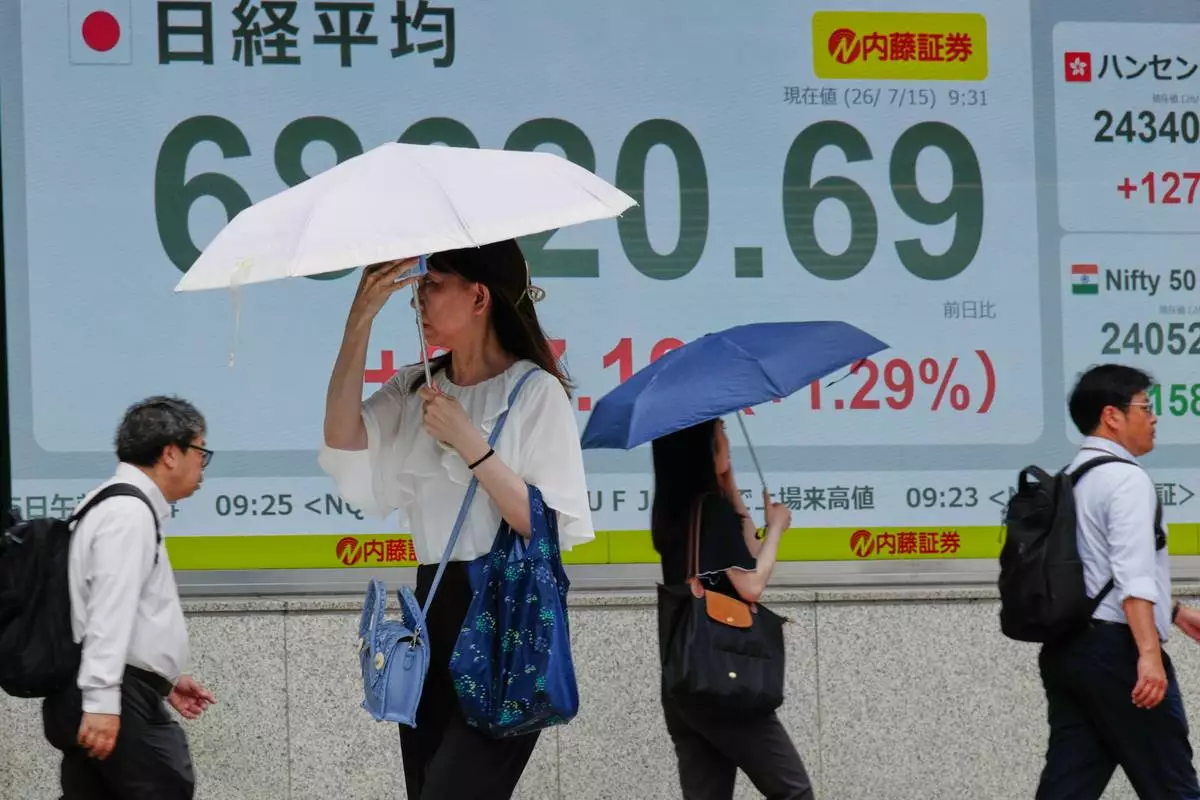
People walk in front of an electronic stock board showing Japan's Nikkei 225 index at a securities firm Wednesday, July 15, 2026, in Tokyo. (AP Photo/Eugene Hoshiko)