Former Democratic Party chairman Wu Chi-wai recently faced a tense standoff at London Heathrow Airport. UK border authorities detained him upon arrival and temporarily confiscated his passport. Wu had just been released from Hong Kong prison on June 30 after serving his sentence for the "35+ subversion case."
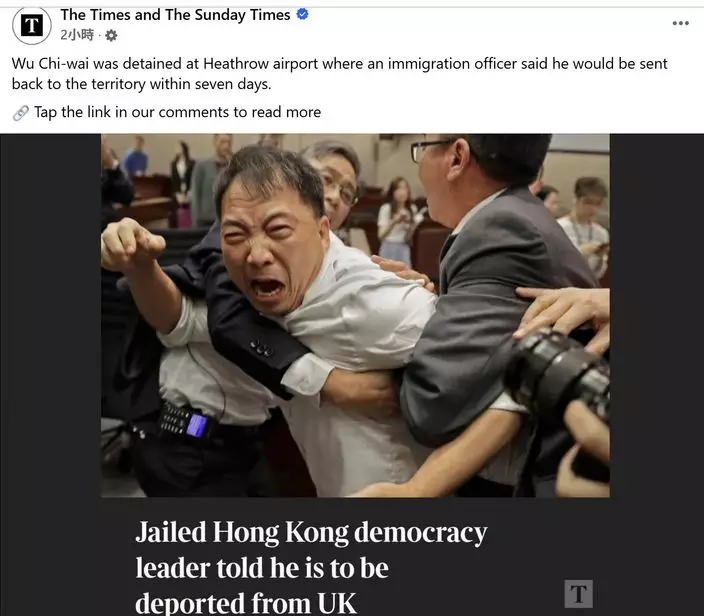
Detained on arrival, told he'd be deported within a week.
The UK's The Times broke the story. The newspaper reported that the British government warned Wu he might be deported back to Hong Kong within a week. Shortly after the report surfaced, a friend revealed that Wu admitted to the airport detention but eventually secured entry into the UK using his BNO passport.
A well-informed source suggests: someone may have deliberately leaked this information to put pressure on the British government into letting Wu in.
The Times Report
The Times published an article titled "Jailed Hong Kong democracy leader told he is to be deported from UK." The report stated that Wu originally intended to seek asylum in the UK while also planning to settle there via the BNO visa route. The UK Home Office has acknowledged the incident. Officials cited issues related to immigration documents or administrative procedures and confirmed the case is currently being handled.
The report quoted Paul Harris, former chairman of the Hong Kong Bar Association. Harris stated that local authorities told Wu his passport would be confiscated and he would face deportation to Hong Kong within seven days. The article also cited a friend of Wu who revealed the former politician arrived in the UK to seek political asylum. The friend added that Wu simultaneously planned to settle down through the BNO route.
The Times noted that the BNO visa scheme allows applicants to apply after they arrive in the UK. The country has transformed into a major destination for Hong Kong emigrants in recent years. The British government stated in February that over 230,000 people have received visas since the launch of the BNO route. Nearly 170,000 Hong Kong BNO holders have already moved to the UK.
Make no mistake: the broader immigration picture remains complex. The total number of UK asylum applications reached 93,525 as of March 2026, and the initial approval rate stood at 42 percent in early 2025. The report indicated that Wu's case sits precisely at the intersection of the BNO migration wave, asylum seeking, and post-prison arrangements for Hong Kong political figures.
Reunited With Family
But the real issue is how the situation ultimately resolved. Wu's friend clarified that the former politician has since successfully entered the country and reunited with his family. Wu himself admitted to the brief airport detention. He was later released and allowed to enter the UK through normal procedures rather than by seeking asylum.
A well-informed source noted that Wu could have originally taken the standard BNO route. This path involves living in the UK for the required number of years before applying for settlement and carries a lower risk of being denied entry. His detention at the border combined with British media reports claiming he intended to apply for political asylum paints a mixed picture.
The asylum approach offers a distinct advantage, as approval can trigger the naturalization process. The downside is that it automatically initiates a rigorous British government screening. The inside story remains somewhat perplexing, especially with subsequent leaks suggesting UK authorities wanted to deport him back to Hong Kong.
Avoiding a Diplomatic Row
The source estimated that The Times would not fabricate the story out of thin air, regardless of who leaked the information. The objective outcome is that Wu ultimately arrived in the UK through normal procedures as a BNO holder. This resolution creates a certain amount of public pressure on the new UK cabinet. At the same time, avoiding a political asylum entry has successfully averted a diplomatic spat between China and the UK.
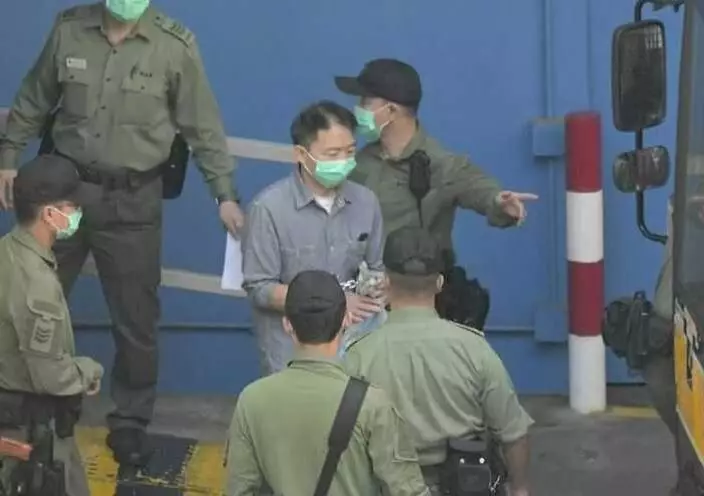
Jailed 4 years 5 months for subversion, out three weeks ago.
The 63-year-old Wu Chi-wai previously pleaded guilty to the charge of "conspiracy to subvert state power" under the Hong Kong National Security Law for his role in the "35+ subversion case." The court ruled him an "active participant" and sentenced him to four years and five months in prison. He just completed his sentence on June 30 this year. This timeline means he has only been out of prison for about three weeks.
Past Cases of Political Asylum
The reality is that multiple individuals have sought political asylum abroad after being released from prison over national security cases.
Tony Chung, former convenor of Studentlocalism, was sentenced to three years and seven months in prison for secession under the National Security Law and money laundering. He was originally required to serve a one-year statutory supervision order under the Correctional Services Department after his release on June 5, 2023. He was later granted permission to travel to Okinawa, Japan, in December 2023 under the pretext of emotional adjustment.
Chung then caught a connecting flight to the UK and arrived in London on December 27, 2023, to seek political asylum. The Correctional Services Department strongly condemned his blatant violation of the supervision order. Authorities immediately issued a recall order and placed him on a wanted list.
Consider another high-profile case involving Agnes Chow, former deputy secretary-general of Demosisto. She was sentenced to 10 months in prison for the 2019 siege of the police headquarters and was released in June 2021. Chow was also implicated in a "colluding with foreign forces" charge under the National Security Law. She remained on bail pending investigation with her passport confiscated after her release.
The police returned Chow's passport in September 2023 so she could study in Canada. She officially announced her exile in Canada and sought political asylum on December 3, 2023. Chow stated she would jump bail and no longer report back to Hong Kong. The Hong Kong police strongly condemned her absconding to evade legal responsibilities. They warned that fugitives should have no delusion of escaping criminal liability by fleeing Hong Kong and will be pursued for life unless they surrender.
A Family Already in the UK
Wu Chi-wai only finished serving his sentence at the end of last month. The media photographed him on that day boarding a seven-seater vehicle early in the morning to leave Stanley Prison before alighting at Fung Tak Estate in Diamond Hill. Observers saw him carrying two bags of personal belongings into the building.
The outside world assumed Wu would keep a low profile and live a quiet life in Hong Kong after serving his sentence. The truth is that all of Wu's family members are in the UK. This family connection suggests he likely had plans to travel there long ago.
Ariel
** 博客文章文責自負,不代表本公司立場 **
Ta Kung Pao recently published a series of commentaries under the byline "Gong Zhiping" over three consecutive days. The series, titled "Safeguarding Hong Kong's High-Quality Development with High-Level Security," was reposted on the website of the Hong Kong and Macao Affairs Office (HKMAO) for three days running, drawing public attention.
The Ta Kung Pao articles point out that, at present, the HKSAR Government and all sectors of society are more clear-eyed, more conscious and more resolute in coordinating development and security, and in safeguarding the new development paradigm with a new security architecture.
Chief Executive John Lee has led the SAR's executive, legislative and judicial authorities in firmly discharging the constitutional responsibility of safeguarding national security, continuously consolidating the bedrock of high-level security for high-quality development.
Under the protection of security, Hong Kong's development momentum is growing ever stronger and its pace ever faster. Security has become an advantage for Hong Kong's development. The full text of the article follows:
Hong Kong's journey from chaos to order, and from order to prosperity, proclaims a simple truth: only with security every step of the way has there been development every step of the way. Security is not a "tightening spell," the incantation in Journey to the West that constricts the Monkey King's headband. It is a "protective talisman" and a "booster." Security not only provides the most solid foundation for development, it also creates new dividends for development.
Today, the HKSAR Government and all sectors of society are more clear-eyed, more conscious and more resolute in coordinating development and security, and in safeguarding the new development paradigm with a new security architecture.
Chief Executive John Lee has led the SAR's executive, legislative and judicial authorities in firmly discharging the constitutional responsibility of safeguarding national security. In doing so, they continuously consolidate the bedrock of high-level security for high-quality development.
The SAR made history in completing the legislation of Article 23 of the Basic Law. The Safeguarding National Security Ordinance was passed unanimously by the Legislative Council and, together with the Hong Kong National Security Law, has built a solid shield for safeguarding national security in the SAR. The principle of "patriots administering Hong Kong" has been fully implemented, and the power of governance in the SAR remains firmly in the hands of patriots.
The Committee for Safeguarding National Security of the HKSAR has earnestly shouldered its principal responsibility for safeguarding national security and strengthened overall coordination. The SAR's law enforcement, prosecution and judicial departments have been fearless and faithful to their duties, cracking down on acts endangering national security in accordance with the law.
The many patriotic groups and individuals who love the country and Hong Kong have carried forward their fine traditions, waging a resolute struggle against words and deeds that undermine, vilify and disrupt Hong Kong. When hostile forces at home and abroad launch attacks and smears in the arena of public opinion, the SAR Government responds with timely and forceful exposure, criticism and rebuttal.
As for the anti-China elements bent on disrupting Hong Kong who fled overseas and continued to flagrantly violate the Hong Kong National Security Law and the Safeguarding National Security Ordinance, the National Security Department of the Hong Kong Police Force has lawfully placed them on the wanted list. Measures have been applied against them as specified absconders.
The SAR Government and all sectors of society have also worked hard to advance national security education. They have held the "April 15 National Security Education Day" events year after year, opened a permanent National Security Exhibition Gallery, and brought national security education into schools, communities and the grassroots. Particular emphasis goes to strengthening such education for young people.
Hong Kong's legal system and enforcement mechanisms for safeguarding national security have been continuously improved, and its capabilities continuously strengthened. The truth that "only when the nation is secure can Hong Kong be secure, and only when the nation is secure can our homes be secure" has taken deep root in people's hearts. The whole of society has formed a mighty collective force for safeguarding national security.
Today, under the protection of security, Hong Kong's development momentum is getting better and better, and its pace faster and faster.
A few examples suffice to give a glimpse. In 2025, Hong Kong retained its ranking as the world's freest economy, held firm as the world's third-ranked international financial center, and rose to fourth globally in talent competitiveness. In 2026, Hong Kong became the world's largest cross-boundary wealth management center and ranked second globally in the World Competitiveness Yearbook. The economy grew 5.9% in the first quarter of 2026, and the SAR Government recently raised Hong Kong's full-year growth forecast from the previously projected 2.5%-3.5% to 3.5%-4.5%.
More encouraging still, Hong Kong is now working at full throttle on the SAR's first-ever five-year plan, painting a bright blueprint for the city's future development. The SAR Government and all sectors of society are earnestly implementing the spirit of President Xi Jinping's important instructions and proactively aligning with the country's 15th Five-Year Plan. They are upholding and refining the executive-led system, better combining a proactive government with an efficient market, and actively recognizing change, adapting to change and seeking change.
This amounts to forward-looking, science-based and systematic planning for Hong Kong's high-quality development in the new stage.
Strong consensus has been forged, and forceful measures proposed, on a range of priorities. These include highlighting the Northern Metropolis as a key focus, using the university town as a lever to drive the integrated development of education, technology and talent, and consolidating and enhancing Hong Kong's status as an international financial, shipping and trade center.
The priority list also includes accelerating the building of an international innovation and technology hub, creating a magnet for high-caliber global talent, and improving people's livelihoods across the board, in particular resolving the housing problem and bidding farewell to subdivided flats and "cage homes."
Hong Kong's development direction is now clearer, and its bright prospects more distinct.
Today, the international community and global investors increasingly agree that Hong Kong is a "safe harbor," and that a "safe harbor" is a "harbor of development." Security has become an advantage for Hong Kong's development. All objective and rational observers can see it plainly: Hong Kong safeguards national security so that the city can develop better, so that its residents can live better lives, and so that investors' lawful rights and interests can be better protected.
Overseas investors have repeatedly said that Hong Kong's safeguarding of national security has injected strong stability, certainty and sustainability into the market. A stream of international mega-events has been held in Hong Kong one after another. Friends from all over the world have come to the city to take part, casting a vote of confidence in Hong Kong.
In 2025, more than 2,700 single family offices were established in Hong Kong, over half of them with assets under management exceeding US$50 million. The number of companies in Hong Kong with parent companies located overseas or in the Chinese Mainland surpassed 11,000, a record high. Also in 2025, more than 31,000 foreign nationals were granted employment visas to work in Hong Kong, more than double the figure of five years ago.
Hong Kong now stands at a new starting point, ushering in its best period of development. The loftier the development goals and the brighter the vision, the less we can afford to slacken the taut string of security.
We must firmly establish the principle that development is an ironclad truth, and that security is no less so. We must do well in both pursuing high-quality development, the foremost task, and safeguarding national security, the matter of paramount importance.
By truly safeguarding high-quality development with high-level security, Hong Kong will surely stride steadily and surely along the broad road from order to prosperity. The city will shine with even greater splendor on the great journey of building a strong nation and realizing national rejuvenation.