Beijing's top office for Hong Kong affairs is pushing back against the idea that the city's security work is finished. The website of the State Council's Hong Kong and Macao Affairs Office (HKMAO) reposted a commentary published in Ta Kung Pao on Thursday (20 August) under the byline "Gong Zhiping." The piece is titled "Hong Kong's Progression from Chaos to Order and from Order to Prosperity Is a Coherent and Unified Process," part of the series "Safeguarding Hong Kong's High-Quality Development with High-Level Security."
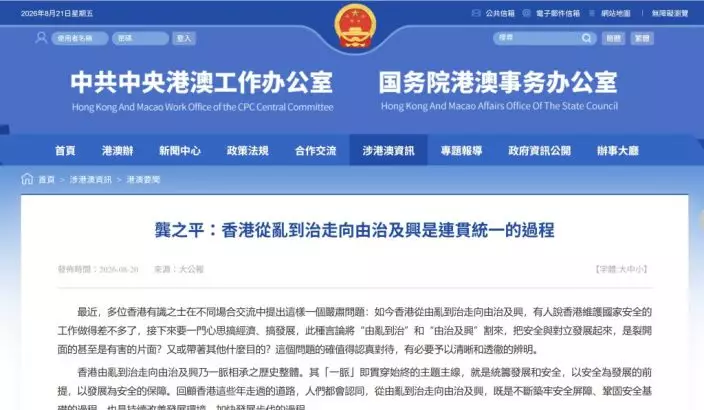
HKMAO reposted Ta Kung Pao's "Gong Zhiping" commentary on Thursday.
The commentary speaks highly of the SAR Government's work. It stresses that development and security are like "the two wings of a bird or the two wheels of a cart." The two must complement and reinforce each other. There is no place for the one-sided claim that "security work is done and we can focus single-mindedly on development."
The Ta Kung Pao article opens with a pointed question. It quotes a number of Hong Kong people of insight who recently raised a serious issue in exchanges on various occasions. As Hong Kong now moves from chaos to order and from order to prosperity, some say the city's work to safeguard national security is more or less done. The next step, they say, is to devote itself single-mindedly to the economy and development.
Such remarks tear "from chaos to order" and "from order to prosperity" apart and set security against development. Are they not one-sided, or even harmful? Or do they carry some other purpose? Citing the questions raised by these people of insight, the author argues that they must be clearly and thoroughly addressed.

"From chaos to order to prosperity" is one continuous whole.
Two Wings of a Bird, Two Wheels of a Cart
The Ta Kung Pao article points out that Hong Kong's progression "from chaos to order" toward "from order to prosperity" is a historical whole carried forward in one continuous vein. The main theme running through it from beginning to end is "coordinating development and security, taking security as the prerequisite for development and development as the guarantee for security."
The article stresses that development and security are "like the two wings of a bird or the two wheels of a cart, complementing and reinforcing each other." As circumstances change, "one wing or one wheel may become more prominent and bear more weight at a given moment. But that by no means implies that the other wing or wheel stops moving or turning. Were that the case, the bird could not fly and the cart could not move. As for when which wing or wheel should be more prominent and bear more weight, that depends on the actual circumstances."
In other words, "from chaos to order" is not solely about security, and "from order to prosperity" is not solely about development. Security and development, "righting wrongs" and "invigorating governance," are interwoven and fused throughout Hong Kong's entire journey from chaos to order, and onward from order to prosperity.
The Ta Kung Pao article makes a blunt case: "building a secure environment is creating the conditions for development." During the 2019 extradition bill turmoil, Hong Kong faced its gravest situation since the handover. "Hong Kong independence" ran rampant, black-clad violence raged, and "mutual destruction" (laam chau) tactics swept the city.
Hong Kong was battered beyond recognition and left in ruins. "One Country, Two Systems" was nearly destroyed in one fell swoop. "Without security, how could there be any talk of development?"
Order Restored, Development Never Shelved
Fortunately, at that critical moment, the Central Authorities enacted the Hong Kong National Security Law and improved the SAR's electoral system. These moves effectively defused the major and imminent threats to national security and reversed Hong Kong's chaos in one stroke. The SAR subsequently completed its Article 23 legislation under the Basic Law, building a solid barrier for safeguarding national security. Hong Kong bid farewell to turmoil and unrest, restored order and vitality, and its business environment has continued to improve.
The article also notes that while stepping up security work, the SAR Government has "never for a moment shelved the development agenda." With the support of the Central Authorities and the Chinese Mainland, Hong Kong emerged smoothly from the pandemic. GDP has grown for 14 consecutive quarters.
The city's status as an international financial, shipping and trade center has been consolidated and enhanced. The building of an international innovation and technology hub has accelerated. The drive to "grab talent and grab enterprises" has yielded remarkable results. Livelihoods, labor, welfare, health and education have all continued to improve.
All this shows that "grasping security and grasping development are not two processes alternating one after the other, but two aspects of the same process."
The Message: Stay the Course
The Ta Kung Pao article concludes on a warning note. As changes unseen in a century unfold at an accelerating pace, the world is entering a new period of turbulence and transformation. Hong Kong's accelerated development places higher demands on security. The city must "grasp both safeguarding security and promoting development, and grasp both firmly." Only by consolidating the gains of "righting wrongs" and strengthening the momentum of "invigorating governance" in tandem can Hong Kong ensure long-term prosperity and stability, and ensure that "One Country, Two Systems" advances steadily and goes far.
An insider said this Ta Kung Pao article is highly significant. It forcefully rebuts the "security is done, focus single-mindedly on development" rhetoric. It directly brands as one-sided, and even "harmful," the view that Hong Kong's national security work is "more or less done" and should give way to "single-minded focus on the economy."
The article also quotes Hong Kong people of insight who question whether such arguments "carry some other purpose." The issue is clearly not that simple.
The article rebuts the "security is enough" theory on three levels. The HKMAO's reposting of the article is clearly targeted. The aim is to refute the fallacy of setting "security" against "development."
High praise for advancing security and development in parallel.
On the other hand, it is worth noting that the article gives high affirmation to the SAR Government's work and to Hong Kong's economic development achievements. In particular, it affirms that the current-term government has advanced "security" and "development" in parallel. This creates a favorable public opinion environment for the continuity of its governance. The core message it conveys is that "the current course is correct and must be upheld."
The insider believes the HKMAO's republication of the article shows that its views accurately reflect the attitude of the Central Authorities. This merits close attention.
Ariel
** 博客文章文責自負,不代表本公司立場 **
The PGA Tour lost Kapalua on Maui as a season opener when a water dispute left the Plantation course unplayable, and then it played the Sony Open in Honolulu for the last time to avoid having one tournament in the middle of the Pacific Ocean.
But that's hardly the end of professional golf in Hawaii.
Kapalua is back in the fold with the announcement that the Lotte Championship is moving from Hoakalei on Oahu to the Plantation course, which had hosted a PGA Tour event starting in 1999.
The Lotte Championship moves from October to March 18-21, one week after the new Nanea Cup on the Big Island that will have 95 players from the LPGA Tour and 25 players from five colleges competing concurrently in separate tournaments.
"As we continue to strengthen the LPGA Tour schedule, venues with deep-rooted heritage like Kapalua are exactly what we look for,” LPGA Commissioner Craig Kessler said.
The LPGA was at Kapalua for one year in 2008, won by Morgan Pressel on the Bay course. The Plantation course has more than 25 years of memories, from Tiger Woods beating Ernie Els in a playoff in 2000 to Hideki Matsuyama setting the PGA Tour's record score to par at 35 under in 2025, the final year it was played.
March also is the last month before the humpback whales — Kapalua is famous for its views of humpbacks breaching in the Pacific — head north toward Alaska.
“Kapalua is an incredible venue to showcase the beauty of Hawaii and everything that makes the islands so special,” said Allisen Corpuz, a Hawaii native and the 2023 U.S. Women's Open champion.
The PGA Tour Champions also has a two-week Aloha swing. It picked up the Sony Championship at Waialae to go along with its Mitsubishi Electric Championship on the Big Island.
The newest team for the indoor golf league TGL at SoFi Center in South Florida is already off to a big start in filling the roster.
The Motor City Golf Club started with Brooks Koepka, a five-time major champion who returned to the PGA Tour this year. This week it announced the addition of Jackson Koivun, who in four months led Auburn to the NCAA golf title, won his first PGA Tour title in his third start as a pro and then went unbeaten in the Presidents Cup.
The Detroit-based club is the first expansion team for TGL and makes its debut early next year.
“With Jackson and Brooks, we have an amazing foundation for what we are trying to build,” said Michael Hamp, the team governor of Motor City.
Meanwhile, TMRW Sports announced an extension of its U.S. media rights with ESPN, which has been the network for TGL since it began two years ago.
The Korn Ferry Tour ends its season with the Tour Championship, and eight of the 20 cards for the PGA Tour in 2027 already have been secured. Blades Brown, who turned pro while still in high school and has contended on the Korn Ferry Tour and PGA Tour this year, is at No. 14 and seemingly would be safe to be in the big leagues next year.
Holding down the 20th spot is Cole Hammer, who is just over five points ahead of Yuta Sugiura of Japan. Sugiura originally was in the field for the Baycurrent Classic in Japan, but he withdrew because of his position on the Korn Ferry points list.
Sugiura last week became the fourth player in Korn Ferry Tour history with a 58 or lower.
Also at stake this week is a fight for No. 1. Sandy Scott won in Oklahoma last week to overtake Ross Steelman on the points list by a mere 24 points. The leading player gets into The Players Championship and the U.S. Open next year.
Bernhard Langer is in the field for the Constellation Furyk & Friends on the PGA Tour Champions, marking his return to the Ocean Course at the Hammock Beach Golf Resort.
But it's been a minute.
Langer was 50 when he won the Ginn Championship at Hammock Beach for his third career PGA Tour Champions title. Ginn dropped its sponsorship the following year.
The Furyk & Friends, previously held at Timuquana Country Club in Jacksonville, Florida, moves to Hammock Beach about 60 miles down the Atlantic coast this year. Langer, the last player to win on the Jack Nicklaus design, returns 18 years later at age 69 and goes for his 48th career Champions title. He has not won since the season finale in 2024.
The European tour schedule for 2027 had one curious shift of tournaments. The BMW PGA Championship, the flagship event on the tour, is moving to the week after the Ryder Cup in Ireland.
The flagship event for years was held in May until it was moved to September in 2019. For the next three Ryder Cups — one in Italy in 2023, the other two in the United States — the BMW PGA Championship has been held two weeks before the matches.
The schedule change allows for the Ryder Cup at Adare Manor next year to be Sept. 17-19. It will be preceded by the European Masters in Switzerland and the French Open. It also means 12 very happy — or very sad — Europeans go to flagship events with a hangover, literal or figurative.
It's reminiscent of 2008, when the PGA Tour rearranged its schedule for the Ryder Cup at Valhalla. There were three FedEx Cup playoff events, followed by a week off and then the Ryder Cup. The Tour Championship was the week after Valhalla.
The Americans won, there was a great celebration. And then the top 30 headed to East Lake. That was the year Vijay Singh only had to finish 72 holes to claim the FedEx Cup. It also was the year Kentucky native Kenny Perry showed how little he wanted to be there.
“I don’t want to be here — don’t want nothing to do with this deal,” Perry said that week. ”It's ruined the greatest week of my life coming here. I don’t want to play golf. I want to go home and celebrate. I’m physically tired. I have no focus. I don’t even care. I’m just trying to get my last-place check, post a 72-hole number and go home."
He tied for 24th, collected $120,400 and went home.
Along with having world No. 1 Scottie Scheffler as its defending champion, The American Express will have the Zac Brown Band and Train performing on consecutive nights after the second and third rounds at PGA West in the California desert. ... George McNeill is No. 7 on the Charles Schwab Cup and still needed an exemption to get into the Constellation Furyk & Friends this week. The good news for McNeill? The top 36 at the end of the season are fully exempt for next year. ... Xander Schauffele brought 1-year-old son Victor to the Baycurrent Classic in Japan for grandparents on both sides — his mother and his wife's mother grew up in Japan — to see him for the first time.
Jeeno Thitikul of Thailand needed only 101 starts on the LPGA to surpass $20 million in career earnings. She is $30,163 ahead of Cristie Kerr, who played in 609 tournaments.
“That means I need to pay more tax.” — Jeeno Thitikul on surpassing $20 million in career earnings.
See AP’s full golf coverage here

Brooks Koepka of USA tees off the 2nd on day three of the Dunhill Links Golf Championship in St Andrews, Scotland, Saturday, Oct. 3, 2026. (Steve Welsh/PA via AP)
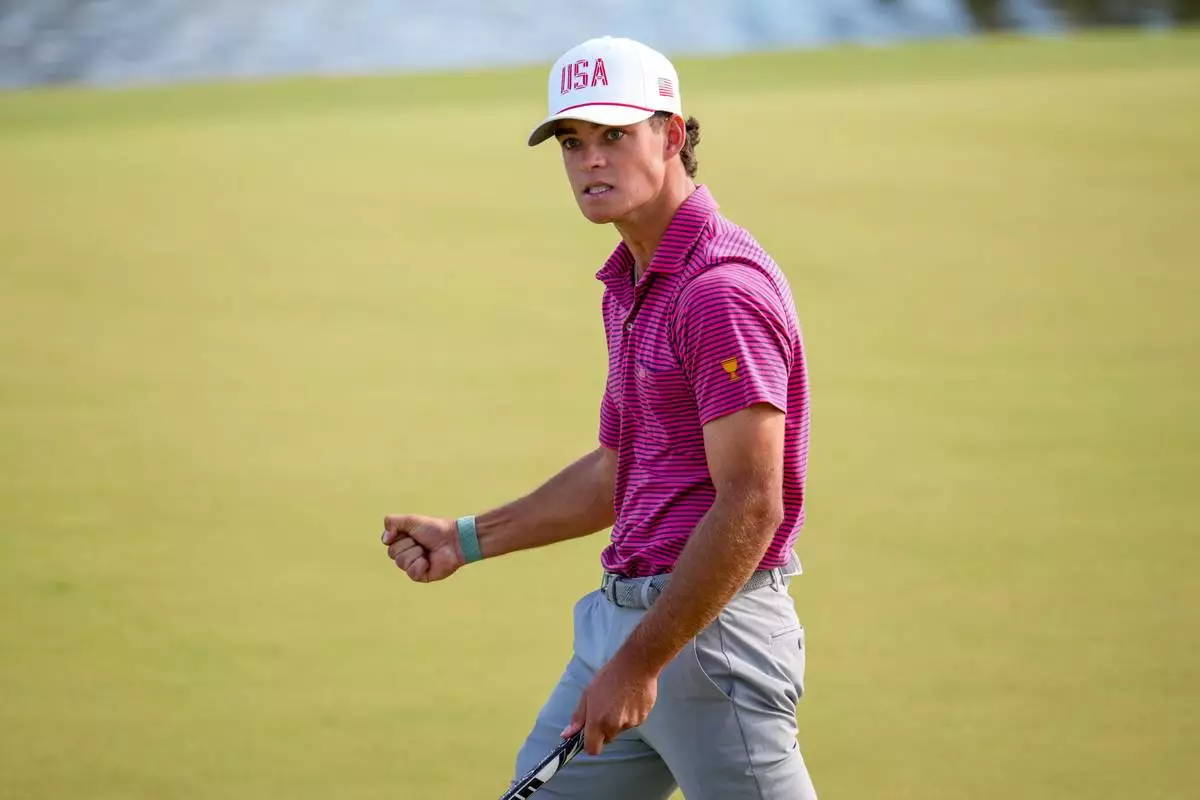
USA teams' Jackson Koivun reacts to his birdie putt on the 12th hole against the International team during a Presidents Cup golf tournament final round singles match at Medinah Country Club, Sunday, Sept. 27, 2026, in Medinah, Ill. (AP Photo/Matt Slocum)