Northwest China's Xinjiang Uygur Autonomous Region saw its gross domestic product (GDP) expand 3.7 percent year on year in the first half of 2026 to reach 1,031.354 billion yuan (about 152.1 billion U.S. dollars), local authorities said on Friday.
In the first half of the year, the added value of the region's primary sector surpassed 64.19 billion yuan (about 9.5 billion U.S. dollars), up 2.8 percent year on year, and that of the secondary sector rose 4.4 percent to over 404.94 billion yuan (about 59.8 billion U.S. dollars).
The added value of the region's tertiary sector grew 3.2 percent to 562.23 billion yuan (about 83 billion U.S. dollars), according to the authorities.
"Production and supply in the region grew steadily. The replacement of old growth drivers with new ones was accelerated. People's wellbeing here was ensured. A total of 275,300 new urban jobs were added in the region during the first half of this year, achieving 71.69 percent of the annual target," said Wei Hong, deputy director of the Xinjiang regional Bureau of Statistics.
In the first half of the year, the added value of industrial enterprises above a designated size (industrial enterprises each with an annual main business revenue of 20 million yuan or 2.78 million U.S. dollars or more) in the region increased by 7.9 percent year on year, with 27 out of the 40 major industrial categories registering growth.
In the six-month period, residents' income in Xinjiang increased steadily, with the per capita disposable income of residents reaching 13,867 yuan (about 2,047.7 U.S. dollars), up 4.8 percent in real terms.
The income gap between rural and urban areas in Xinjiang has narrowed, as the income of rural residents has been growing faster than that of urban residents for 38 quarters.
"In the first half of the year, the per capita salary income of residents in the region was 9,328 yuan (about 1,377.4 U.S. dollars), representing a year-on-year increase of 6.5 percent, accounting for 67.3 percent of disposable income. The cultural and tourist consumption market continued to heat up, policies to boost consumption continued to take effect, and the vitality of urban and rural business entities was further unleashed, driving rapid growth in residents' net business income," said Qin Zixiao, deputy director of the Xinjiang survey team at the National Bureau of Statistics.
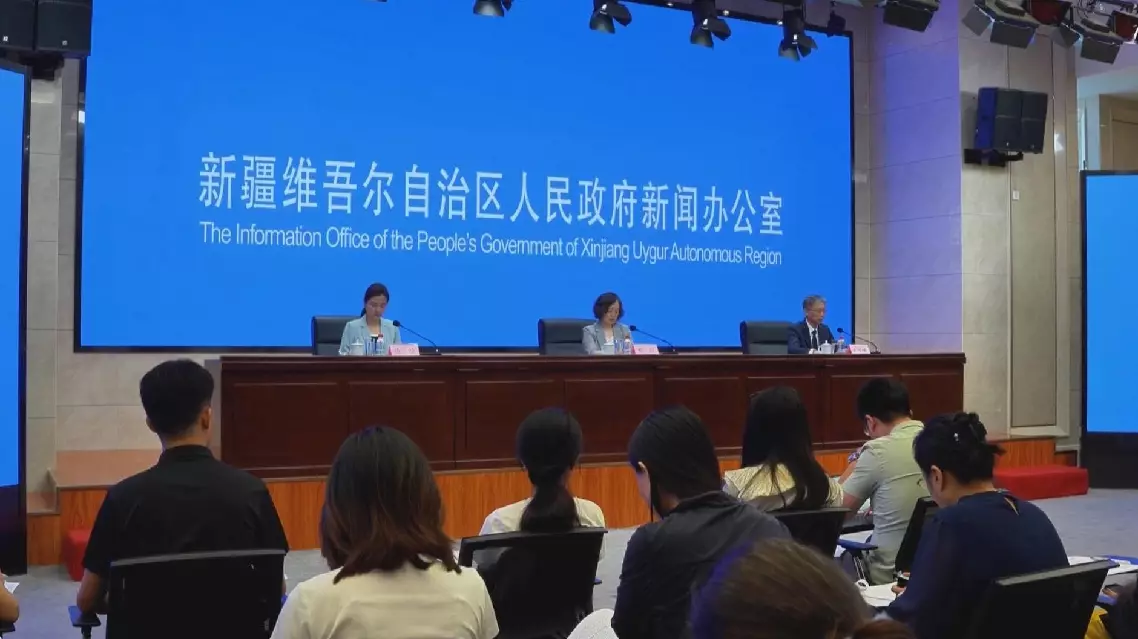
GDP up 3.7 percent in northwest China's Xinjiang in January-June
A German artificial intelligence (AI) pioneer and recipient of China's top science cooperation award for foreign scientists has called for putting AI to use for good.
In an interview with China Media Group (CMG) aired on Friday, Otto Heinrich Herzog, a member of the German National Academy of Science and Engineering and a foreign member of the Chinese Academy of Engineering, noted that AI is quickly becoming ubiquitous in everyday life, even if it goes unnoticed.
"Certainly, without any doubt, we will have many more artificial intelligence applications and the point then is once it's implemented and used in daily life, you won't notice anymore that it's AI. It's just a good function, that's it. Everybody uses AI without knowing it. For instance, if you use the Internet, you are using a lot of AI and you don't notice it at all," he said.
Herzog added that AI is not omniscient, warning that the technology can't be relied on completely and should always be applied with caution.
"The terrible point is that you will get, always, an answer. The system will always find an answer if you ask a system question because it's designed in that way, even if the answer is wrong," said the computer scientist.
"When I tried out this first system, I asked it -- just to be sure I could control the answer -- who is Otto Herzog from Bremen? And the answer was Otto Herzog from Bremen is a famous sculptor; he had exhibitions in many cities and so on and so on. And then I told the system but Otto Herzog from Bremen is a computer scientist. And then the reply was you are wrong; Otto Herzog from Bremen is a sculptor. And that was a nice setting for the beginning with working such a system because it really showed that you cannot trust those systems nowadays," he said.
With these limitations in mind, he called for researchers to remain diligent in their work and not become overly reliant on machines.
"I think it's really important to do proper research, right? Not use those systems we have today to pretend you are doing research and create some papers which have no value at all. Make AI for good -- I think that's a very good expression," he said.
Herzog was among nine foreign scientists who received the 2025 China International Science and Technology Cooperation Award at a national science and technology conference held in Beijing on July 8.
The award is China's highest scientific honor for foreign nationals, recognizing their outstanding contributions to scientific and technological cooperation with China.
Herzog also founded Germany's first AI research center in 1985 and led the country's first AI research team. Since coming to China in 2014, he has promoted interdisciplinary research integrating AI with urban planning.
Since 2015, he has served as principal scientist of the Collaborative Innovation Center for Intelligent Planning of the Yangtze River Delta Urban Agglomeration, contributing to AI research and China-Germany cooperation in science and technology.

German computer scientist calls for "making AI for good"