Countries should maintain in-depth international cooperation at the sci-tech research level, and healthy competition at the product level should be encouraged, said German scientist Otthein Herzog.
Herzog, a foreign member of the Chinese Academy of Engineering and a member of the German National Academy of Science and Engineering, received China's International Science and Technology Cooperation Award earlier this month.
Since coming to China in 2014, Herzog has dedicated himself to the innovative development of the interdisciplinary field of AI and urban planning. Since 2015, he has served as the chief scientist of the Collaborative Innovation Center for Intelligent Planning in the Yangtze River Delta Urban Agglomeration, making outstanding contributions to the construction of the theoretical system of intelligent planning and China-German exchange and cooperation.
During an interview with China Media Group (CMG) in Shanghai aired on Friday, Herzog shared his view on the topic of cooperation versus competition in the development of AI.
"I think it's especially critical in AI research is not that publicly or research results are not that publicly available anymore like they have been. But I think research really has to be founded on international collaboration. And as I said earlier, good research results do not need necessarily lead to good products. There are completely other kinds of people to have to do that. So I think it would be really good [that] we have a very, very strong international cooperation in research in general. And then if somebody else picks up some results and makes products, that's life. And somebody will see it, somebody won't see it. And so there's a good competition there," he said.

German AI pioneer calls for deeper int'l cooperation in scientific research
Multiple technology companies and industry organizations in the U.S. Friday called on the country's policymakers to support open-weight artificial intelligence models and avoid premature restrictions.
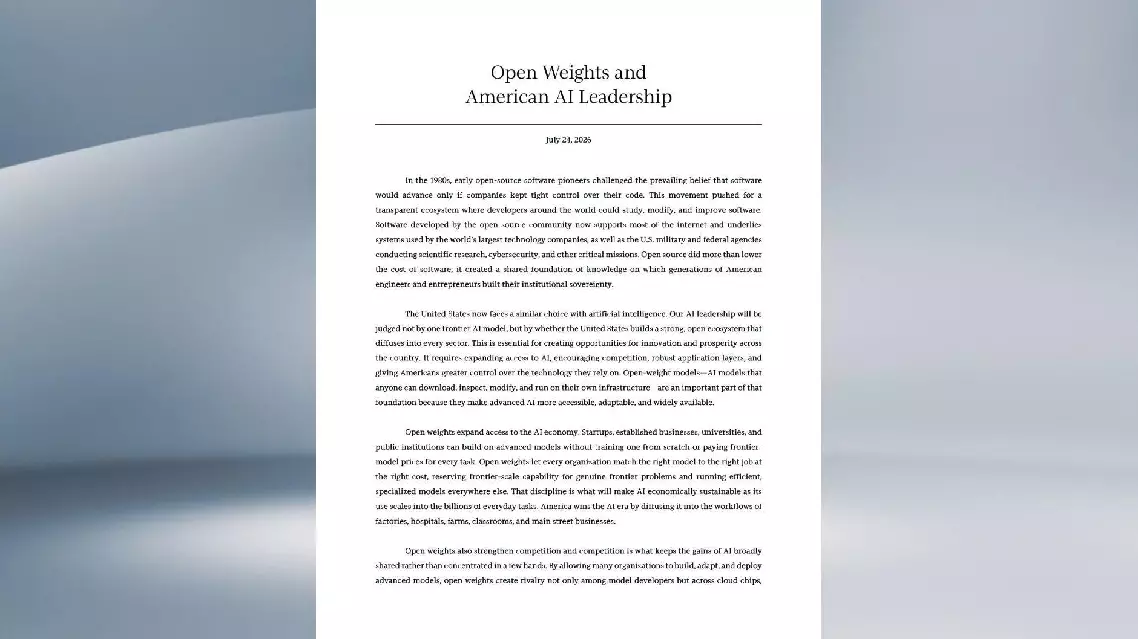
In a joint statement titled "Open Weights and American AI Leadership," they argued that U.S. leadership in AI depends on building an open ecosystem across all sectors, rather than on a single frontier model.
Open-weight models are AI models that anyone can download, inspect, modify and run on their own infrastructure. According to the statement, they make advanced AI systems more accessible, adaptable and widely available. They also allow organizations to match models to particular tasks and costs, reserving frontier-scale capabilities for the most demanding problems while using efficient and specialized models for other purposes, it said.
Open weights also strengthen competition among model developers and across cloud computing, chips, applications and services, according to the statement. Such competition could encourage innovation, reduce costs and prevent the economic benefits of AI from becoming concentrated in a small number of hands.
The statement said open-weight models also give users greater control by reducing the risk of dependence on a single provider. They allow organizations to control their own data, evaluate and adapt models to meet their needs, and deploy them according to their business requirements.
The statement acknowledged that open weights carry "real and distinct risks." Once released, model weights are beyond the original developer's control, while modified versions are difficult to trace or reverse. However, it said the appropriate response was not to prohibit open weights. As cyberattackers increasingly use advanced AI, defenders also need access to models with comparable capabilities to detect, simulate and respond to emerging threats.
Open models could expand defensive capabilities, increase transparency and allow vulnerabilities to be identified and remedied by multiple teams, the statement said.
It added that relying solely on closed models was not inherently safe. Concentrating advanced AI capabilities in a few closed models could create single points of failure, weaken competition and leave critical technologies in the hands of a few providers.
Open-weight models, by contrast, allow a broader community of researchers and developers to examine model behavior, identify vulnerabilities, develop safeguards and improve systems over time, it said.
On model distillation, the statement said that using the outputs of one model to help train, improve, evaluate or validate another was a widely used model-development technique.
Policymakers should not conflate such legitimate practices with unlawful efforts to extract value from closed models, it said, adding that concerns over unlawful conduct should be addressed through targeted legal and commercial frameworks rather than sweeping restrictions on techniques important to AI innovation.
The signatories included Nvidia, Microsoft, IBM, Meta, OpenAI, Cisco, Dell Technologies, GitHub, Hugging Face, Mozilla, the Linux Foundation, Palantir, and Y Combinator.
Tech companies, organizations urge U.S. support for open-weight AI models