Skip to Content Facebook Feature Image

Carbon Economics Salon Held at PHBS in Shenzhen

Business

Carbon Economics Salon Held at PHBS in Shenzhen
Business

Business

Carbon Economics Salon Held at PHBS in Shenzhen

2026-07-27 22:02 Last Updated At:22:25

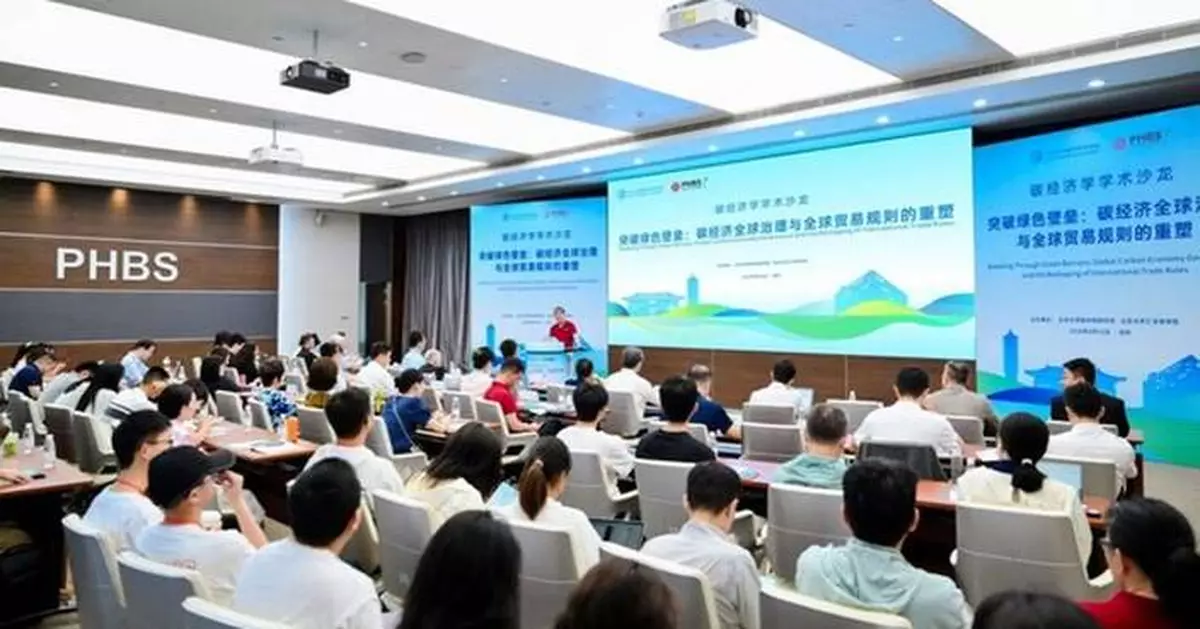
SHENZHEN, China, July 27, 2026 /PRNewswire/ -- The climate-trade nexus has become a defining challenge for the Asia-Pacific region — a topic that drew nearly 100 scholars, policymakers, and industry representatives to the Carbon Economics Salon Series in Shenzhen on June 16, just weeks ahead of the APEC Forestry Ministerial Meeting (July 27-28), where the green transition is expected to take center stage.

Themed "Breaking through Green Barriers: Carbon Economy Governance and the Reshaping of International Trade Rules," the salon was co-hosted by Peking University HSBC Business School (PHBS) and the Institute of Carbon Neutrality at Peking University (ICN-PKU). Discussions centered on three interconnected challenges: unilateral climate-related trade measures, uneven carbon market development, and the emerging role of AI in carbon governance — topics that also foreshadowed key themes on the APEC agenda in November.

In opening remarks, Piao Shilong, vice president of PKU and dean of ICN-PKU, and Hai Wen, vice chair of the PKU Council and founding dean of PHBS, underscored the urgency of building an inclusive global carbon governance system. Wang Pengfei, Boya Distinguished Professor at PKU and dean of PHBS, called for stronger carbon pricing mechanisms and market-based tools.

The keynote session featured Thomas J. Sargent, the 2011 Nobel laureate in economics and honorary director of the PHBS Sargent Institute of Quantitative Economics and Finance, who noted that uncertainty should encourage earlier investment in green R&D, emissions reduction, and forest conservation. Jiang Kejun, professor and head of the Thrust of Carbon Neutrality and Climate Change at HKUST (Guangzhou), identified 2030–2035 as a critical window for China's energy transition, driven by rapid growth in renewables and electric vehicles. Wu Dengsheng, professor at Shenzhen University, presented a review of carbon economics research, showing that China ranks second worldwide in publications.

Two roundtable sessions examined the spread of unilateral climate measures and their implications for global trade equity, as well as carbon market cooperation with the Global South. Zhang Haibin, Boya Distinguished Professor at PKU and vice dean of ICN-PKU, delivered closing remarks, reaffirming the importance of continued dialogue across disciplines.

The salon highlighted that carbon governance is increasingly shaped by trade rules, technology, and international coordination. It opened space for continued exchange between PHBS and ICN-PKU on global climate governance and China's "dual carbon" goals — topics that are expected to feature as APEC economies deepen their climate cooperation.

** This press release is distributed by PR Newswire through automated distribution system, for which the client assumes full responsibility. **
Carbon Economics Salon Held at PHBS in Shenzhen

Carbon Economics Salon Held at PHBS in Shenzhen

HONG KONG, Sept. 11, 2026 /PRNewswire/ -- At the Belt and Road Summit 2026 in Hong Kong, AluHouse Group, a global leader in Modular Integrated Construction (MiC), signed three Memorandums of Understanding (MoUs) with Australian partners Northland Group Pty Ltd, DCF Property Group, and Up Modular Pty Ltd. This marks a major milestone in AluHouse's strategy to introduce its proven modular technology to the Australian market.

"This partnership is an important milestone in AluHouse's globalisation journey," said Eric Kwong, Founder and Chairman of AluHouse Group. "Australia's housing shortage demands innovative, scalable solutions. We will leverage our Hong Kong-proven MiC technology and project experience to deepen local collaboration and help ease Australia's housing challenge."

Responding to Australia's Housing Challenge

Australia faces a severe housing shortage, with a projected shortfall of 380,000 homes by 2030 according to the Urban Development Institute of Australia. In response, the Australian government has committed over AUD 174 million to promote Modern Methods of Construction (MMC). While MMC can cut construction times by 20–50% and costs by 20%, market penetration remains below 5%.

"Australian developers see the efficiency gains of MMC but often lack the expertise in modular design, compliance, supply chain developments, logistics, and on-site installation," said Johnny Nassif, Director of Northland Group. "We look forward to leveraging AluHouse's mature modular systems to deliver high-quality housing efficiently."

Global Modular Expertise, Local Commitment

The three partnerships bring together complementary capabilities required for successful large-scale Modern Methods of Construction (MMC) adoption in Australia, covering modular residential and mixed-use development, prefabricated building R&D, and strategic collaboration across Australia's rapidly growing construction sector. AluHouse will provide a full-chain, one-stop solution covering all stages from project development and design to manufacturing and installation.

"Hong Kong, as a 'super-connector' and 'value-adder', continues to bridge Hong Kong and international markets," Eric Kwong added. "The Belt and Road Summit provided an ideal platform for connecting with Australian partners, with important support from the Hong Kong Trade Development Council (HKDTC)." Eric Kwong, emphasized that the company seeks deep local integration rather than just viewing Australia as an overseas market. "Our vision is to integrate globally proven MiC technology and Hong Kong MiC expertise with Australia's building regulations, local market needs, and supply chain ecosystem."

About AluHouse

AluHouse is a global leader in modular construction. Headquartered in Hong Kong, the company operates one of the world's largest modular manufacturing hubs in China's Greater Bay Area (48,000 modules/year), with a second facility under construction in Saudi Arabia (30,000 modules/year).

As one of the few modular solution providers with expertise in steel, concrete, and aluminum modular systems, AluHouse provides integrated, end-to-end services—from design and engineering to manufacturing, logistics, and on-site installation. Its projects span high-rise residential housing, apartment, student housing, schools, hospitals, and public utilities, serving markets across North America, Australia, New Zealand, the Middle East, and Greater China.

For more information, please visit www.aluhouse.com

** This press release is distributed by PR Newswire through automated distribution system, for which the client assumes full responsibility. **

AluHouse Signs Strategic MoUs with Three Australian Partners to Address Housing Shortage with MiC Technology

AluHouse Signs Strategic MoUs with Three Australian Partners to Address Housing Shortage with MiC Technology

Recommended Articles