A survey of 400 warehouse and operations professionals, checked against nearly 4,000 real customer signals in inFlow Inventory software, points to a widening gap between the technology operators say they want and the tools they actually use. And in 2026, the spreadsheet is still the tool still running the warehouse is the spreadsheet, even at billion-dollar companies.
TORONTO, July 28, 2026 /PRNewswire/ -- Operators want AI in the warehouse more than ever. Almost none of them are using it. That's the headline from State of Inventory Management 2026, a new report from inFlow Inventory, based on a survey of 400 operations professionals across 33 industries.
Click to Gallery
81% of Inventory Operators Want AI. Only 11% Are Using It

81% of Inventory Operators Want AI. Only 11% Are Using It

81% of Inventory Operators Want AI. Only 11% Are Using It

81% of Inventory Operators Want AI. Only 11% Are Using It
Key findings at a glance
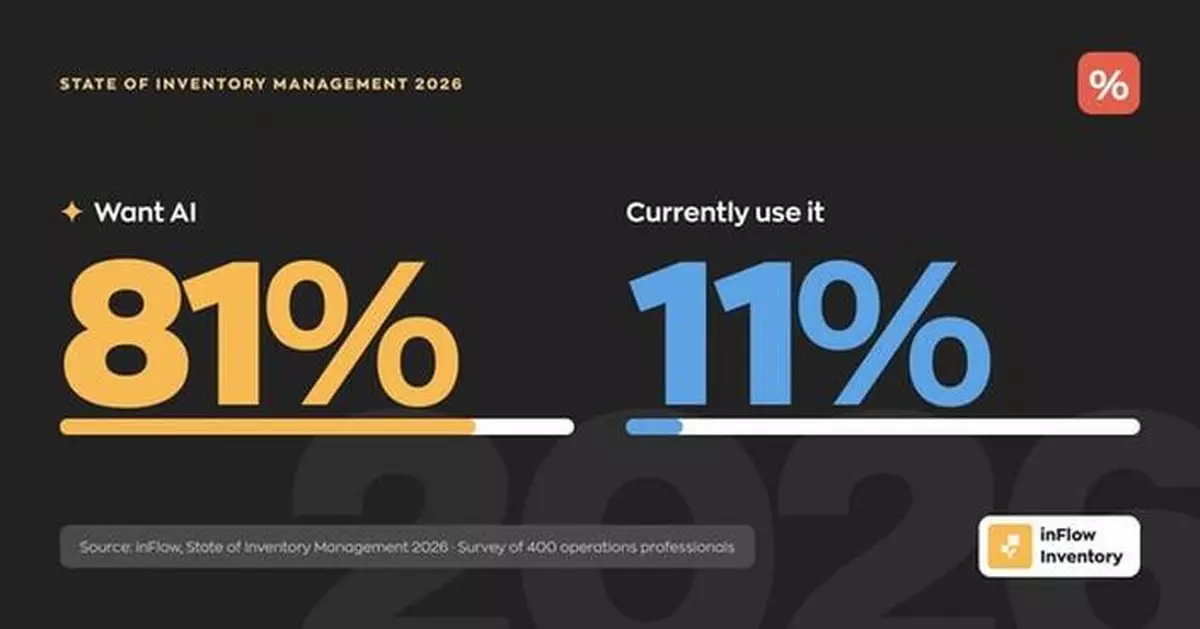
- Significant AI interest, minimal adoption: 81% want AI; only 11% currently use it.
- Spreadsheets dominate: 85% use spreadsheets as a primary tool, including 53% of companies with 500+ employees.
- The satisfaction paradox: 92% are satisfied, yet 49.5% cite inventory accuracy as their top area for improvement.
- Frequent stockouts: 44% run out of stock at least once a month.
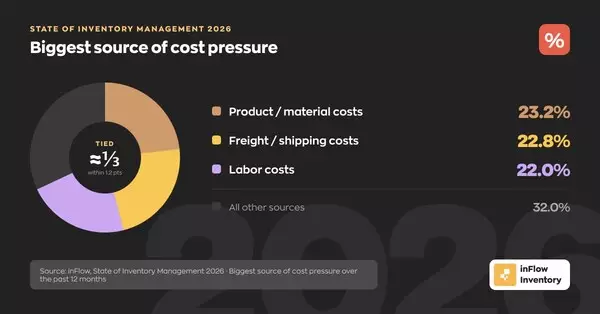
- Broad cost pressure: materials, freight, and labor are in a near-even tie as the top cost sources.
In the survey, 81% of operators said they want to implement AI in their inventory or warehouse operations, while only 11% currently use any AI tool in their day-to-day work. To put that demand in context, 81% is the same share of operators who already use barcode scanning, one of the most established technologies in the warehouse. Interest in AI is now as widespread as the use of a tool most operators consider standard.
The report also identifies what operators want AI to do. Rather than chatbots or dashboards, their requests center on a single use case: demand forecasting and automated replenishment, or software that recommends what to reorder, and when, based on sales history.
"The interest is real, but it is waiting for the right capability to catch up," said Jared Plumb, Lead Content Creator at inFlow and co-host of the Secret Life of Inventory podcast. "Operators aren't asking for general intelligence. They're asking for a tool that tells them what to buy and when, and most systems they use today still can't do that."
So why the gap? When operators name their worries about adopting new technology, cost comes first at 62%. Doubt about return on investment comes dead last at 21.5%. The message is clear. Operators aren't questioning whether AI works; they are weighing whether they can afford to adopt it.
Excel still runs the warehouse, even at the enterprise level
The most common finding in the whole report is also the simplest: the spreadsheet still rules. Across the survey, 85% of operators use spreadsheets as a primary inventory tool, and 74% lean on them as their only or main system, with no dedicated software in the mix.
And this isn't just a small-business habit. Among companies with 500 or more employees, 53% still operate primarily on spreadsheets, indicating that spreadsheet reliance is not limited to small businesses but is an industry-wide default.
The satisfaction paradox
Here's the twist: operators report high satisfaction with systems that the same survey shows are underperforming. While 92% say they are satisfied with their current inventory approach, nearly half (49.5%) identify inventory accuracy as their top area for improvement, 44% experience stockouts at least once a month, and 52% cite supplier reliability as their single biggest challenge.
The report attributes this contradiction to a common pattern in mature industries: operators who have used a system for years measure it against what they know, rather than against what they may be missing. inFlow's customer data supports this. Businesses rarely search for solutions when they are mildly frustrated; instead, they reach out at breaking points due to more orders, SKUs, or staff, when a system that once worked can no longer keep up.
A three-way squeeze on costs
Cost pressure in 2026 has no single source. When operators named their biggest cost pressure over the past year, responses split almost evenly among product and material costs (23%), freight and shipping (23%), and labor (22%), one of the tightest three-way splits in the survey. Roughly two-thirds saw both freight and material costs rise over the year, and 84% now buy ahead at least occasionally to hedge against uncertainty, which increases the cost of holding inventory.
Why it matters
The report describes a market at an inflection point. Operators are experienced, satisfied, and cost-pressured at the same time, a combination that keeps them on manual systems until a growth event forces a change. For technology providers, the takeaway aligns with the findings about AI: adoption depends less on proving that a tool works and more on lowering the barriers of cost, implementation, and integration.
For operators, the findings point to a clear opportunity. The heavy reliance on spreadsheets and the appetite for smarter reordering suggest that even incremental moves toward dedicated tools could address the accuracy and stockout problems they cite most. The full report, with detailed findings across all six topic areas and the complete survey methodology, is available at https://inflowinventory.com/blog/state-of-inventory-management-2026.
Methodology
State of Inventory Management 2026 is based on an online survey of 400 full-time professionals working in warehouse, inventory, supply chain, or operations roles. It was fielded in March 2026 and conducted by inFlow in partnership with research firm OvationMR. Respondents were recruited through online panels and screened for full-time employment, and all 400 completed the survey in full. The survey covered 38 questions across six topic areas.
To validate the findings, inFlow compared them against its own customer feedback: nearly 4,000 structured observations drawn from support tickets, sales calls, recorded calls, and customer emails across 293 companies between February and June 2026.
About inFlow
inFlow Inventory is inventory management software for small and mid-sized product businesses in wholesale, manufacturing, field service, and retail. More than 20 million products are tracked in inFlow worldwide. The platform helps teams manage inventory, sales orders, purchase orders, and B2B wholesale from one place, with integrations for Xero, QuickBooks Online, Shopify, WooCommerce, and 95+ other tools. inFlow is a trademark of Archon Systems Inc., a proudly Canadian company. Learn more or start a free trial at https://inflowinventory.com.
Media Contact: Jared Plumb, Lead Content Creator, inFlow Inventory — jared.plumb@inflowinventory.com
Photo - https://mma.prnasia.com/media2/3007121/inFlow_Inventory_81__of_Inventory_Operators_Want_AI__Only_11__Ar.jpg?p=medium600
Photo - https://mma.prnasia.com/media2/3007122/inFlow_Inventory_81__of_Inventory_Operators_Want_AI__Only_11__Ar.jpg?p=medium600
Photo - https://mma.prnasia.com/media2/3007123/inFlow_Inventory_81__of_Inventory_Operators_Want_AI__Only_11__Ar.jpg?p=medium600
Photo - https://mma.prnasia.com/media2/3007124/inFlow_Inventory_81__of_Inventory_Operators_Want_AI__Only_11__Ar.jpg?p=medium600
** This press release is distributed by PR Newswire through automated distribution system, for which the client assumes full responsibility. **
81% of Inventory Operators Want AI. Only 11% Are Using It
81% of Inventory Operators Want AI. Only 11% Are Using It
81% of Inventory Operators Want AI. Only 11% Are Using It
81% of Inventory Operators Want AI. Only 11% Are Using It