Smart QS Hackathon 2026 officially launched to jointly build new AI milestone for construction industry
The Smart QS Hackathon 2026, co-organised for the first time by the Housing Bureau and the Hong Kong Housing Authority (HA), Cyberport, and the University of Hong Kong (HKU), was officially launched today (July 29) with a welcome ceremony and briefing session held at Cyberport. The Hackathon aims to explore innovative applications of Artificial Intelligence (AI) in Quantity Surveying (QS) through cross-sector collaboration, facilitating the intelligent transformation of the construction industry and enhancing the management and service effectiveness of public works.
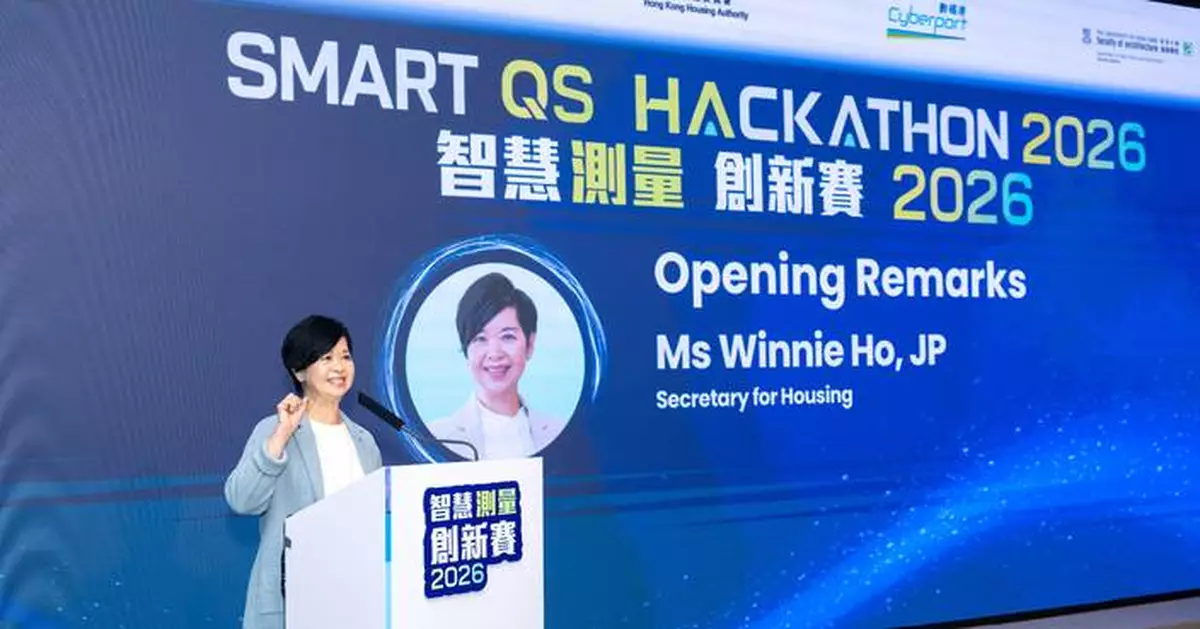
In her opening remarks at the ceremony, the Secretary for Housing, Ms Winnie Ho, said, "This year marks the beginning of the National 15th Five-Year Plan. Hong Kong proactively aligns with the requirements of national strategies to drive new quality productive forces with innovative technology, accelerating high-quality development in various industries. The Government has laid out a vast blueprint for housing and infrastructure development, and is fully committed to advancing smart city development and smart construction. We aim to boost the digital transformation of the QS industry by leveraging cutting-edge AI solutions, with a view to optimising contract management, expediting payment assessment, and mitigating disputes and project delays, thereby directly enhancing housing construction in terms of speed, quantity, quality and efficiency.
"We are delighted to spearhead the joint roll-out of this Hackathon with our partner institutions. By bringing together young academics, information technology professionals and QS industry leaders, this initiative highlights the Government's continuous effort to foster cross-sector synergy. The Smart QS Hackathon 2026 holds high practical value, serving not only as a demonstration of integration between the construction industry and the digital economy, but also as an important testing platform for cultivating new quality productive forces in the construction industry. The innovative solutions can undergo on-site testing at public housing construction sites, with the potential for gradual implementation across public housing projects and the wider QS industry, thereby promoting sector-wide innovation and development. We hope all participants to this programme can enjoy the platform by transcending their professional boundaries and co-creating innovative forward-looking solutions."
The Chief Executive Officer of Cyberport, Dr Rocky Cheng, stated in his opening remarks, "Cyberport has always been committed to driving AI+ development and fostering the deep integration of AI with different industries. In the Smart QS Hackathon 2026, Cyberport will leverage its role as Hong Kong's digital tech hub and AI accelerator, with an integrative ecosystem of over 2 300 technology enterprises, including over 500 AI enterprises. We will broadly mobilise community technology enterprises to participate, and provide participating teams with computing resources from the AI Supercomputing Centre (AISC), alongside pioneering technology training and resources, to effectively fast track innovative solutions from ideation to practical implementation."
The Associate Dean (Teaching and Learning) of the Faculty of Architecture at HKU, Professor Isabelle Chan, said at the ceremony, "This programme fully demonstrates the collaborative innovation power of the Government, academia, the innovation and technology sector and the construction industry, providing students and professionals with a unique and hands-on platform to apply AI technologies to real-world QS and project management scenarios. During the Hackathon, the HKU Faculty of Architecture will provide training workshops, technical sharing, and expert guidance to help participants master AI tools and practical applications, fostering deep integration of innovative technology and professional practice."
This was followed by the Head of Business Development of Hong Kong Cyberport, Dr Crystal Fok, and the Chairman of the QS Division of the Hong Kong Institute of Surveyors, Mr Eric Ting, on the Hackathon Briefing and Introduction of QS respectively.
Cross-sector collaboration drives QS industry transformation to cultivate AI talent and promote construction innovation
Centred on the practical needs of the QS profession, the Hackathon aims to jointly build and validate practical AI innovative solutions that address real-world industry challenges through cross-sector collaboration and systematic practice, thereby driving innovative development across QS and the wider construction industry. The organisers will host a series of AI training sessions and workshops with expert mentors from the HA, academia, and industry to share real workflows and business experience, offering professional guidance to help participants master AI technologies, data applications, and solution development. Participants will also have free access to Cyberport's AISC computing resources to accelerate model training, testing, and optimisation. The Hackathon enables participants to gain hands-on industry experience and transform their learning into versatile professional skills, nurturing diverse talents for the industry.
Implementing winning solutions to drive practical application of results
The Hackathon features two categories, namely Assigned Challenges and Open Challenges. The Assigned Challenges cover contract advisory and payment valuation. The contract advisory track includes using AI to assist in drafting, analysing, and reviewing tender and contract documents, improving efficiency and accuracy; the payment valuation track involves using AI, image analysis, and smart evaluation technologies to identify project progress and assess payment amounts. The Open Challenges welcome proposals from professional and student teams on QS and construction-related topics, encouraging innovative solutions to drive industry transformation. On Hackathon days, teams must design and develop innovative solutions within 48 hours and demonstrate their ideas to the judging panel. In addition to winning cash prizes of up to $20,000, winning teams will have the opportunity to further collaborate with the organisers and the HA on proof-of-concept and solution implementation.
Application now open to co-create new milestone in smart construction
Application for the Smart QS Hackathon 2026 is now open with the deadline on August 14. Full-time undergraduate or postgraduate students from local institutions, as well as QS professionals, AI and technology talent, and innovation and technology enthusiasts are welcome to register and participate, seizing the valuable opportunities to collaborate and exchange with industry experts, working together to propel the industry towards intelligence.
For competition and application details, please visit the official event webpagewww.cyberport.hk/en/smart_qs_hackathon_2026.
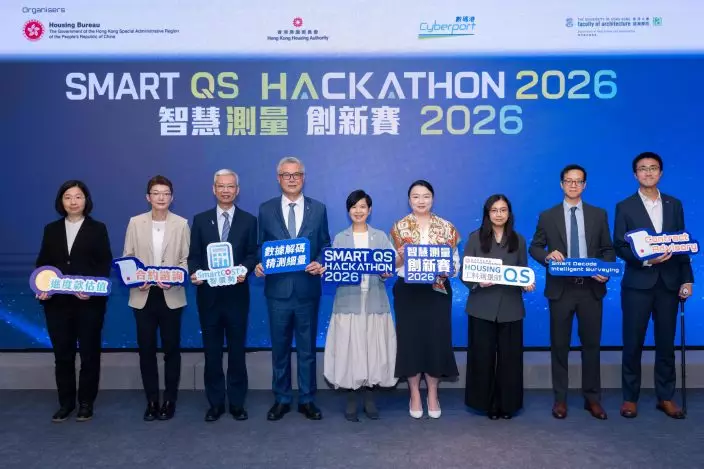
The Smart QS Hackathon 2026, co-organised for the first time by the Housing Bureau and the Hong Kong Housing Authority, Cyberport, and the University of Hong Kong (HKU), was officially launched today (July 29) with a welcome ceremony and briefing session held at Cyberport. Photo shows the Secretary for Housing, Ms Winnie Ho (centre); the Chief Executive Officer of Cyberport, Dr Rocky Cheng (fourth left); the Associate Dean (Teaching and Learning) of the Faculty of Architecture at HKU, Professor Isabelle Chan (fourth right), and other guests at the event. Source: HKSAR Government Press Releases
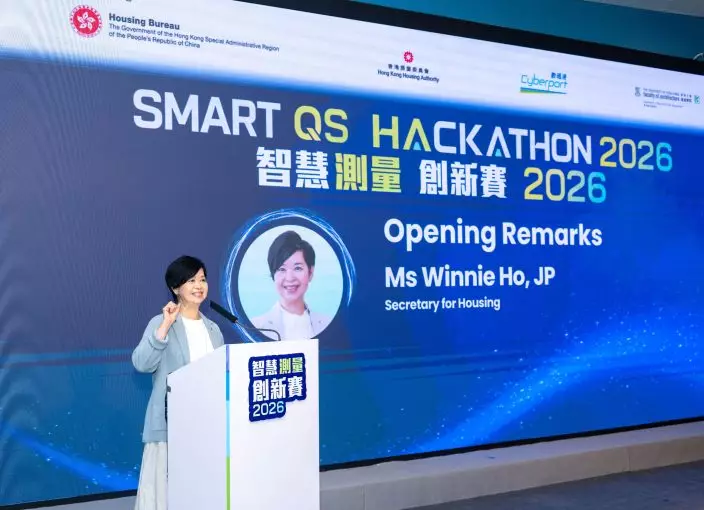
The Smart QS Hackathon 2026, co-organised for the first time by the Housing Bureau and the Hong Kong Housing Authority, Cyberport, and the University of Hong Kong, was officially launched today (July 29) with a welcome ceremony and briefing session held at Cyberport. Photo shows the Secretary for Housing, Ms Winnie Ho, delivering a speech at the event. Source: HKSAR Government Press Releases