Iran's Islamic Revolutionary Guard Corps (IRGC) claimed attacks on U.S. bases and F-35s on Thursday. The U.S. has denied the claim.
According to the IRGC's statement, Iran had attacked U.S. military bases in the Middle East and destroyed U.S. F-35 fighter jets and other facilities.
According to the U.S. Central Command's post on social media responding to the claim, no U.S. aircraft were destroyed or damaged in recent attempted Iranian attacks. All missiles and drones were intercepted or failed to reach targeted areas, it said.
The IRGC's statement claimed that its Aerospace Force used several ballistic missiles to strike the U.S. base in Azraq, Jordan, hitting the F-35 fighter jet apron and maintenance hangars. Three F-35 fighters were destroyed, and another three were severely damaged, according to the statement.
The attack also killed multiple enemy officers, technical personnel, and maintenance staff.
The IRGC also claimed on Thursday it had attacked the U.S. Ali Al Salem Air Base in Kuwait earlier that day, destroying two drone hangars and a fuel depot for aircraft and military helicopters.
The Iranian military announced later that evening that it had used drones to strike Bahrain's Sheikh Isa Air Base, hitting U.S. generators, navigation systems, and administrative and logistical support buildings. The announcement noted that despite the U.S. base's numerous defense systems and equipment, the recent series of attacks on U.S. military bases in the region had caused significant damage to U.S. equipment.
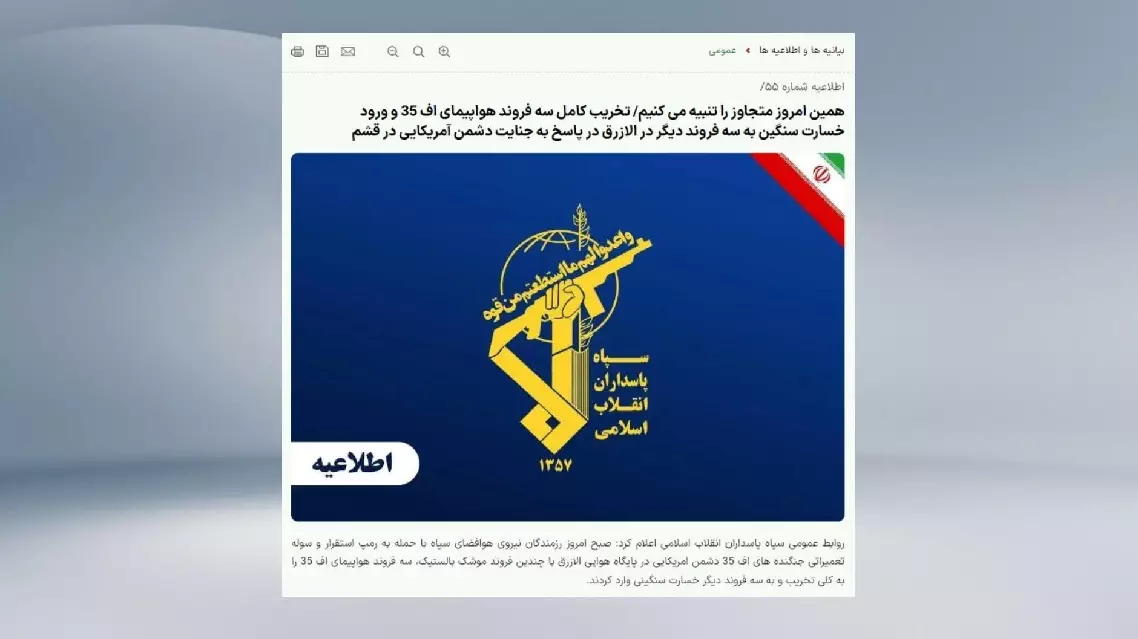
Iran says it destroyed F-35 fighter jets, US denies claim
China's foreign trade maintained steady growth in the first half of 2026, demonstrating strong resilience and vitality amid a complex and fluid external environment, according to data released Friday by the China Council for the Promotion of International Trade (CCPIT).
From January to June, the national trade promotion system issued more than 4.26 million certificates, including certificates of origin, ATA carnets -- an international customs document commonly known as the "passport for goods", and commercial certificates, representing a year-on-year increase of 9.64 percent, the CCPIT said.
The CCPIT data also highlighted robust bilateral exchanges with the United States. During the six-month period, CCPIT-affiliated offices issued 44,600 certificates of origin for exports to the U.S., involving 2.95 billion U.S. dollars in trade value, up 13.38 percent year over year.
Outbound ATA carnets from China to the U.S. reached 735, an increase of 15.93 percent, while inbound ATA carnets from the U.S. to China totaled 381, up 17.96 percent compared with same period last year.
"These figures show that in the face of the complex and fluid external environment, China's foreign trade has pressed ahead and maintained steady growth, demonstrating strong resilience and vitality. Two-way exchanges of personnel and goods between China and the U.S. have shown positive momentum in both quantity and quality," Yang Fan, a CCPIT spokeswoman, said at a press conference in Beijing on Friday.
On the exhibition front, as of the end of June, CCPIT had approved 150 projects for Chinese corporate to participate in U.S. trade fairs and exhibitions in 2026. Of these, 87 projects had already been implemented in the first half of the year, with nearly 2,000 Chinese companies attending exhibitions in the United States.
The agency said it will continue to promote exchanges and cooperation between the Chinese and American business communities to serve the steady, healthy, and sustainable development of bilateral relations.
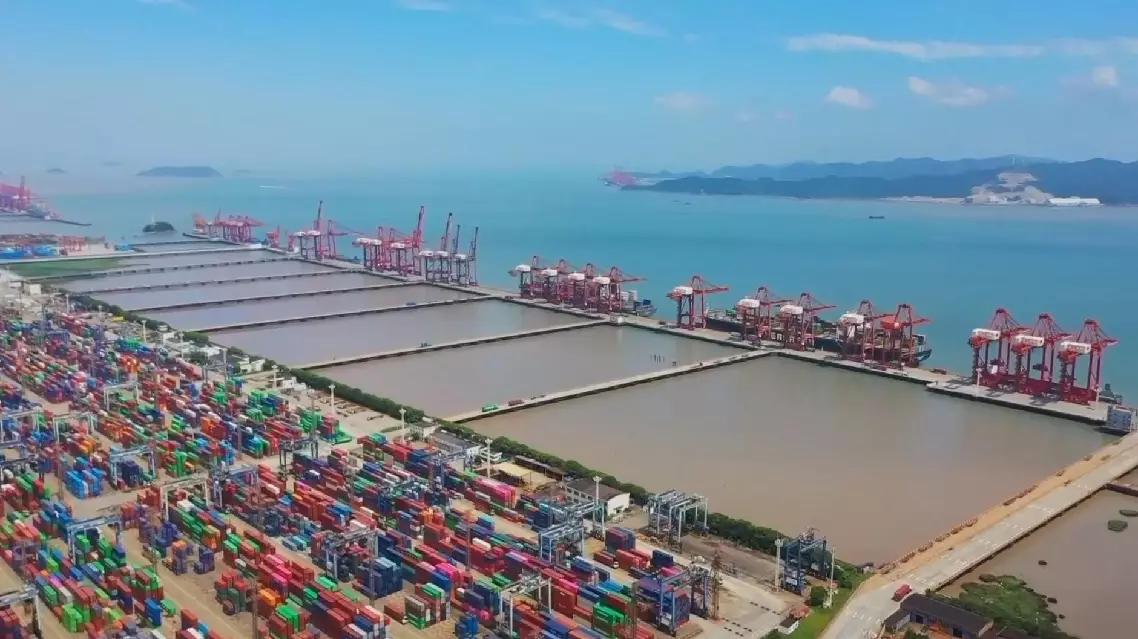
China's foreign trade steadily expands in Jan-June despite external headwinds: trade promotion body