The Zhuonai Lake, a core breeding ground for the Tibetan antelope in northwest China's Qinghai Province, has entered the peak season for Tibetan antelope births.
Known as a "natural maternity ward" for the species, the remote lake area welcomed its first group of around 70 pregnant Tibetan antelopes in late May, who soon gave birth to their calves.
Chen Jiarui, an associate professor at the School of Ecological and Environmental Engineering at Qinghai University, said monitoring revealed notable changes in the animals' calving patterns.
"With environmental changes, the core lambing areas of the Tibetan antelope become more concentrated. In the past, we found them giving birth across riverbanks and upstream of the lake. However, our survey this year found that the population giving birth on the lake beach has become very small, with most now concentrated further up the lake," said Chen.
"Secondly, in our survey, we find the population of the Tibetan antelope is quite large," Chen added.
During recent fieldwork, researchers documented a birth firsthand, highlighting the newborns' rapid adaptation to the harsh plateau environment.
"We saw that within a few minutes, even less than 10 minutes, it could stand up and walk around to nurse. The mother antelope continuously licks the newborn. Once the baby's fur dries, it provides good warmth. This shows that from the moment they are born, Tibetan antelope calves have inherited very excellent genes from their parents, making them fully capable of adapting to this environment," said Chen.
As of the middle of July, monitoring data showed the first batch of returning antelopes heading back from the Zhuonai Lake, with a larger grouping of about 200 mothers and their newborns.
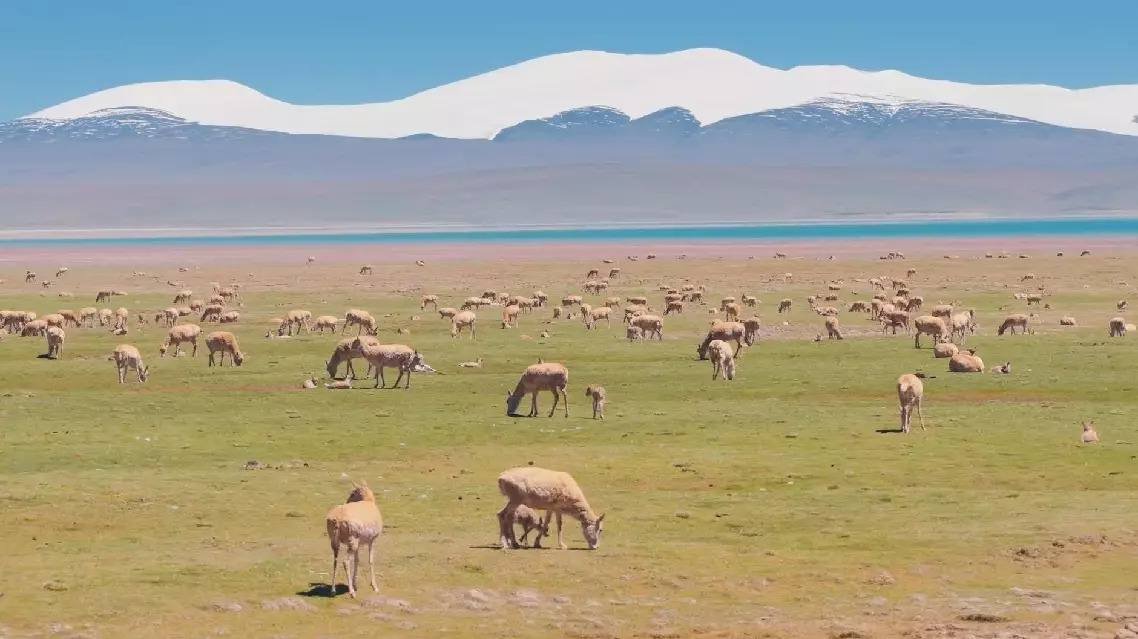
Zhuonai Lake in Qinghai enters peak season for Tibetan antelope birth