Slovak President Peter Pellegrini said on Wednesday that formulating long-term development plans and ensuring their steady implementation are crucial for any country's future, pointing to China's remarkable changes over the years as a prime example.
In an interview with China Media Group (CMG) in Beijing, Pellegrini underscored the importance of national development planning, saying that the absence of a clear strategy had cost Slovakia valuable opportunities over the past decades.
"I see a tremendous change in China, and I split it in my view into two areas. One is hardware -- let's say, I see incredible investments in infrastructure: new highways, bridges, railways, high-speed trains, and these kinds of things. But then also software. That means implementing new technology into daily life, implementing the five-year plan or even the long-term plan, because this is something that I believe is the right way to have plans. Because I have to say that we did make a mistake after the Velvet Revolution -- we stopped planning things," said the president.
He said that Slovak policymakers have been studying and drawing on China's planning system, hoping to absorb the essence of its approach to help drive their own country's development.
"We were missing long-term plans and strategies in our policy, and that is not good for the country. So we are already really watching and following the system of planning here. And also now we decided in the Slovakia -- the Slovak government decided to create a new vision for Slovakia for 2040. So I hope that this will help us to reach our targets, to define our priorities for the decades, (and to achieve) early implementation of the new technologies in different areas in our daily lives. So there I see the potential," he said.

Slovak president hails coherence of China's development planning system
The Chinese People's Liberation Army (PLA) Southern Theater Command conducted a joint naval-air training exercise in the territorial sea and airspace of China's Huangyan Dao and its surrounding areas on Saturday.
The theater command said in a statement that relevant subjects included reconnaissance and early warning, deterrence patrol, air-sea control, and joint strike.
The drills commenced immediately after the operational order was issued, with bomber formations and a naval fleet, including the destroyer Zhanjiang and the amphibious transport dock Qilianshan, arriving at the designated zone on schedule.
During the exercises, the bomber units executed simulated strikes against maritime targets, while the naval task force established air-defense formations to repel mock aerial assaults.
Operating teams utilized helicopters and ship-borne small boats to search for surface targets, conduct armed boarding operations on simulated hijacked vessels, control the ships to rescue hostages, and carry out emergency medical triage and evacuation for wounded personnel.
"Similar joint training exercises have become our routines. We adhere to sharpening our ability to respond to various contingencies at combat-readiness standards, and always maintain a state of readiness to execute missions at any time and effectively counter various risks and challenges," said Sun Junhui, an officer on the naval vessel Zhanjiang.
According to the theater command, the exercise effectively honed the troops' naval-air coordination, rapid support and win-by-system capabilities.
The theater command also said that the drill is a necessary action taken in light of the current situation in the South China Sea and in response to the acts of certain countries within the region that have undermined regional peace and stability.
The training exercise aimed to test and enhance the army's real combat capabilities to safeguard China's territorial sovereignty and maritime rights and interests, the theater command said.
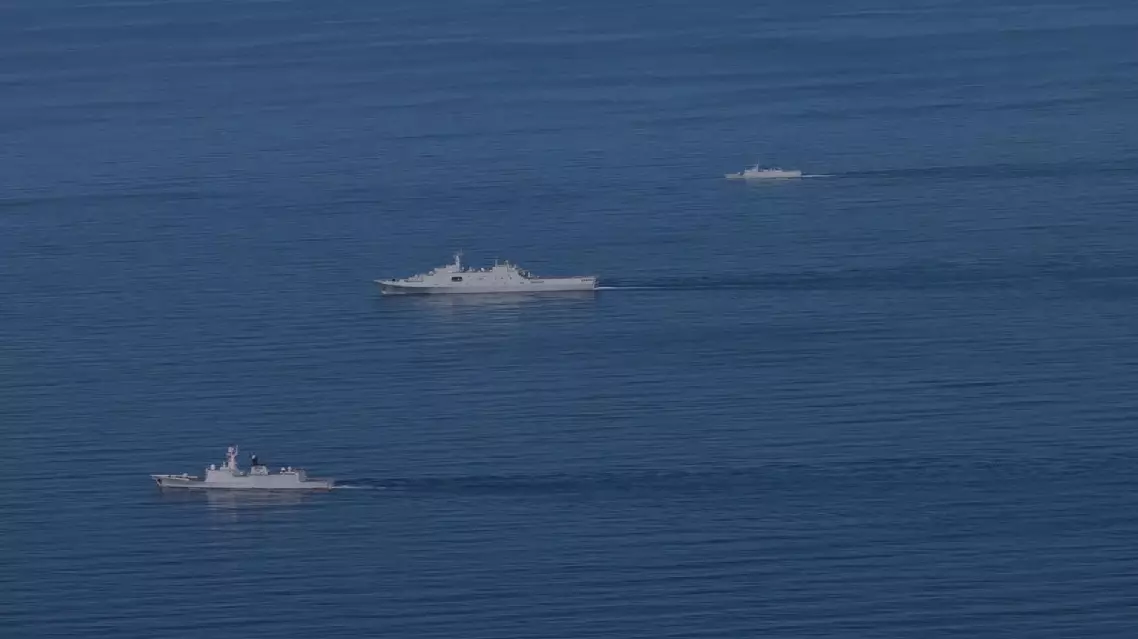
PLA conducts naval-air training exercise at Huangyan Dao