Displaced residents in north Syria’s Idlib Province are enduring life-threatening summer heat as temperatures inside their tents surge past 50 degrees Celsius, with little access to water, electricity or relief.
In the camp in northern Idlib, Bassam Abu Amer, displaced from a village east of Hama, lives with his family in a tent.
"I cannot describe the situation in the camp. It's like a dramatic television series," said Bassam.
The family's entire life unfolds inside a single tent, where temperatures can exceed 50 degrees on a 40-degree day, leaving the children drenched in sweat.
"This tent has only one room. We cook here, eat here, do everything here. The tent cannot block the scorching heat. If it's 40 degrees outside, it can reach 50 or even 55 degrees inside. Sometimes we find our children sweating excessively," said Bassam.
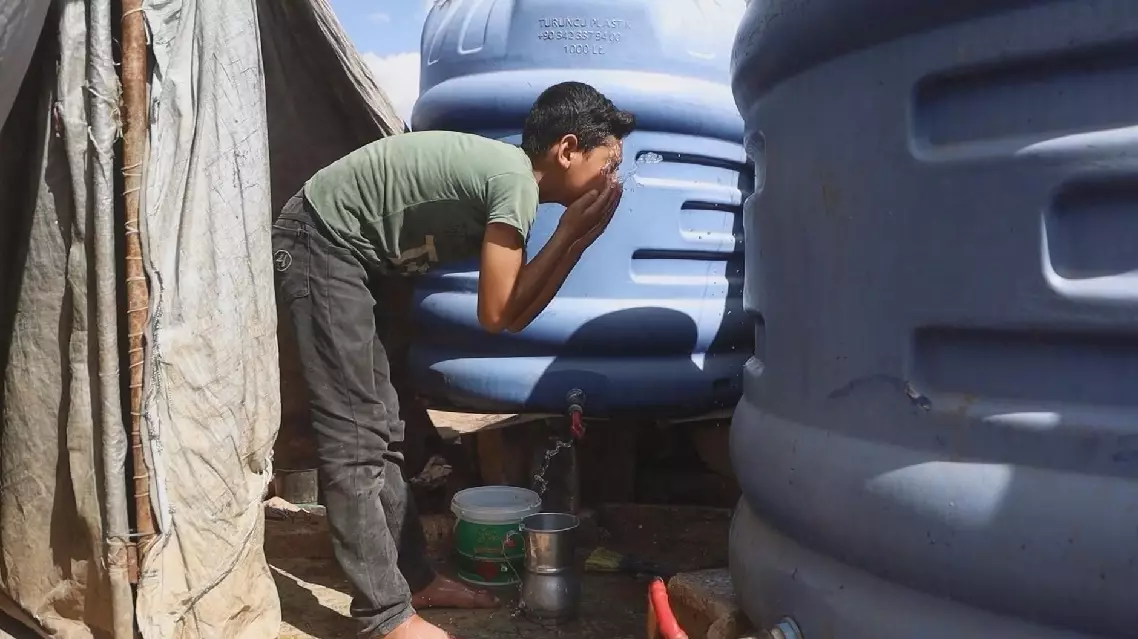
The camp lacks a reliable water supply, forcing residents to buy water by the bucket to cool their children by pouring it over them or placing them in makeshift containers. Every bucket compounds the family's financial burden.
"There's no water here. We have to buy water, and we are always worried about running out [of water]," said Bassam.
To make ends meet, Bassam has sold nearly all his possessions. His son now scrapes together about two dollars a day through odd jobs to buy bread, drinking water and ice. The son, Abdul Karim, has rigged up a fan using wires, a small motor and plastic blades, yet the camp's solar panels can barely keep it running in the relentless heat.
"It's too hot outside. I can't stand it anymore. I made a fan. I bought wires, a motor and blades, and assembled them together. The only way is to pour water on myself. Right now, my biggest dream is to have an air conditioner or a refrigerator, but that's simply impossible. Even ice has to be bought," said Abdul.
By day, the family stays inside the suffocating tent, moving outside after sunset to sleep, only to face swarms of mosquitoes through the night, as heat, thirst and disease define each day.
"My dream is to have a house that can protect us from the scorching sun. I work hard at a restaurant just to buy water and ice," said Abdul.
For those displaced by war, a home that shelters them from the sun and allows their children to sleep in peace remains the simplest yet most elusive dream.
Life in Syria's refugee camps turns perilous as summer temperatures soar
North China's Inner Mongolia Autonomous Region is welcoming a growing number of foreign tourists this summer, as destinations across the region have rolled out innovative desert activities and immersive cultural experiences to enrich inbound travel offerings.
In Ordos, a city famed for its vast desert landscapes, the Xiangshawan scenic area has launched a creative summer lineup combining desert sightseeing, water-based cooling activities and indoor ice skating.
Visitors can enjoy classic desert adventures such as camel rides and dune bashing, while also cooling off with water play and even ice skating in the heart of the desert.
The unique combination has been well received by international visitors.
"The facilities here are great. I'm from the Republic of Korea, and I'm really enjoying my time," said Lee Hong-deok, a tourist.
According to the scenic area's management, Xiangshawan has received 16,000 foreign tourists since July 1, marking a 176 percent year-on-year increase. Most overseas visitors come from the Republic of Korea, Thailand, Malaysia and Singapore.
The strong growth is supported by targeted measures from local authorities to boost connectivity and upgrade cultural and tourism products.
"We have opened seven direct flight routes to countries and regions including the Republic of Korea, Thailand, Malaysia and Vietnam. We have also rolled out more than 10 signature cultural and tourism products, such as desert space capsules and distinctive Mongolian yurts, and distributed over 3 million yuan in vouchers. These efforts have effectively driven the upgrading of the entire industrial chain, covering catering, accommodation, cultural and creative products, intangible cultural heritage and leisure services," said local tourism official Hou Le.
Beyond desert destinations, the border port city of Erenhot has become a popular stop for foreign travelers journeying eastward, offering a taste of traditional Chinese culture and local urban life.
Visitors can sample local delicacies, take in city scenery and participate in hands-on cultural activities there. Calligraphy, shadow puppetry, weaving and sugar figure making are among the most sought-after experiences.
"This is my first time trying sugar painting. The works are so exquisite. They are both visually appealing and edible," said a visitor from Mongolia.
"I used to mostly pass through here on my way to Hohhot, Beijing and other destinations. This time, I got to truly explore Erenhot. It's been such a delightful surprise," said another tourist from Mongolia.
Across Inner Mongolia, destinations are increasingly focusing on night performances, specialty dining, and intangible cultural heritage experiences. These efforts are steering inbound tourism away from single-purpose sightseeing toward deeper, more immersive engagement, and sustaining the vitality of cultural and tourism consumption.
Official statistics show that in the first half of 2026, Inner Mongolia received 1.0978 million inbound tourists, up 11.90 percent year on year. Total tourism spending from inbound visitors reached 5.501 billion yuan (about 815 million U.S. dollars), a 16.07 percent increase compared with the same period last year.
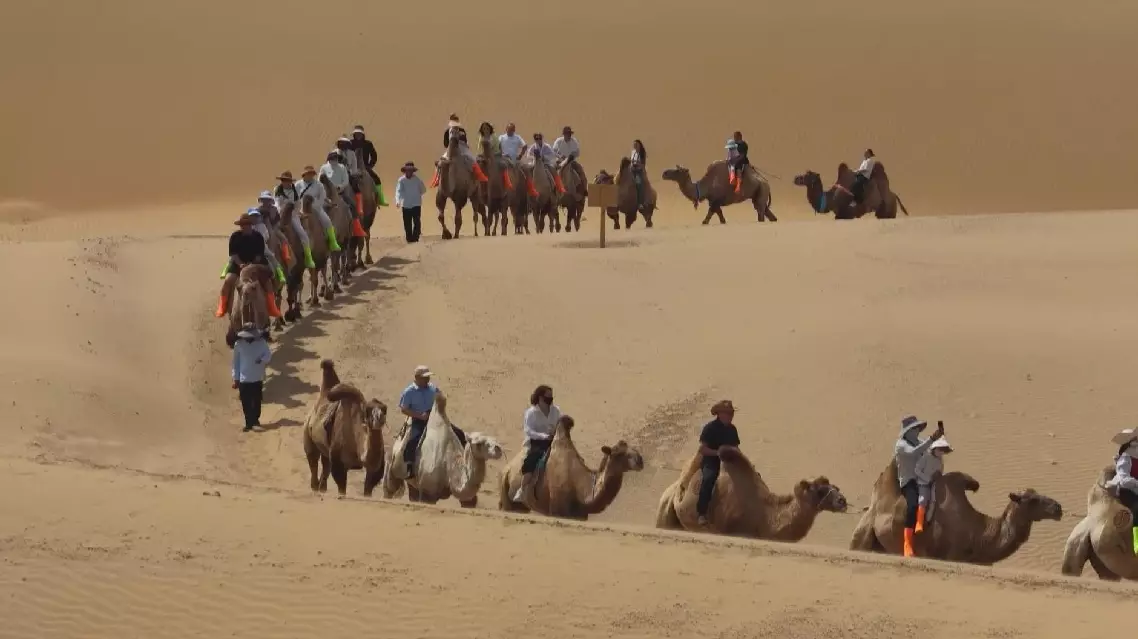
Foreign travelers drawn to diverse desert and cultural experiences in Inner Mongolia